Gaano ka nagtitiwala na tama ang ginagawa ng Kongreso sa budget ng bayan?
This is an informal survey of people who choose to participate. It is not a scientific or nationally representative sample.
DAILY BRIEF
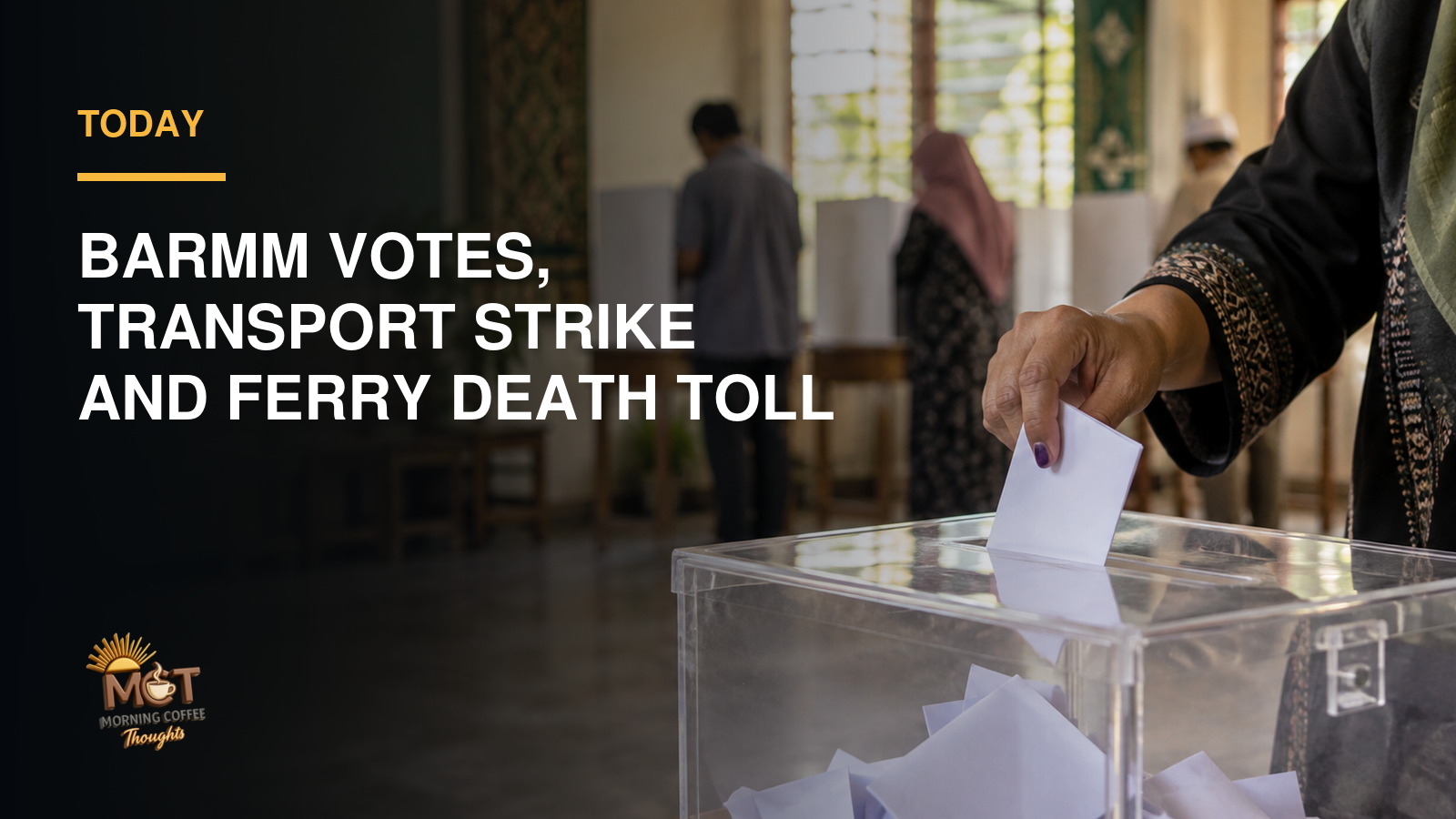
BARMM VOTES, TRANSPORT STRIKE AND FERRY DEATH TOLL
The first Bangsamoro parliamentary election opens under tight security, commuters face a two-day strike, and families in Coron await identification of the dead.
Good morning. Voters in the Bangsamoro are choosing their first regular parliament today, while election officials deal with a vote-buying allegation against a former Comelec chair who is now a candidate. Commuters may also feel the effects of a two-day transport strike as drivers protest another round of fuel increases. In Coron, the scale of the June Aster tragedy has become clearer, but many families are still waiting for identified remains. Congress begins floor scrutiny of the proposed 2027 national budget this week, and the country’s foreign debt has risen from its March level. Here is what has changed, why it matters and what comes next.
1
1. BARMM VOTES TODAY AS COMELEC ORDERS SHERIFF ABAS TO ANSWER A VOTE-BUYING ALLEGATION
About 2.4 million voters are expected to help choose the Bangsamoro’s first regular parliament today. The election will produce an 80-seat chamber that replaces the interim Bangsamoro Transition Authority after years of delay. It is not an ordinary election for governor. Voters choose district representatives and political parties, while eight seats are reserved for designated sectors. The new parliament will later elect the chief minister.
Security forces are on full alert across the region. Nearly 9,500 police officers had been deployed before election day, with the military, Comelec and local authorities coordinating around polling places and election materials. Officials have also warned against vote-buying, intimidation and false information about the voting machines.
One integrity question now involves former Comelec chair Sheriff Abas, who is running for a parliamentary district seat in Cotabato City. Comelec issued a show-cause order dated September 12 after a social-media post allegedly showed a sample ballot together with three ₱1,000 bills. Abas is being required to explain. The image and the order do not by themselves prove that he bought votes, and Comelec has not yet announced a final finding.
WHAT TO WATCH
Watch for verified reports on whether precincts open normally, turnout, security incidents and the transmission and canvassing of results. Comelec’s action after Abas submits his answer will matter more than online accusations. Any claim of fraud should be tied to a complaint, evidence or an official ruling, not a viral post alone.
2
2. A TWO-DAY TRANSPORT STRIKE BEGINS AS DRIVERS PROTEST HIGHER FUEL COSTS
Manibela has called a transport strike for today and Tuesday as drivers brace for another fuel-price increase. Organizers say several jeepney, app-based transport and motorcycle-taxi groups plan to take part. Other organizations and individual drivers may make their own decisions, so the actual disruption can vary widely by city and route.
The protest follows steep pump-price increases last week. Fuel companies are expected to announce another adjustment for September 15, but the final peso-per-liter figures were not yet confirmed at this morning’s cutoff. Manibela is asking the government to review petroleum taxes and oil policy and to provide more immediate relief to drivers.
For commuters, an announced nationwide strike does not automatically mean every jeepney will stop. Some routes may operate normally while others lose vehicles or develop long lines. The effect will depend on participation, replacement rides and local traffic conditions. Drivers, meanwhile, are arguing that higher diesel and gasoline costs are eating into earnings before they can bring money home.
WHAT TO WATCH
Check verified route conditions before leaving, especially local government, school and transport-agency advisories. The two figures that matter most today are how many vehicles actually stop operating and where passengers are stranded. On Tuesday, compare the oil companies’ final price notices with the government’s announced relief measures, not with early estimates alone.
3
3. THE JUNE ASTER DEATH TOLL REACHES 76, BUT MOST FAMILIES STILL NEED IDENTIFICATION
Authorities have now confirmed 76 deaths from the fire aboard the MV June Aster off Coron, Palawan. Forty-three people survived and 13 remained missing in the latest count available this morning. The ferry carried 132 people, according to the corrected accounting, after two people whose names appeared on the original 134-person manifest said they had not boarded.
The number changed sharply after teams recovered dozens of bodies from the burned vessel on September 12. Recovery, however, is not the end of the work. Five of the dead had been formally identified in the latest report, leaving many families to wait before remains can be released and brought home. President Ferdinand Marcos Jr. has ordered agencies to speed up identification and assistance.
The cause of the September 9 fire has not been established. One survivor described a possible fire in the cargo hold, but that account is not yet an official finding. Investigators are also trying to locate and obtain a clear account from the captain, who was reported to have survived but did not appear on the published survivor list.
WHAT TO WATCH
The next meaningful updates are the number of formally identified victims, the search for the 13 still missing, and a reconciled list of everyone aboard. After that, the public needs the findings on the fire’s origin, the crew’s response, safety equipment and any responsibility of the operator or regulators. An investigation, not speculation, must establish fault.
4
4. THE PROPOSED ₱7.2-TRILLION 2027 BUDGET MOVES TO HOUSE FLOOR DEBATES
The House of Representatives is scheduled to begin plenary deliberations on the proposed ₱7.2-trillion national budget on Tuesday. Committee hearings ended on September 8. The next stage moves the spending plan to the full chamber, where lawmakers can question agency budgets, defend allocations and offer amendments.
This matters because the National Expenditure Program submitted by the executive branch is still a proposal. It does not become the 2027 budget merely because agencies have completed their hearings. Spending for classrooms, hospitals, transport, cash aid, infrastructure and debt payments can still be changed before the House passes its version and sends it to the Senate.
House leaders say they want second-reading approval by October 6 and third-reading approval by October 9. A fast calendar is not automatically good or bad. The real question is whether major changes are visible, explained and debated before lawmakers vote. A line added late can matter as much as an agency’s headline allocation.
WHAT TO WATCH
Follow the published debate schedule, livestreams, proposed amendments and voting records. Pay particular attention to changes made after the agency hearings and to large lump sums whose projects or recipients are not yet clear. The October 6 and 9 targets will show whether the House keeps its timetable without shortening scrutiny of disputed items.
5
5. PHILIPPINE EXTERNAL DEBT RISES TO $154.9 BILLION
The country’s external debt stood at $154.932 billion at the end of June, according to Bangko Sentral ng Pilipinas data. That was about 5.1 percent higher than the $147.35 billion recorded at the end of March. Of the June total, roughly $98.5 billion belonged to the public sector and $56.4 billion to private borrowers.
External debt means money Philippine residents, companies or government institutions owe to lenders outside the country. It is not the same as the national government’s entire debt, and it is not a bill divided among individual Filipinos. Still, foreign-currency borrowing deserves attention because payments can become more expensive in peso terms when the peso weakens.
The debt was equivalent to about 31.6 percent of the economy, up from 30 percent in March. That rise does not by itself prove the country is close to default. The risk also depends on when loans fall due, how much is fixed or floating interest, the country’s dollar reserves and whether export and investment earnings can cover payments.
WHAT TO WATCH
Watch the BSP’s next figures on debt service, short-term maturities and foreign reserves, along with movements in the peso. The most useful test is not whether the headline total rises once, but whether foreign obligations keep growing faster than the economy and the country’s capacity to earn the currency needed to repay them.
BOTTOM LINE
Today’s most immediate questions are practical: whether Bangsamoro voters can cast and count their ballots safely, which transport routes lose vehicles, and when families in Coron receive confirmed identities instead of changing totals. The budget and foreign-debt stories move more slowly, but both involve decisions that will shape public services and future costs. In every case, the next verified record matters more than a confident announcement: official election results, actual route conditions, identified victims, visible budget amendments and complete BSP measures of the country’s ability to pay.
Google’s Preferred Sources feature lets you choose publications you want Google to prioritize for you. Select “Add to Preferred Sources” to make MCT easier to find in Top Stories and other eligible Google results. This does not subscribe you to email.
Morning Coffee Thoughts is reader-supported. Contributions help pay for research tools, hosting, and the work required to verify and explain each development.
Monthly PayPal subscription — choose your support amount.