Gaano ka nagtitiwala na tama ang ginagawa ng Kongreso sa budget ng bayan?
This is an informal survey of people who choose to participate. It is not a scientific or nationally representative sample.
DAILY BRIEF
MCT DAILY BRIEF
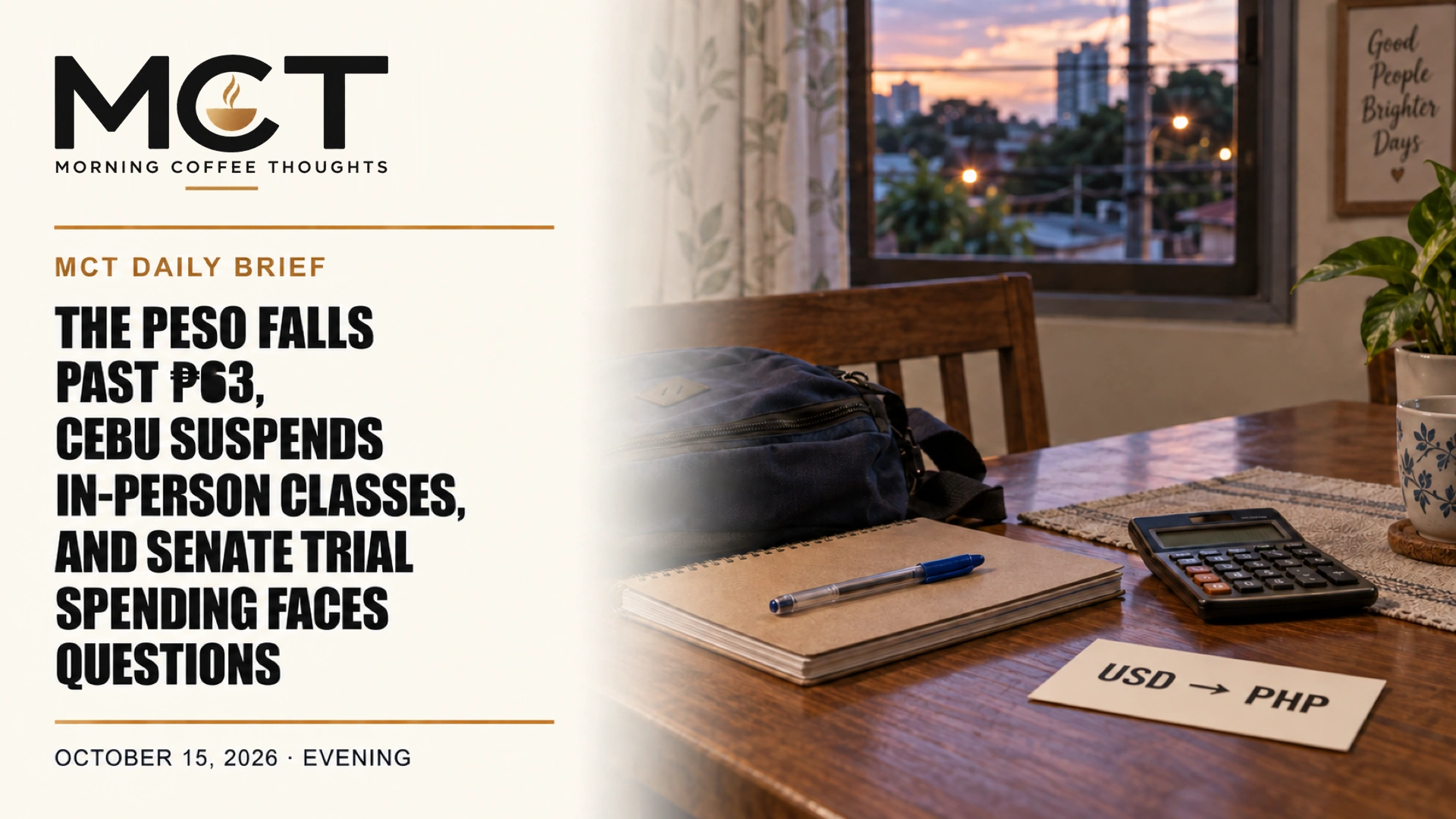
THE PESO FALLS PAST ₱63, CEBU SUSPENDS IN-PERSON CLASSES, AND SENATE TRIAL SPENDING FACES QUESTIONS
Good evening. Get your coffee ready. Here’s tonight’s briefing.
1
The peso closes at ₱63.06 against the dollar
The peso finished Thursday at ₱63.06 per US dollar, its weakest closing rate on record. During trading, it fell as far as ₱63.15 before recovering some ground. The closing rate and the intraday low are different figures, although both show how much pressure the currency faced today. [ABS-CBN report](https://www.abs-cbn.com/news/business/2026/10/15/peso-hits-record-low-of-p63-15-vs-dollar-in-intraday-trade-1040), [Daily Tribune report](https://tribune.net.ph/2026/10/15/peso-hits-record-low-close-of-p6306-as-stocks-rebound)
A weaker peso can raise the peso cost of imported goods priced in dollars. Businesses may absorb some of that cost or pass it on, so today’s exchange rate does not translate into an immediate, uniform price increase.
Families receiving dollars may get more pesos when they exchange their money. But that benefit can be reduced by transfer fees and higher household expenses.
WHAT TO WATCH
Friday’s trading and any BSP statement on the currency’s movement. For households, the practical question is whether sustained weakness begins appearing in the prices of imported goods and other dollar-linked expenses.
2
Poor air quality interrupts classes in several Cebu cities
Cebu City, Mandaue City and Lapu-Lapu City suspended face-to-face classes on Thursday because of poor air quality. The coverage differed: Mandaue’s notice covered all levels in public and private schools, while Lapu-Lapu’s covered kindergarten through Grade 12.
Schools were directed toward alternative arrangements, with details depending on the local order and the school. These were not nationwide suspensions, and Thursday’s notices should not be treated as automatic instructions for Friday. [GMA report](https://www.gmanetwork.com/news/serbisyopubliko/walangpasok/1005993/walang-pasok-class-suspensions-for-thursday-october-15-2026-due-to-poor-air-quality/story/?order=1&top_picks=)
For parents, another disrupted school day can mean arranging supervision, adjusting work schedules and finding ways for children to complete lessons at home. Clear, timely notices are especially important when families must make those arrangements overnight.
WHAT TO WATCH
Cebu City’s announced stakeholder meeting on Friday, October 16, along with fresh environmental readings and school advisories. Parents should check their own city and school announcements before leaving home.
3
Senate president disputes the ₱25-million daily impeachment figure
Senate President Sherwin Gatchalian says expenses directly linked to Sara Duterte’s impeachment trial totaled ₱14.55 million over 44 trial days, averaging approximately ₱330,763 a day.
In his October 14 statement, Gatchalian said the ₱25-million daily figure being circulated refers to operating the entire Senate, including salaries, maintenance, rentals and utilities. He said those expenses continue whether or not an impeachment trial is taking place. [Gatchalian’s statement](https://wingatchalian.com/news/statement-on-the-cost-of-the-impeachment-trial/)
That distinction changes the calculation. Counting the whole Senate’s operating expenses as additional trial spending does not show what the proceedings actually added to the bill.
The smaller figure still deserves examination. It is the Senate president’s reported accounting, not an independent audit, and taxpayers can ask for the records behind it.
WHAT TO WATCH
An itemized expense report and the final accounting after the trial. Those records should separate regular Senate spending from additional costs caused by the proceedings, rather than leave the public comparing competing headline figures.
4
OFW remittances rise from a year earlier, but decline from July
Cash remittances sent through banks reached $3.035 billion in August, up 1.9% from August last year, according to preliminary BSP figures reported by BusinessWorld. However, the amount was 6.3% below July’s total.
For January through August, bank-coursed remittances reached $23.424 billion, an increase of 2.2% from the same period in 2025. The annual increase and the monthly decline describe different comparisons; neither cancels out the other. [BusinessWorld report carried by Metrobank](https://wealthinsights.metrobank.com.ph/news/philippine-cash-remittances-drop-to-3-month-low-in-august)
These national totals do not mean every OFW family received more money. A household’s position depends on how much was sent, the exchange rate used, fees deducted and the bills waiting at home.
Today’s weaker peso may help some dollar recipients at conversion, but it does not establish that their overall purchasing power improved.
WHAT TO WATCH
The September remittance figures, which will show whether August’s decline from July continued. Families can also compare the pesos actually received after fees, rather than rely on the advertised exchange rate alone.
5
PSA estimates a smaller third-quarter palay harvest
The Philippine Statistics Authority estimates July-to-September palay production at 3.10 million metric tons, down 17.2% from the actual harvest in the same quarter of 2025.
The October 13 release used standing-crop information as of September 1. It remains an estimate, not the final count of everything harvested during the quarter. PSA also estimated a smaller harvest area, while output per hectare was slightly higher. [PSA release](https://psa.gov.ph/statistics/crops/palay-and-corn-estimates)
A smaller domestic harvest can put pressure on supply, but this report alone does not prove a rice shortage or establish a coming retail-price increase. Stocks, incoming shipments and the timing of distribution also affect what reaches markets.
For farmers, the immediate questions include how much they harvested, what buyers paid and whether their earnings covered production costs.
WHAT TO WATCH
The final third-quarter production report, updated rice inventories and the government’s supply plans. Those records will give a clearer picture of the gap between the estimated harvest and the rice available to consumers.
BOTTOM LINE
Tonight, families are dealing with pressures that can reach them in different ways: a weaker peso, interrupted classes and uncertainty over food supply. Government responses need to be specific enough for people to act on, whether that means a school notice before morning or a clear account of available rice stocks.
The same standard applies to public spending. A large figure should not be accepted simply because it sounds alarming, and a smaller official figure should not escape scrutiny simply because it comes from someone in authority.
Google’s Preferred Sources feature lets you choose publications you want Google to prioritize for you. Select “Add to Preferred Sources” to make MCT easier to find in Top Stories and other eligible Google results. This does not subscribe you to email.
Morning Coffee Thoughts is reader-supported. Contributions help pay for research tools, hosting, and the work required to verify and explain each development.
Monthly PayPal subscription — choose your support amount.