
LATEST COMMENTARY
FIVE THINGS TO KNOW
MCT READER PULSE · MCT-PULSE-2026-017
MCT READER SURVEY
Gaano ka nagtitiwala na tama ang ginagawa ng Kongreso sa budget ng bayan?
This is an informal survey of people who choose to participate. It is not a scientific or nationally representative sample.
ABOUT EL NIÑO AND PREPARING FOR LESS RAIN
It can be raining outside while PAGASA warns about El Niño. That can sound confusing when the immediate problem is a wet road or a flooded field. The two warnings describe different periods: the weather happening now and the rainfall conditions that may develop over the coming months.
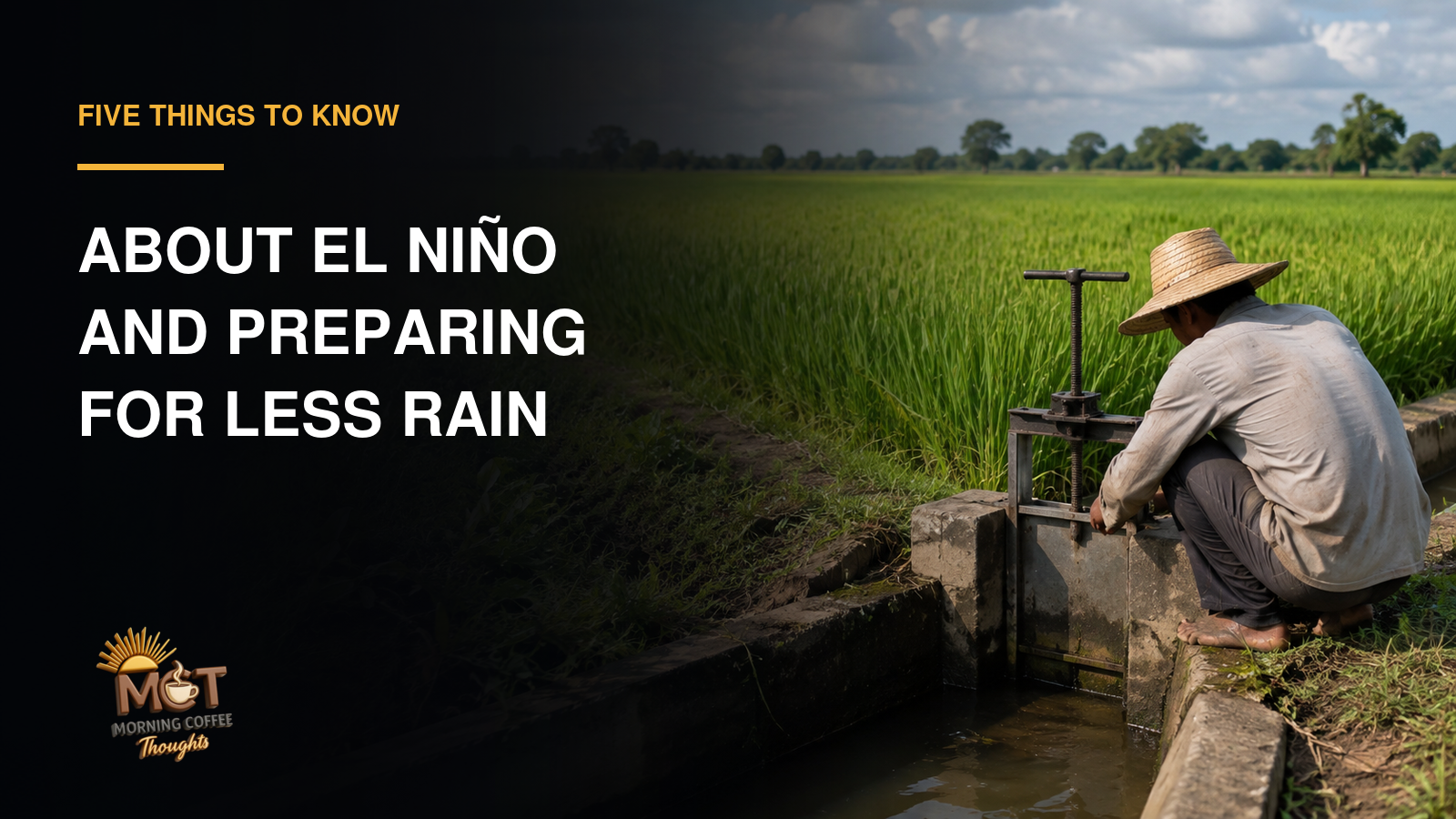
PAGASA says a moderate to strong El Niño is present in the tropical Pacific and may strengthen further before the year ends. For households and farmers, the useful questions are closer to home. How much water will reach the local supply? Will irrigation last through the crop's growing period? What preparation can be done before a shortage becomes urgent?
These five points explain what the forecast supports, what it cannot tell us yet, and what information communities should ask for.
1
EL NIÑO IS ALREADY PRESENT, WHILE ITS FUTURE STRENGTH REMAINS A FORECAST
El Niño involves unusually warm surface waters in the central and eastern equatorial Pacific, alongside changes in the atmosphere. Those changes can shift rainfall and temperature patterns far from the ocean area where scientists measure them.
PAGASA's September 8 farm advisory describes the present event as moderate to strong. Its outlook says El Niño may reach a very strong state before the end of 2026 and continue into the first half of 2027. The World Meteorological Organization's September 3 update likewise expects the event to strengthen, with a near-100-percent likelihood of persistence through February 2027.
That high probability describes El Niño's persistence. It is not a 100-percent probability that every Philippine town will suffer drought or lose its water supply. WMO specifically cautions that an event's strength does not directly determine how severe its effects will be in each region.
The forecast gives communities time to prepare. It does not supply the date when a particular household's tap might run dry, and a headline using “very strong” should not be read as a local interruption notice.
WHAT TO WATCH
Follow the next PAGASA El Niño advisory for changes in strength and duration. Then check the rainfall outlook for your province, because the local forecast is what helps turn a Pacific-wide warning into decisions about water and planting.
2
A RAINY DAY DOES NOT CANCEL THE RISK OF A DRY PERIOD
PAGASA's 7 a.m. forecast today still has the southwest monsoon affecting Luzon and the Visayas, with monsoon rain expected in Zambales and Bataan. The same advisory carries the El Niño warning. Neither statement requires the other to be false.
A daily weather forecast describes conditions over a short period. A seasonal rainfall outlook considers a much longer stretch. Several heavy downpours can occur within a month that ultimately receives less rain than usual, just as one dry afternoon tells us little about the month's total.
PAGASA also warns that localized thunderstorms can still bring heavy rain and flash flooding during generally drier conditions. Anyone facing a current flood warning needs to respond to that immediate danger. Preparing for reduced rainfall later should not become an excuse to disregard a warning about rising water today.
For a family or a farmer, this means keeping two sets of information in view. Use daily advisories for travel and work that cannot safely wait; use the longer outlook when considering water storage, irrigation and the next planting cycle.
WHAT TO WATCH
Check the next local rainfall or flood advisory for immediate hazards, then compare the month's measured rainfall with PAGASA's outlook. A single photograph of rain, flooding or cracked soil cannot settle what an entire province will experience over the season.
3
“BELOW NORMAL” DEPENDS ON THE PLACE AND THE MONTH
The usual rainfall for a place is the starting point when a forecast says “below normal.” It does not mean zero rain, and it is not a uniform amount that applies everywhere. A normally wet month and a normally dry month begin with very different expectations.
PAGASA's August 26 outlook covers September 2026 through February 2027 using separate monthly forecasts. That structure is useful: the outlook for one month should not be copied across the entire six-month period. Likewise, a description of Luzon cannot automatically stand in for conditions in the Visayas or Mindanao.
For water supply, where the rain falls is also relevant. Rain over your street is not a measurement of the water entering the watershed or reservoir serving your community. PAGASA's water-resources guidance explains that prolonged rainfall reductions can affect water available for household use and irrigation.
Ask the local provider what source supplies your area and which measurements it uses to assess a shortage. A dated reservoir reading, inflow report or supply advisory is more useful for that question than an undated nationwide map circulating in a group chat.
WHAT TO WATCH
Check the issue date, forecast month and location on the next rainfall map you see. For your water supply, look for updated local source measurements and an explanation of whether they require changes in service or water use.
4
FARM PREPARATION HAS TO MATCH THE CROP AND ITS WATER SUPPLY
A farmer cannot choose a planting date from the word El Niño alone. The crop, its stage of growth, soil conditions and available irrigation all affect the decision. PAGASA's agricultural assessments take crop water requirements and growing stages into account rather than assuming that the same rainfall amount serves every field equally well.
The agency advises conserving water, maintaining irrigation systems, collecting rainwater and using suitable drought-tolerant crops and practices that retain soil moisture. Its current advisory also calls for checking pumps and drainage after heavy rain, since damage or blockage can interfere with water management.
Before buying seed or changing a planting plan, ask the local agriculture office and irrigation provider about the specific crop and the expected water schedule. A general recommendation to change crops leaves too much unanswered if the farmer does not know the cost, suitability or water requirement of the alternative.
That conversation needs to happen while choices remain open. Once money has gone into seed, labor and land preparation, discovering that irrigation will be unavailable can leave a farming household with expenses it cannot recover from the planned harvest.
WHAT TO WATCH
Watch for the next local irrigation schedule and crop-specific advisory before committing to planting. Ask whether the expected supply covers the crop's growing period, and what adjustment the agriculture office recommends if it does not.
5
HOUSEHOLDS NEED SPECIFIC WATER-SERVICE INFORMATION
Reduced rainfall can put pressure on water supplies, but an El Niño forecast alone cannot establish that a particular interruption was caused by drought. The provider still needs to explain the local problem, the affected areas and the work needed to restore service.
For households, start with avoidable losses that can be checked now: a leaking tap, a toilet that keeps running or a damaged connection. Report leaks outside the property to the water provider. These are practical conservation steps, not a substitute for repairing losses in the wider distribution system.
Local preparation should also include people who cannot easily buy storage equipment or arrange alternative water deliveries. A renter in an upstairs room and a household with a large tank have different options. Any proposed interruption schedule should give residents enough detail to plan essential household tasks, rather than leaving them to interpret a general climate warning.
Ask the provider and barangay where an actual service notice will appear, how affected households will be identified and who can answer questions. Those details can be established before residents have to search for help during an interruption.
WHAT TO WATCH
If restrictions or interruptions are announced, look for the exact streets, hours, expected restoration time and any available assistance. Check whether the notice is current before changing household plans or forwarding it to neighbors.
BOTTOM LINE
The warning gives us a reason to prepare for reduced rainfall without pretending that the same outcome is certain everywhere. Keep today's weather alerts, the coming months' rainfall outlook and the condition of your local water supply separate enough to understand what each one tells you.
For farmers, preparation means checking water availability before spending on the next crop. For households, it means reducing avoidable waste and knowing where to get reliable service information. Government agencies and water providers should make those decisions easier with dated forecasts, understandable measurements and specific plans people can actually use.
GOOGLE PREFERRED SOURCES
FOLLOW MCT ON GOOGLE
Google’s Preferred Sources feature lets you choose publications you want Google to prioritize for you. Select “Add to Preferred Sources” to make MCT easier to find in Top Stories and other eligible Google results. This does not subscribe you to email.
SUPPORT MCT
HELP KEEP INDEPENDENT POLITICAL WRITING GOING.
Morning Coffee Thoughts is reader-supported. Contributions help pay for research tools, hosting, and the work required to verify and explain each development.