
LATEST COMMENTARY
FIVE THINGS TO KNOW
MCT READER PULSE · MCT-PULSE-2026-017
MCT READER SURVEY
Gaano ka nagtitiwala na tama ang ginagawa ng Kongreso sa budget ng bayan?
This is an informal survey of people who choose to participate. It is not a scientific or nationally representative sample.
ABOUT GRID BATTERIES: WHAT THEY CAN DO WHEN POWER IS TIGHT
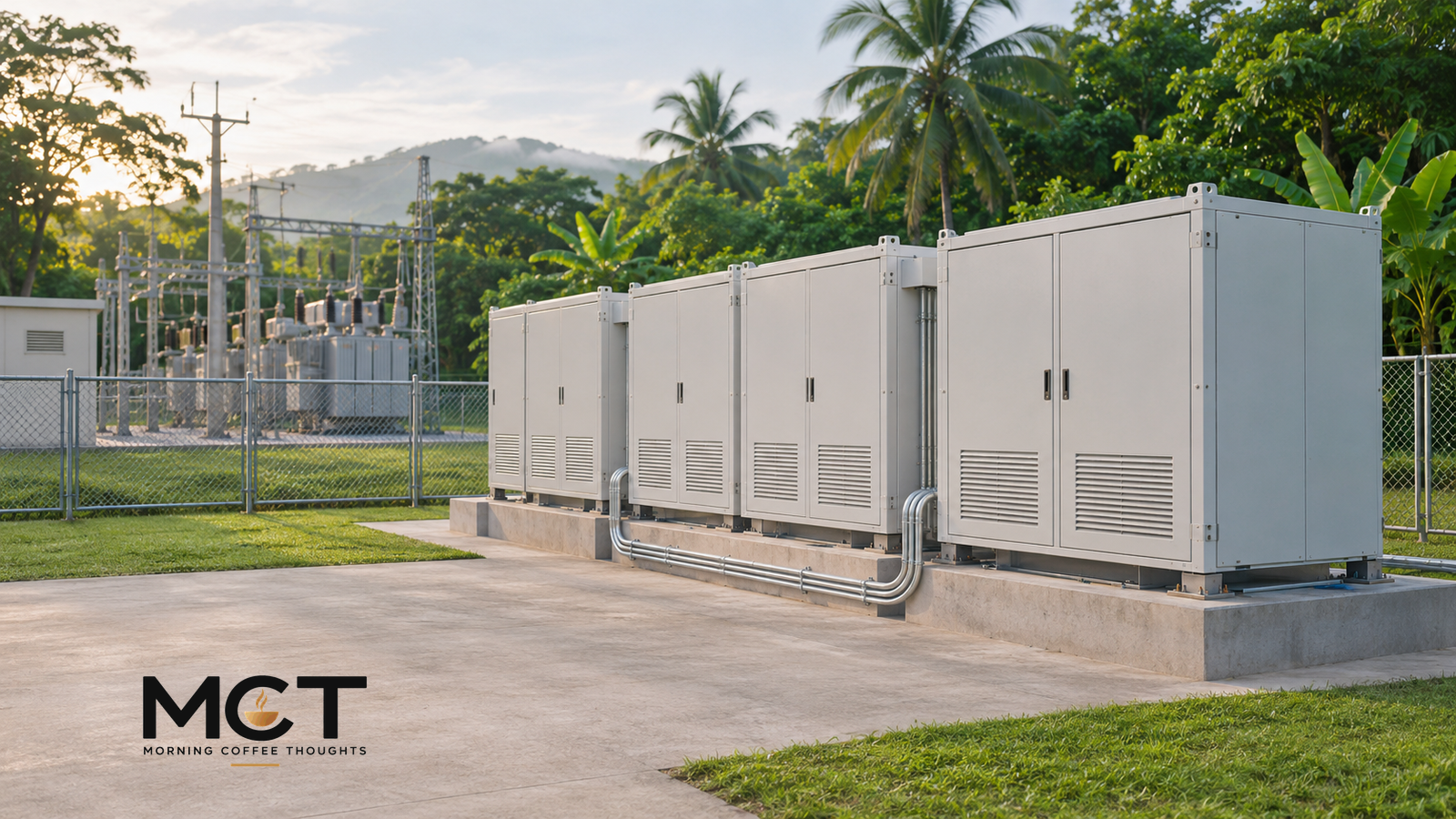
A battery can help keep electricity available when demand rises or a power source suddenly drops. But the word “battery” does not tell us how much power it can deliver, how long it can last or which problem it is meant to solve.
Reports on the National Grid Corporation of the Philippines' Project Airbag have renewed attention to battery storage and pressure on the grid. The proposal deserves a practical reading. Here are five things that matter before an announced storage project becomes something households can rely on.
1
A BATTERY STORES ELECTRICITY. IT STILL NEEDS TO BE CHARGED.
A grid battery takes in electricity and releases it later. The electricity has to come from a generating source, and some energy is lost in charging and discharging.
That makes storage useful when electricity is available at one time but needed at another. It can also respond quickly when supply and demand move out of balance. It does not remove the need for power plants or another source that can recharge it.
For a system facing a long shortage, that charging question matters. A battery that has used its stored energy needs another supply of electricity before it can do the same job again.
WHAT TO WATCH
Where the charging electricity will come from and what service the battery is designed to provide. A plan for a short, sudden imbalance is different from a plan to cover several hours of high demand.
2
ASK HOW MUCH POWER AND FOR HOW LONG.
A project's megawatt rating describes how much power it can deliver at a time. Its megawatt-hour rating describes the amount of energy it can store. The two numbers answer different questions.
For a simple example, a hypothetical system with 400 megawatt-hours of usable stored energy could supply 100 megawatts for about four hours. That is an illustration, not a specification for Project Airbag. Actual operation also depends on the system's limits, losses and remaining charge.
A large power rating alone does not show whether a battery can cover a long evening peak. Readers need the energy rating and expected duration as well.
WHAT TO WATCH
The proposed output, usable storage capacity and duration at the stated output. Ask whether those figures describe a single installation or the combined total of several sites.
3
STORAGE CAN MOVE SOLAR POWER INTO HOURS WHEN IT IS MORE USEFUL.
Solar output follows daylight. Household and business demand does not always follow the same pattern. Batteries can store electricity when it is available and release it later, including into the evening.
This is one reason storage is being added to electricity systems with more renewable power. A battery can also react quickly to changes in supply. Those are useful services, but they are not unlimited: the installation still has a maximum output and a finite amount of stored energy.
The relevant question is which hours and which grid need the project will serve. A battery's value depends on the problem it is being asked to solve, not just on the size of the announcement.
WHAT TO WATCH
The operating plan: when the battery will charge, when it will discharge, and which grid constraint or demand period it is intended to address.
4
GRID STORAGE DOES NOT AUTOMATICALLY KEEP EVERY HOME ON DURING AN OUTAGE.
Electricity still needs a working path to the customer. Damage to transmission or distribution equipment can interrupt that path even when electricity is available elsewhere.
Local backup systems and properly designed microgrids can serve particular buildings or communities during a wider outage. That is a different arrangement from simply adding a large battery somewhere on the grid. Even rooftop solar usually needs suitable equipment and a properly configured system to operate safely when the grid is down.
A grid-storage announcement should therefore not be read as a promise that every household will have backup power. The location, connections and intended service determine who can benefit during a particular disruption.
WHAT TO WATCH
Which network problem the project addresses, where it connects and whether it is designed to serve an isolated area during an outage. Look for an explicit operating plan rather than assuming that any battery provides household backup.
5
AN ANNOUNCEMENT IS ONLY THE START OF A WORKING PROJECT.
Reports on Project Airbag describe a proposed storage response to grid strain. They do not establish that the equipment is already operating or that household bills will fall by a stated amount.
Storage projects need financing, permission to proceed, a grid connection and commissioning before they can provide their intended service. The International Energy Agency identifies these practical requirements as part of getting storage projects into operation.
For Philippine consumers, the useful next record is a project plan that sets out the sites, capacity, cost, approvals and delivery schedule. Those details allow the public to judge the promised benefit against the actual project, including how any cost would be recovered.
WHAT TO WATCH
The regulatory filings and decisions, the approved technical plan, commissioning dates and evidence of actual operation. A forecast benefit should remain a forecast until the service and its cost can be checked.
BOTTOM LINE
Grid batteries can respond quickly and make electricity available at a more useful time. Their limits matter just as much: they need charging, have a finite duration and depend on the surrounding network. Before treating a project as an answer to shortages or high bills, ask what it will do, for how long, where and at what cost.
SOURCES
- The Philippine Star, November 9, 2026 Project Airbag and the proposed response to grid strainhttps://www.philstar.com/headlines/2026/11/09/2568885/ngcp-unveils-project-airbag-ease-grid-strain
- BusinessMirror, November 9, 2026 NGCP's storage proposal and grid preparationhttps://businessmirror.com.ph/2026/11/09/ngcp-unveils-project-airbag-to-ease-grid-strain-ready-for-el-nino/
- U.S. Energy Information Administration, March 25, 2022 Battery storage duration and different grid useshttps://www.eia.gov/TodayinEnergy/detail.php?id=51798
- U.S. Energy Information Administration, January 8, 2018 Power capacity, energy capacity and battery charginghttps://www.eia.gov/todayinEnergy/detail.php?id=34432
- International Energy Agency, May 29, 2026 Battery storage's expanding role and requirements for deliveryhttps://www.iea.org/commentaries/battery-storage-is-scaling-up-and-taking-on-a-larger-system-role
- U.S. Department of Energy Solar and Resilience Basics, including local storage and damaged networkshttps://www.energy.gov/cmei/systems/solar-and-resilience-basics
- National Energy System Operator How storage helps balance the gridhttps://www.neso.energy/energy-101/electricity-explained/how-do-we-balance-grid/how-does-storage-help-us-balance-grid
GOOGLE PREFERRED SOURCES
FOLLOW MCT ON GOOGLE
Google’s Preferred Sources feature lets you choose publications you want Google to prioritize for you. Select “Add to Preferred Sources” to make MCT easier to find in Top Stories and other eligible Google results. This does not subscribe you to email.
SUPPORT MCT
HELP KEEP INDEPENDENT POLITICAL WRITING GOING.
Morning Coffee Thoughts is reader-supported. Contributions help pay for research tools, hosting, and the work required to verify and explain each development.