
LATEST COMMENTARY
FIVE THINGS TO KNOW
MCT READER PULSE · MCT-PULSE-2026-017
MCT READER SURVEY
Gaano ka nagtitiwala na tama ang ginagawa ng Kongreso sa budget ng bayan?
This is an informal survey of people who choose to participate. It is not a scientific or nationally representative sample.
ABOUT LINO CAYETANO AND THE CHANGE AT THE PCO
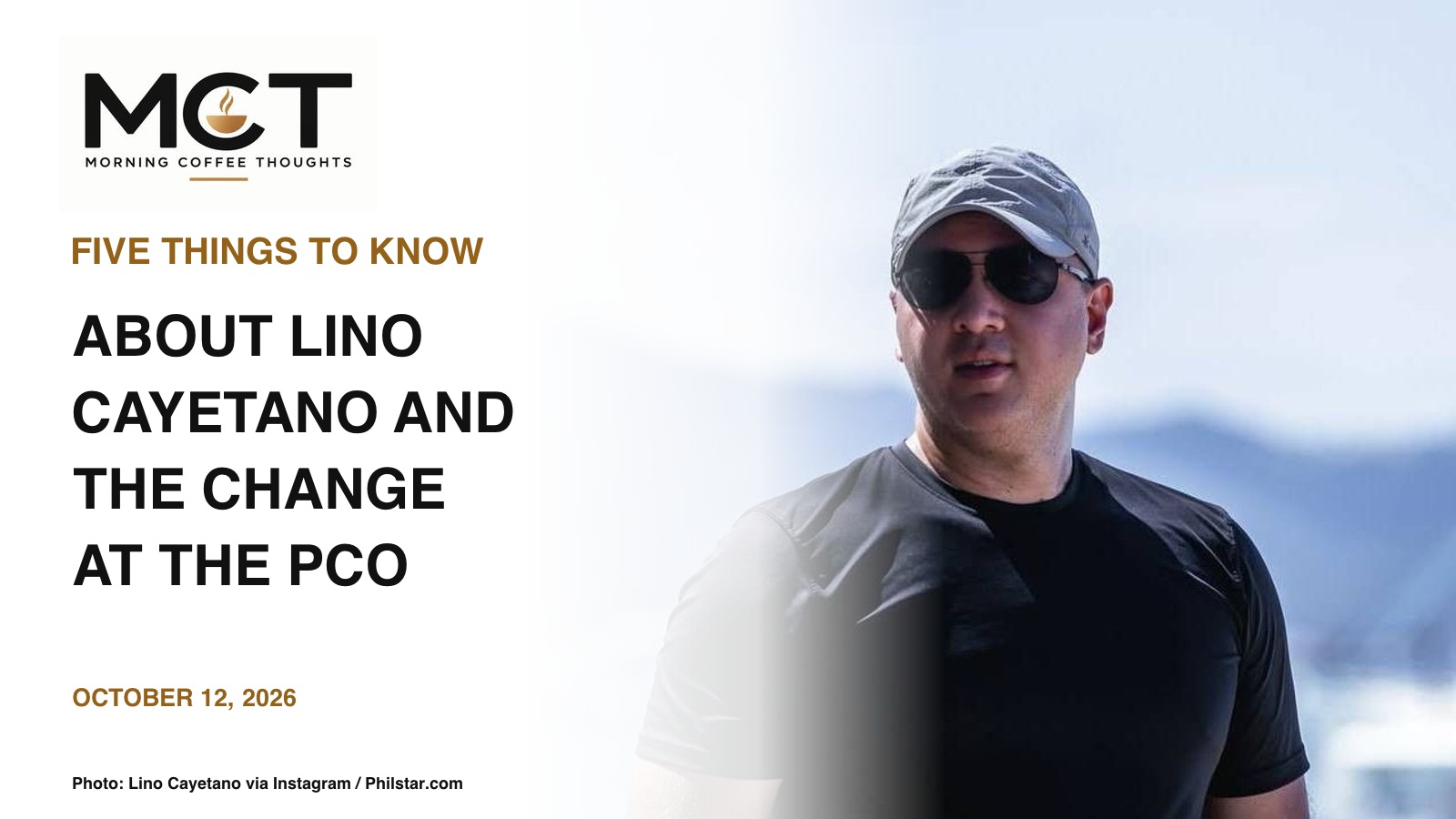
President Ferdinand Marcos Jr. announced on October 11 that Lino Cayetano would replace Dave Gomez at the Presidential Communications Office. He said Gomez had been bypassed by the Commission on Appointments and that the change would be formalized when they returned from Singapore.
It is reasonable to ask what changes when the person in charge of presidential communications changes. This office helps shape the information the public receives about government. Its announcements can explain a policy, clarify an earlier statement, or leave people with more questions than answers.
Here are five things to understand about the appointment and the work attached to it.
1
THE PRESIDENT HAS ANNOUNCED HIS CHOICE
Marcos has identified Cayetano as Gomez’s replacement. His statement also points to a formal step still to follow. An announcement, a signed appointment and the start of an official’s service should each be reported accurately when they happen.
That sequence is useful whenever a government office changes leadership. Someone needs the authority to approve decisions and answer for the office’s actions during the handover. Readers should be able to find out who currently holds that responsibility without guessing from a headline.
The announcement establishes the President’s choice. The appointment document and assumption of office will establish the details of the transition.
WHAT TO WATCH
The signed appointment, its effective date and confirmation of the handover. These will identify when Cayetano takes responsibility for the office.
2
A BYPASSED APPOINTMENT HAS A SPECIFIC MEANING
Marcos said Gomez’s appointment had been bypassed. That word should not be used to suggest that the Commission on Appointments made a final finding that Gomez was unqualified.
In Matibag v. Benipayo, the Supreme Court explained that a bypassed ad interim appointment is one the commission has not finally acted on before Congress adjourns. An ad interim appointment is issued during a congressional recess and remains subject to the constitutional confirmation process. The President may renew a bypassed appointment. A final disapproval by the commission has a different legal effect.
This explains the term; it does not establish why Gomez’s particular appointment was left unacted on. The President’s decision to choose someone else is a further decision that needs to be reported on its own terms.
WHAT TO WATCH
The commission’s record and the Palace’s formal appointment documents. They can clarify the procedural history without turning inaction into an invented finding against an appointee.
3
THE PCO COORDINATES HOW THE ADMINISTRATION COMMUNICATES
Executive Order No. 16, issued in February 2023, describes the PCO’s role in engaging the public and media and coordinating the messaging of the President and executive branch. Its structure covers media relations, digital communication, content and broadcast production, and administration.
Think of an announcement about a new government benefit. A reader needs to know who qualifies, when applications open and which office receives them. When agencies give conflicting instructions, someone has to clarify the government’s position. Those are practical standards for judging official communication.
For a political controversy, the same demand for clarity applies: identify the decision, explain its basis and provide a way for people to check what has been said. Readers should not have to reconstruct the answer from scattered briefings.
WHAT TO WATCH
Whether new announcements provide working links to decisions, definite dates and instructions that agree with those of the agencies implementing them.
4
CAYETANO BRINGS EXPERIENCE IN POLITICS AND TELEVISION
Cayetano has served as a district representative and Taguig mayor, worked as a television director, and headed PTV since June. His move therefore combines experience in public office with experience producing material for an audience.
That background can help explain a complicated policy clearly. It does not tell us in advance how he will handle an uncomfortable question. His briefings, corrections and responses to requests for records will provide evidence of that.
PTV is among the agencies attached to the PCO under EO 16. The move also raises an ordinary management question: who takes over his previous job? People should be able to follow the handover at both offices and understand where their responsibilities begin and end.
WHAT TO WATCH
The arrangement for PTV’s leadership and Cayetano’s first substantive briefings. Look for clear answers to follow-up questions, including questions that challenge the administration’s account.
5
READERS CAN JUDGE THE OFFICE THROUGH THE ANSWERS IT PROVIDES
GMA’s account identifies Cayetano as the sixth person to head the PCO under Marcos. Repeated leadership changes give the public a reason to ask about continuity. The count alone cannot establish why each predecessor left or whether a particular official performed poorly.
A useful assessment starts with something a reader can check. If the Palace changes an earlier statement, does it explain what changed and when? If it cites an investigation, does it identify the agency and the stage reached? If it promises a service, does the announcement tell people how to obtain it?
This is how the office can earn credibility through its daily work. A correction that is easy to find, a complete transcript and a direct answer make it easier to hold government accountable.
WHAT TO WATCH
The handling of the first correction or disputed announcement under the incoming chief. Check whether the original statement, correction and supporting record remain accessible to readers.
BOTTOM LINE
Cayetano will inherit responsibility for explaining an administration whose decisions people need to understand and scrutinize. The public can reasonably expect complete answers, accessible records and prompt corrections. His appointment gives us a name to follow; his work will give us the basis for judging the change.
GOOGLE PREFERRED SOURCES
FOLLOW MCT ON GOOGLE
Google’s Preferred Sources feature lets you choose publications you want Google to prioritize for you. Select “Add to Preferred Sources” to make MCT easier to find in Top Stories and other eligible Google results. This does not subscribe you to email.
SUPPORT MCT
HELP KEEP INDEPENDENT POLITICAL WRITING GOING.
Morning Coffee Thoughts is reader-supported. Contributions help pay for research tools, hosting, and the work required to verify and explain each development.