
LATEST COMMENTARY
FIVE THINGS TO KNOW
MCT READER PULSE · MCT-PULSE-2026-017
MCT READER SURVEY
Gaano ka nagtitiwala na tama ang ginagawa ng Kongreso sa budget ng bayan?
This is an informal survey of people who choose to participate. It is not a scientific or nationally representative sample.
ABOUT PARLIAMENTARY COURTESY AND THE OVP BUDGET
The Senate's official calendar lists the Office of the Vice President's budget briefing for tomorrow, October 20, at 10 a.m. in the Recto Room.
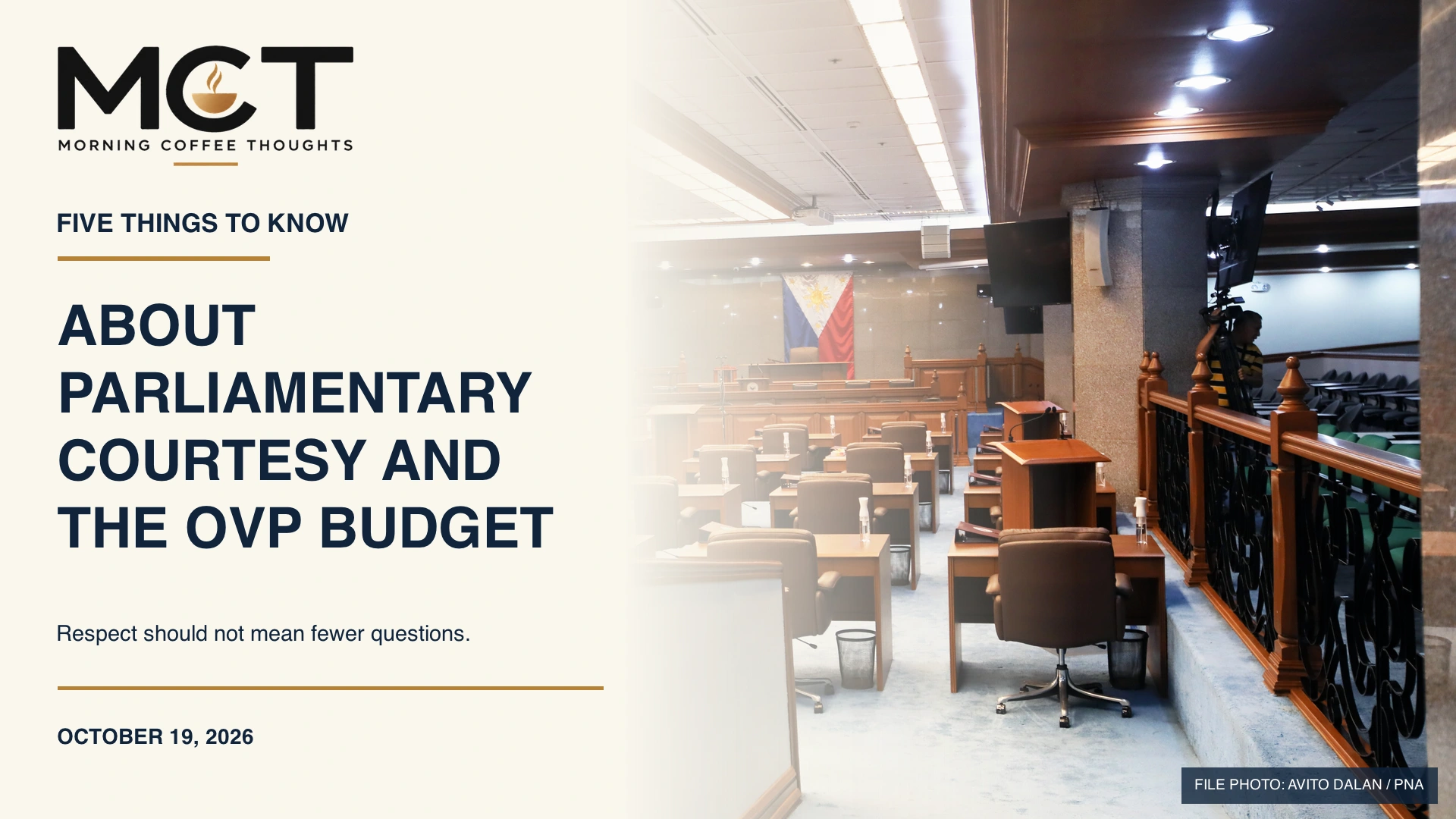
Sen. JV Ejercito has said the chamber is ready to extend parliamentary courtesy to the office, while assessing its programs on their merits. He also acknowledged the awkwardness of a budget hearing alongside the impeachment proceedings.
That leaves a reasonable question for taxpayers: How much questioning will senators do?
Nobody needs a shouting match. But being respectful to an official should not leave the public guessing about the money that official wants to spend.
1
COURTESY CAN AFFECT HOW MUCH OF A BUDGET GETS EXAMINED
In budget hearings, parliamentary courtesy can mean more than a polite welcome. It can be used to cut short deliberations on an office's proposed spending. [Senate hearing schedule](https://budget-transparency-portal.senate.gov.ph/schedules)
There is a recent example involving the presidency. In September, the Philippine Star reported that the House appropriations committee had voted 37–5 the previous week to end deliberations on the Office of the President's proposed 2027 budget. Budget watchdogs opposed special treatment for both the OP and OVP. [Philippine Star](https://www.philstar.com/headlines/2026/09/08/2554787/end-parliamentary-courtesy-op-ovp-budgets-watchdogs)
That earlier House action does not tell us what the Senate will do tomorrow. Ejercito's offer should not be described in advance as a promise to approve everything without questions. It does give the public a reason to watch how the hearing is handled.
WHAT TO WATCH
Whether senators examine the proposed programs, or end the hearing before the spending has been explained.
2
AN OFFICE DOES NOT GET ITS BUDGET JUST BECAUSE SOMEONE OFFERS COURTESY
Appropriation bills begin in the House, and the Senate can propose or agree to changes. Public money can be paid out only under an appropriation made by law. Those constitutional rules do not disappear because an office receives a friendly reception. [1987 Constitution, Article VI](https://lawphil.net/consti/cons1987.html)
The DBM describes separate stages for preparing, passing, carrying out and accounting for the budget. A committee hearing is part of that process, not the whole process. A favorable hearing does not by itself mean the final appropriation has become law or the money has been released. [DBM](https://www.dbm.gov.ph/index.php/the-secretary-2/speeches/3799-the-national-budget-process-turning-plans-and-priorities-to-quality-public-services)
When someone says an office's budget was “approved,” ask at which stage. Otherwise, a committee action can easily sound like the final outcome.
WHAT TO WATCH
The committee report, the Senate's version and the final enacted budget, rather than relying only on remarks after the hearing.
3
THE HEARING SHOULD EXAMINE THE PROGRAMS, NOT REWARD OR PUNISH POLITICAL LOYALTY
Ejercito said good proposals could be approved on their merits. That should mean asking what each program does, who benefits, what it costs and what the office has accomplished with earlier funding. His remarks do not establish that every proposal has already passed that examination. [Philippine Star](https://www.philstar.com/headlines/2026/10/19/2564134/senate-objectively-assess-ovps-proposed-budget/amp/)
The impeachment case does not answer those budget questions. Neither does support for the Vice President, opposition to her, or a desire to avoid another confrontation.
If a program overlaps with work already funded elsewhere, senators should ask why it needs another allocation. If it serves people who would otherwise be missed, the office should explain that with records. The people receiving services deserve more than a fight over personalities.
WHAT TO WATCH
Cost breakdowns, beneficiary records and explanations of possible duplication. Political assurances cannot do the work of those documents.
4
BUDGET APPROVAL DOES NOT CLEAR AN OFFICE'S PAST SPENDING
A decision to fund an office next year is not a finding that all its earlier spending was proper.
The Commission on Audit examines government receipts, expenditures and the use of public funds and property. That work is separate from a budget committee's decision on proposed spending. [COA](https://www.coa.gov.ph/FAQS/what-agencies-can-be-audited-by-coa/)
For the same reason, a friendly budget hearing is not an acquittal in an impeachment or criminal case. And questions about past spending do not, by themselves, prove an official guilty. Each claim needs the records and proceedings that belong to it.
We should be wary when either side tries to turn one favorable event into a clean bill for everything, or one unresolved accusation into a settled verdict.
WHAT TO WATCH
Whether officials answer the particular audit or legal question being raised, rather than pointing to budget approval as a complete answer.
5
THE STANDARD SHOULD APPLY TO THE PRESIDENT'S OFFICE TOO
The watchdog criticism reported in September covered both the OP and OVP. That is worth remembering when political loyalties enter the hearing room. [Philippine Star](https://www.philstar.com/headlines/2026/09/08/2554787/end-parliamentary-courtesy-op-ovp-budgets-watchdogs)
An office should not escape questions because its occupant is powerful, popular or allied with the legislators holding the hearing. Nor should an opponent face a standard that allies never have to meet.
Tomorrow, readers can look for three things: a clear account of the money being sought, evidence behind claims about program results, and a record of questions left unanswered. Those are more useful than counting compliments, insults or how quickly the hearing ends.
WHAT TO WATCH
Whether senators ask comparable questions of other offices, and whether the public can see the documents behind the answers.
BOTTOM LINE
Senators can treat the Vice President respectfully and still question her office's spending proposal closely. The same goes for the President and every other official asking for public money. If courtesy leaves ordinary questions unanswered, taxpayers are the ones being asked to accept less.
GOOGLE PREFERRED SOURCES
FOLLOW MCT ON GOOGLE
Google’s Preferred Sources feature lets you choose publications you want Google to prioritize for you. Select “Add to Preferred Sources” to make MCT easier to find in Top Stories and other eligible Google results. This does not subscribe you to email.
SUPPORT MCT
HELP KEEP INDEPENDENT POLITICAL WRITING GOING.
Morning Coffee Thoughts is reader-supported. Contributions help pay for research tools, hosting, and the work required to verify and explain each development.