
LATEST COMMENTARY
FIVE THINGS TO KNOW
MCT READER PULSE · MCT-PULSE-2026-017
MCT READER SURVEY
Gaano ka nagtitiwala na tama ang ginagawa ng Kongreso sa budget ng bayan?
This is an informal survey of people who choose to participate. It is not a scientific or nationally representative sample.
ABOUT THE DISPUTE OVER CHANGING THE ORDER OF IMPEACHMENT WITNESSES
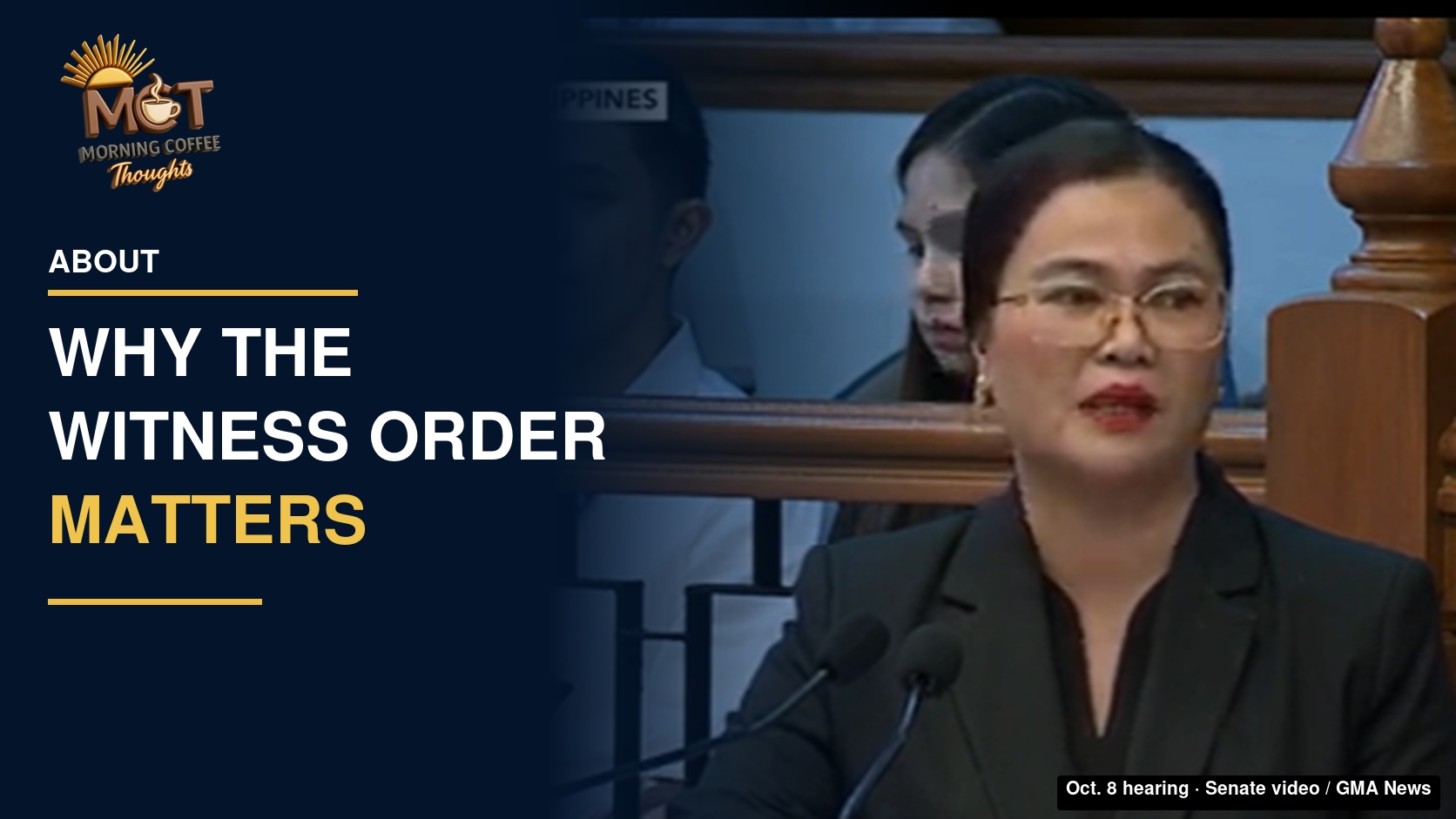
The argument at Thursday’s impeachment hearing was about which witness the prosecution could present next. It began with an absent lawyer and became a dispute over preparation and notice. Understanding the exchange helps explain why a courtroom can pause even when the parties, documents and another potential witness are already in the building.
1
THE SCHEDULED WITNESS WAS A BIR OFFICIAL
Anne Loraine Garcia-Marquez, chief of staff at the BIR Office of the Commissioner, was scheduled to testify on financial records relevant to Article II, the charge involving alleged unexplained wealth and disclosures. Her expected presentation concerned tax returns and audited financial statements associated with Sara Duterte, Manases Carpio and related entities.
WHAT TO WATCH
The prosecution reported that Erwin Matib, the lawyer assigned to present her, was ill. The reported problem concerned the presenting lawyer, not a statement that the BIR official herself was unavailable. That distinction explains why the court asked whether a different prosecutor could question her.
2
THE PROSECUTION ASKED TO HEAR THE FINANCIAL ANALYST FIRST
Terry Ridon requested that financial analyst Alexander Cabrera take the stand ahead of the BIR official. The proposal sought to change the sequence of the presentation. It was not a request to abandon tax records or a ruling excluding the BIR witness.
WHAT TO WATCH
The two roles raise different questions. A records witness may explain what an institution holds and how those documents are identified. An analyst’s interpretation can require scrutiny of assumptions, calculations and the records used. Preparation for one does not necessarily equip the opposing lawyer to test the other immediately.
3
THE DEFENSE OBJECTED TO THE NOTICE AND ITS ABILITY TO PREPARE
Sheila Sison said the defense had prepared for the disclosed BIR witness and objected to being asked to adjust on the day of the hearing. The prosecution, meanwhile, sought a way to continue despite its lawyer’s illness. Benjamin Tolosa pointed to the preparation required for the technical documents and argued for consideration of the circumstances.
WHAT TO WATCH
Those are competing procedural arguments. An objection about preparation does not, by itself, establish an effort to hide evidence. A request to keep the hearing moving does not, by itself, show that the other side has had enough time to prepare. The court must manage the concrete problem rather than infer either side’s motives from the exchange alone.
4
THE COURT’S DIRECTIONS KEPT THE BIR PRESENTATION FIRST
Reports of the morning proceedings describe Escudero asking whether Matib could appear later or another prosecutor could take over. If neither option allowed the BIR presentation to proceed, the court could end the day early. The panel was expected to arrange a substitute for Friday if Matib remained unavailable.
WHAT TO WATCH
These were directions for handling the possible afternoon and following day. They are not evidence that the conditions were met. The next report must establish who actually testified and what was tested. A plan to resume is different from confirmation that a witness completed an examination.
5
CROSS-EXAMINATION IS PART OF TESTING THE CASE
The Senate’s impeachment rules provide for the party calling a witness to examine that witness, followed by cross-examination from the opposing side. Objections and requests about procedure are addressed to the presiding officer. The court manages the presentation; neither side’s preference automatically decides the schedule.
WHAT TO WATCH
For a reader, the important distinction is between showing records and testing what they prove. Cross-examination can examine a witness’s knowledge, the limits of the documents and the basis for a conclusion. The question after Thursday’s dispute is whether the next presentation gives the court usable evidence and gives the opposing side a meaningful opportunity to question it.
GOOGLE PREFERRED SOURCES
FOLLOW MCT ON GOOGLE
Google’s Preferred Sources feature lets you choose publications you want Google to prioritize for you. Select “Add to Preferred Sources” to make MCT easier to find in Top Stories and other eligible Google results. This does not subscribe you to email.
SUPPORT MCT
HELP KEEP INDEPENDENT POLITICAL WRITING GOING.
Morning Coffee Thoughts is reader-supported. Contributions help pay for research tools, hosting, and the work required to verify and explain each development.