LATEST COMMENTARY
FIVE THINGS TO KNOW
MCT READER PULSE · MCT-PULSE-2026-017
MCT READER SURVEY
Gaano ka nagtitiwala na tama ang ginagawa ng Kongreso sa budget ng bayan?
This is an informal survey of people who choose to participate. It is not a scientific or nationally representative sample.
ABOUT THE EXPANDED SCHOOL VOUCHER BILL AND WHO IT COULD HELP
What the ratified voucher bill would change, who may qualify, and what families still need to know.
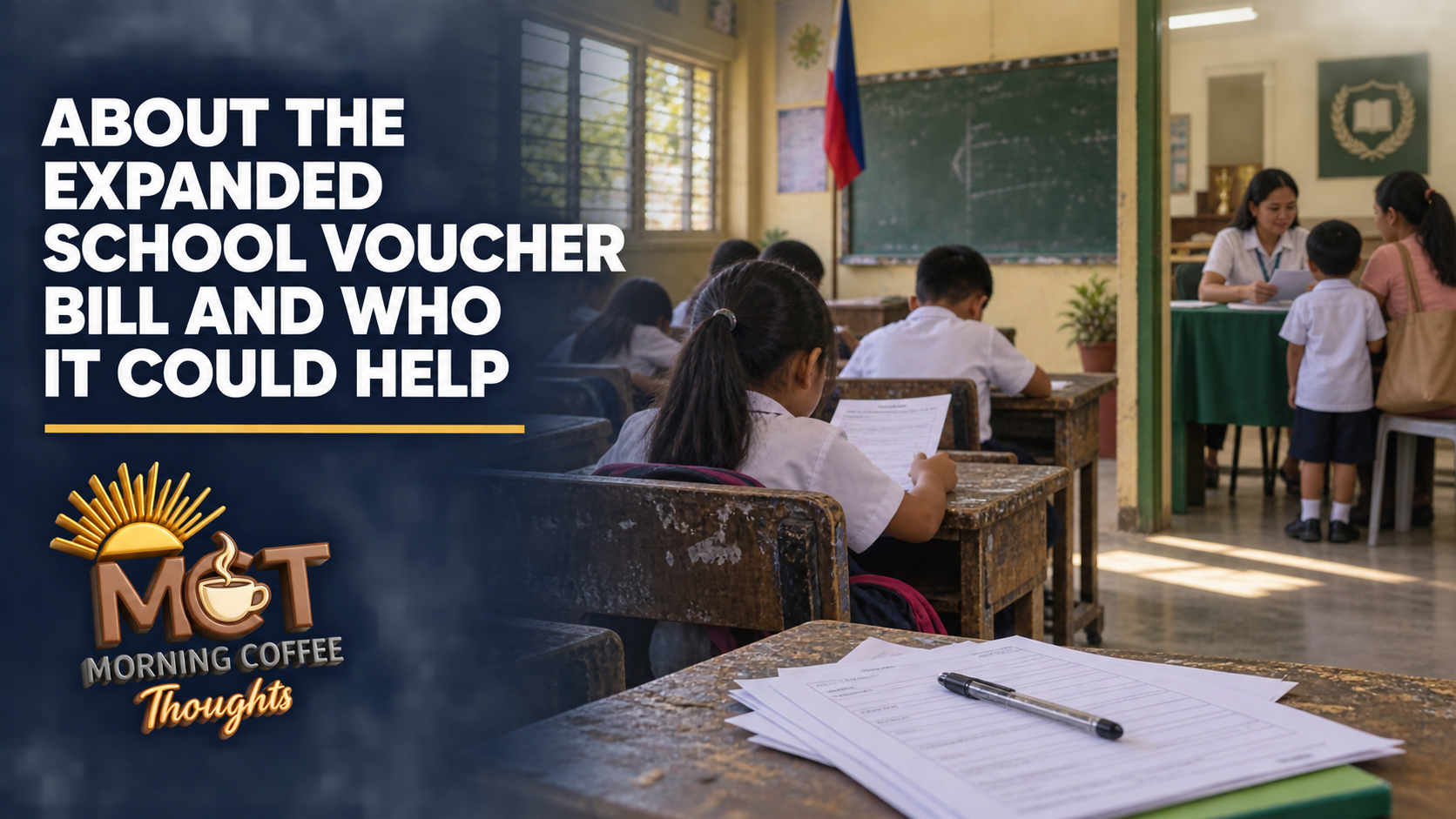
Congress has ratified a bill that would widen government-funded school vouchers to qualified learners from Kindergarten to Grade 12. The plan is meant to give some families access to available places in private schools, especially where public classrooms are crowded or no nearby public school can take the learner.
That sounds simple, but several details are still unsettled. The bill is not yet a law. A voucher may not cover every peso charged by a private school. Families also need to know who receives priority, which schools may participate, and what protection exists against weak teaching or false enrolment records.
Here are five things to know.
1
1. CONGRESS RATIFIED THE BILL, BUT IT IS NOT YET A LAW
The House and Senate ratified the bicameral conference committee report that reconciled House Bill No. 4744 and Senate Bill No. 1981. The proposed law is called the Basic Education Voucher Assistance Act.
Ratification means both chambers accepted the same final congressional text. The next step is transmission to the Office of the President for action. Until the President signs it or it otherwise becomes law under the constitutional process, families cannot claim a new benefit from the proposal.
Even after enactment, the Department of Education will need implementation rules, a budget, a school-participation process, and a schedule before the wider program can operate.
WHAT TO WATCH
Watch for presidential action, publication of the final enrolled bill, DepEd's implementation rules, and the school year when the expanded coverage will actually begin.
2
2. THE MAIN CHANGE IS COVERAGE FROM KINDERGARTEN TO GRADE 12
Government voucher programs already support many learners in private junior and senior high schools. The bill would place a broader Kindergarten-to-Grade-12 program in law and add qualified Kindergarten and elementary learners to the coverage.
The voucher would allow an eligible learner to enroll in a participating private basic-education school recognized by DepEd. It gives families another possible school option; it does not close public schools or end the government's responsibility to build classrooms, hire teachers, and improve public education.
The House said private schools have unused places that could accommodate some learners now attending congested public schools. Using those places may give some children relief sooner while new public classrooms are being built.
WHAT TO WATCH
Check whether the final law introduces the new grade levels all at once or in stages, and whether enough participating schools exist near the communities with the worst classroom shortages.
3
3. NOT EVERY LEARNER WILL AUTOMATICALLY RECEIVE A VOUCHER
The ratified measure gives priority to learners in public schools identified by DepEd as congested, those living where there is no nearby public school, and those in communities served by crowded public schools.
This means the program is intended to direct limited public funds toward learners facing an access or capacity problem. It should not be read as an automatic government payment for every child already enrolled in a private school.
The practical effect will depend on DepEd's definitions and records. Families will need clear instructions on residence, school capacity, grade level, transfer rules, deadlines, and the proof required for eligibility.
WHAT TO WATCH
Look for a simple eligibility checker, a public list of participating schools, an appeals process, and rules that prevent families from being rejected because of confusing paperwork.
4
4. A VOUCHER MAY NOT COVER THE FULL COST OF PRIVATE SCHOOL
A voucher is a government subsidy applied to a learner's education in a participating school. It should not be described as a promise of completely free private-school education unless the final amount covers all tuition and permitted fees at the chosen school.
The value can vary according to the rules, grade level, location, available funds, and the school's charges. Families may still face a balance, along with costs for uniforms, transport, meals, devices, books, projects, or other school requirements.
Parents should receive the voucher amount and the school's full list of charges before accepting a place. A family that saves on tuition can still struggle if transport and other daily expenses are high.
WHAT TO WATCH
Compare the voucher value with the school's total charges and ordinary household costs. DepEd should require participating schools to disclose any amount a family must pay before enrolment is confirmed.
5
5. ACCESS MUST COME WITH QUALITY AND ANTI-FRAUD CONTROLS
Sending public money to private schools requires reliable learner records, attendance checks, school recognition, financial audits, and a way to recover money paid for false or ineligible enrolments.
The expanded program also needs academic safeguards. A child moved out of a crowded public school should receive competent teaching, safe facilities, and support suited to the learner's needs. More school choices do not help if the participating school performs poorly or charges families costs they were not told about.
DepEd has previously proposed centralized verification, stronger audits, data sharing, and whistleblower protection for government education subsidies. Those controls should be visible in the final rules and actual enforcement.
WHAT TO WATCH
Look for public audit results, penalties for false claims, learner-protection rules, school-performance information, and a complaint channel that parents can use without risking the child's place.
BOTTOM LINE
The expanded voucher bill could help some children leave overcrowded classrooms or reach a school when no nearby public option is available. It may also use private-school seats that are currently empty.
It is still a proposal awaiting presidential action, and the benefit will depend on the details. Families need to know who qualifies, how much the voucher pays, what costs remain, which schools may join, and what happens when a school fails the learner.
Vouchers can ease pressure in specific communities, but they cannot replace the slower work of building and repairing public classrooms, hiring enough teachers, and improving the quality of public education for everyone.
GOOGLE PREFERRED SOURCES
FOLLOW MCT ON GOOGLE
Google’s Preferred Sources feature lets you choose publications you want Google to prioritize for you. Select “Add to Preferred Sources” to make MCT easier to find in Top Stories and other eligible Google results. This does not subscribe you to email.
SUPPORT MCT
HELP KEEP INDEPENDENT POLITICAL WRITING GOING.
Morning Coffee Thoughts is reader-supported. Contributions help pay for research tools, hosting, and the work required to verify and explain each development.