
LATEST COMMENTARY
FIVE THINGS TO KNOW
MCT READER PULSE · MCT-PULSE-2026-017
MCT READER SURVEY
Gaano ka nagtitiwala na tama ang ginagawa ng Kongreso sa budget ng bayan?
This is an informal survey of people who choose to participate. It is not a scientific or nationally representative sample.
ABOUT THE MANHUNT FOR BATO DELA ROSA
Authorities say they know where he is. An arrest has yet to be confirmed.
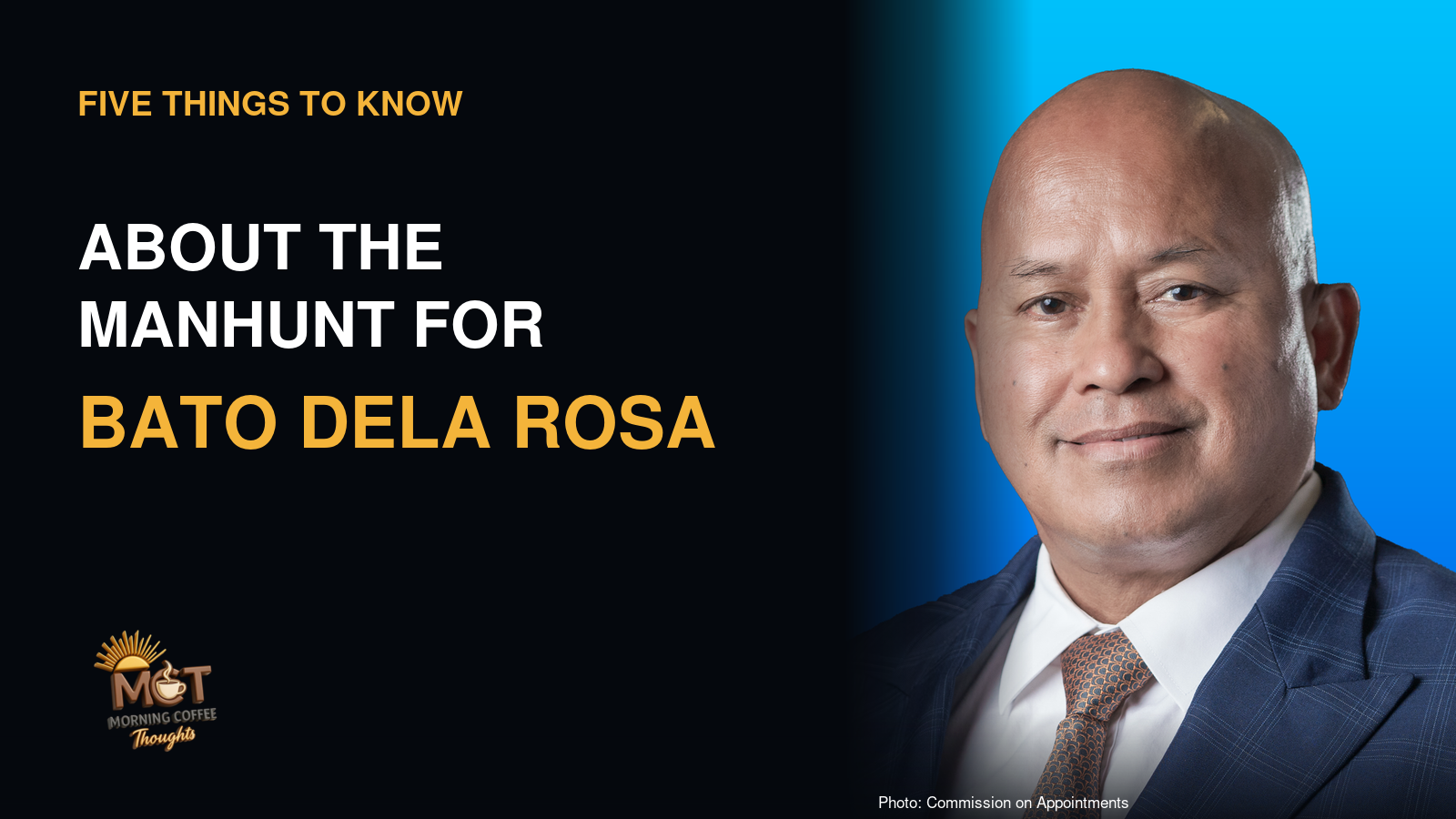
The government says it knows where Senator Ronald “Bato” dela Rosa is hiding. It also says powerful people are protecting him. For anyone following the drug-war cases, that leaves a straightforward question: if officials know where he is, why is he still beyond their custody?
The latest statements do not provide a complete answer. Interior Secretary Jonvic Remulla has described negotiations, while the police say the search continues. Dela Rosa’s lawyer says he has no personal knowledge of the alleged protectors. No confirmed arrest date has been announced in the reports available as of September 10.
There is an existing International Criminal Court warrant behind this manhunt. The new development is what officials are saying about their efforts to carry it out, and the unanswered questions those statements raise.
1
Officials claim they know his location, but have not announced an arrest
In a September 8 interview on One News’ Storycon, Remulla said authorities knew Dela Rosa’s whereabouts and were negotiating with people protecting him. He described those people as powerful. The following day, Philippine National Police spokesman Colonel Allen Rae Co said police efforts to arrest the senator would continue despite the reported negotiations.
Those statements suggest officials are doing more than waiting for a tip. They do not establish that police have secured the location, reached an agreement or set a date to take him into custody. Remulla’s account of what the government knows remains his account; the public has not been given enough information to independently confirm it.
Police have reasons to keep operational details private. Publishing a location or an intended move could endanger officers and others. Even so, the government can be asked to account for the outcome. Saying that a wanted person has been located creates an expectation that authorities will explain, when it is safe to do so, what followed.
WHAT TO WATCH
A confirmed arrest or surrender, the agency taking custody and a clear official account of what happened. Another prediction that police will catch him soon would leave the central question unanswered.
2
The ICC warrant concerns alleged drug-war murders
The warrant was issued under seal on November 6, 2025, and made public on May 11, 2026. It concerns Dela Rosa’s alleged responsibility for the crime against humanity of murder, involving at least 32 people killed between July 3, 2016, and the end of April 2018.
The allegation goes beyond whether he personally fired a weapon. The court’s account concerns an alleged shared plan and his role in killings carried out through other people. That helps explain why a former police chief can face a case over operations performed by officers under a wider chain of command.
At this stage, ICC judges found reasonable grounds to believe he was responsible. A warrant is not a conviction. The prosecution still has to establish its case through the court’s proceedings, and Dela Rosa has the right to contest the allegations and evidence.
The families behind those alleged killings are easily lost in the daily discussion of his whereabouts. Bringing a suspect before a court would allow the case to move forward. It would not, by itself, settle what happened to each victim or deliver a final judgment.
WHAT TO WATCH
The court’s actual filings and orders. Any new allegation, change in the case or ruling on responsibility should be traced to those records, rather than inferred from an arrest announcement.
3
The alleged protectors have not been publicly identified
Dela Rosa’s lawyer, Israelito Torreon, said on September 9 that he had no personal knowledge of the powerful protectors Remulla described. His response leaves the government’s allegation disputed. It does not supply the names, roles or terms of any negotiations.
That gap is important because naming someone as a protector can amount to accusing that person of helping a wanted suspect evade authorities. Political friendships, photographs together or membership in the same party would not, on their own, prove that accusation. No one should be identified on that basis.
Remulla’s statement also raises a question about equal treatment. If influence is affecting how an arrest warrant is carried out, the public deserves an explanation supported by evidence. Officials need not disclose a dangerous operational detail to eventually explain whether assistance was offered, who dealt with whom and whether any arrangement affected enforcement.
For now, there is no verified basis here to claim a particular politician is sheltering Dela Rosa or that a secret deal has been completed. Who has helped him, and what any negotiations involve, still needs to be established.
WHAT TO WATCH
Evidence identifying any alleged assistance, an official explanation of the negotiations and a response from anyone subsequently named. A name circulating online is not sufficient confirmation.
4
Police are also accounting for firearms registered to him
Police reported that 26 of the 117 firearms registered to Dela Rosa had been surrendered, leaving 91 unaccounted for. The reported total consists of 20 turned over in Davao City and six in Calabarzon. These are the figures carried in the latest reporting; the surrender process began months earlier.
The firearms issue follows the revocation of his gun licences and registrations. In June, the PNP described the Davao turnover as part of implementing that revocation and placing the weapons in safekeeping. Returning registered weapons therefore has its own purpose even while the senator remains the subject of a manhunt.
The figure of 91 does not establish that all those guns are beside him, that his alleged protectors hold them or that any particular weapon was used in a crime. The available accounting does not answer those questions. It identifies weapons police still need to locate and account for.
That is a concrete public-safety concern: authorities should know where firearms subject to a revocation order have gone. The recovery total alone does not show whether anyone is preparing to resist arrest or whether a confrontation will occur.
WHAT TO WATCH
An updated inventory of recovered weapons, where the remaining firearms are found and whether police announce any separate case based on verified evidence.
5
An arrest would begin another stage, with further court decisions ahead
If Dela Rosa is arrested, the immediate questions would include who holds him, the legal basis cited and what authorities intend to do next. Taking him into Philippine custody and transferring him to the ICC are separate events. Being held in the Philippines would not mean he had already reached The Hague.
The Department of Justice said in May that law enforcement could serve the ICC warrant after the Supreme Court denied his request for a temporary restraining order. That May ruling dealt with the request for an immediate halt. It did not decide the merits of his main petition challenging the government’s cooperation with the ICC.
If he is surrendered to the ICC, an initial appearance would address the allegations and his rights. A later confirmation-of-charges hearing would examine whether there is enough evidence to send the case to trial. The defence can challenge the prosecution’s evidence at that stage. A trial and a verdict would involve further proceedings.
For families seeking accountability, each step would be significant. None makes the next outcome automatic. The case must still be tested in court, including the evidence linking Dela Rosa to the alleged crimes.
WHAT TO WATCH
Any new Philippine court order, an official custody announcement and, if a transfer occurs, confirmation from the ICC and its hearing schedule.
BOTTOM LINE
There is a real arrest warrant and an ongoing manhunt. The government’s claim that it knows Dela Rosa’s location has sharpened the question of why he remains outside custody. Claims about powerful protectors need evidence, and the police still have firearms to account for.
The next substantial development would be a verified arrest, surrender or court order that changes what authorities can do. Until then, there is no sound basis for promising when he will be caught. Accountability requires carrying out lawful court processes and proving allegations through evidence. It cannot be supplied by another confident prediction at a press briefing.
GOOGLE PREFERRED SOURCES
FOLLOW MCT ON GOOGLE
Google’s Preferred Sources feature lets you choose publications you want Google to prioritize for you. Select “Add to Preferred Sources” to make MCT easier to find in Top Stories and other eligible Google results. This does not subscribe you to email.
SUPPORT MCT
HELP KEEP INDEPENDENT POLITICAL WRITING GOING.
Morning Coffee Thoughts is reader-supported. Contributions help pay for research tools, hosting, and the work required to verify and explain each development.