
LATEST COMMENTARY
FIVE THINGS TO KNOW
MCT READER PULSE · MCT-PULSE-2026-017
MCT READER SURVEY
Gaano ka nagtitiwala na tama ang ginagawa ng Kongreso sa budget ng bayan?
This is an informal survey of people who choose to participate. It is not a scientific or nationally representative sample.
ABOUT THE SUPREME COURT’S DECISION ON THE IMPEACHMENT VOTE THRESHOLD
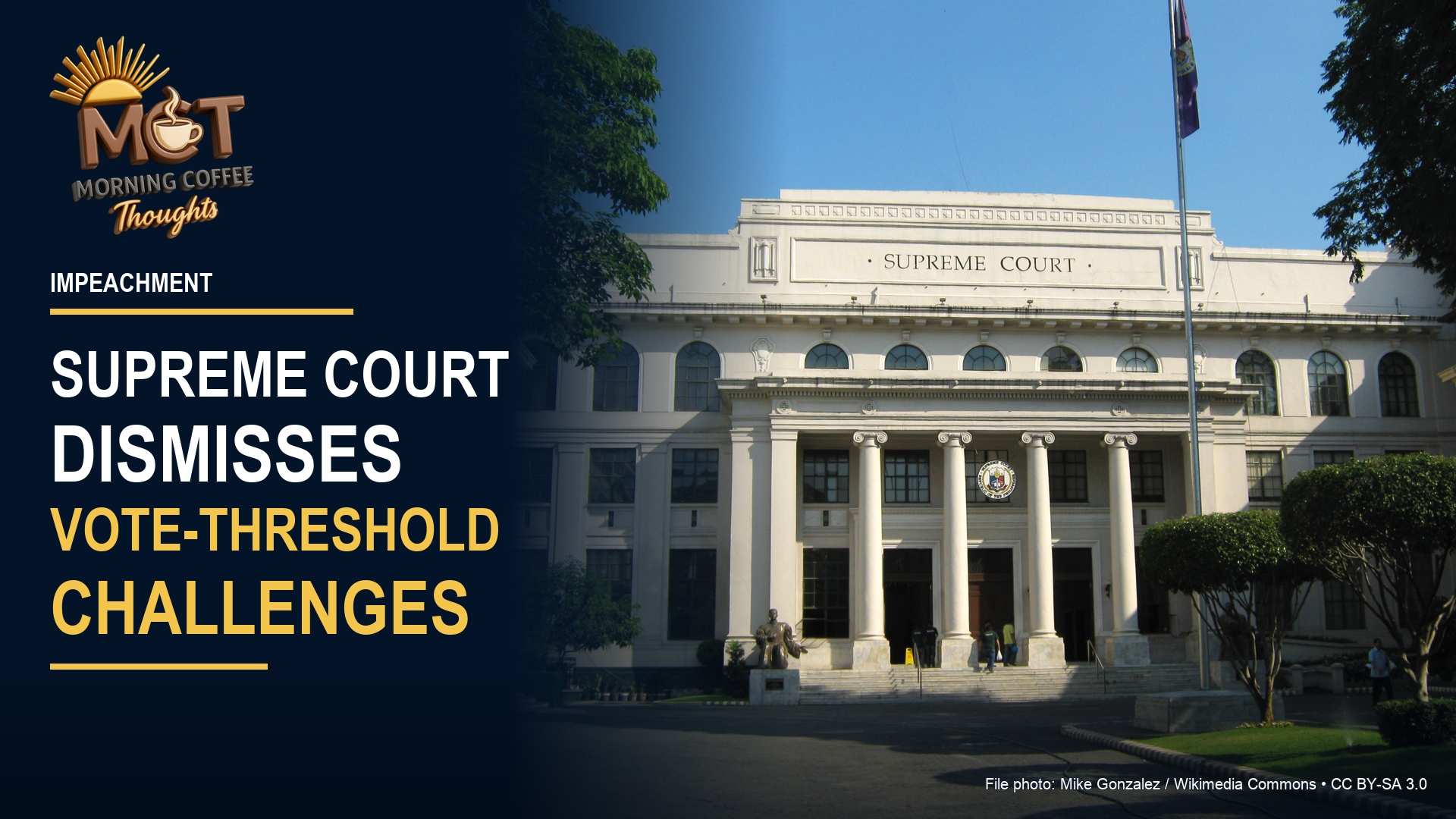
The Supreme Court dismissed three petitions on September 30 challenging how the Senate impeachment court would count the votes needed to convict Vice President Sara Duterte. The dismissal leaves the Senate’s September 23 ruling in place, but it needs to be read carefully. A case can be dismissed because it does not meet the requirements for the Court to hear it, without settling whether the challenged action is constitutional.
Here are five things to know about what happened and how it affects the trial.
1
The Court dismissed the petitions on procedural grounds
The petitions were filed separately by Victor Rodriguez, Berteni Cataluña Causing, and Ernesto Francisco Jr. According to the Supreme Court’s announcement, the grounds for dismissal included lack of standing and prematurity.
In plain language, standing concerns whether the person bringing the case has a sufficient legal interest to ask the Court to act. Prematurity concerns whether the dispute has reached the stage where the Court can properly decide it. These requirements help determine whether a case can be heard before the Court addresses the constitutional arguments.
The announcement identifies those grounds without providing a detailed explanation of how each applied to every petition.
WHAT TO WATCH
The written resolutions and any further explanation of how the procedural grounds applied to each petition.
2
The argument is about which senators count toward the two-thirds requirement
The Constitution requires the concurrence of two-thirds of all members of the Senate to convict in an impeachment case. Using a membership of 24, that means 16 votes.
On September 23, the Senate impeachment court interpreted the membership used in that calculation to include only senators who are legally and actually able to participate when the vote takes place. That interpretation could produce a lower required number.
The petitioners challenged this reading. Their position was that senators remain members even when detained, temporarily absent, or medically unable to attend. They argued that those circumstances should not reduce the membership used to calculate the required votes.
WHAT TO WATCH
How the impeachment court determines which senators qualify for inclusion when judgment is taken, and the reasons it gives for any exclusion.
3
The Supreme Court did not set a fixed 14-vote threshold
Fourteen is one possible result of the Senate’s method of counting. It is not a number established by the Supreme Court’s September 30 announcement.
For example, two-thirds of 21 is 14. If 22 senators are counted, at least 15 votes would be needed because votes cannot be split into fractions. If all 24 are counted, the requirement remains 16.
These are examples of the arithmetic. They do not establish how many senators will ultimately be counted. The Senate’s stated rule concerns their ability to participate at the time of the vote. It should not be reduced to a claim that anyone who misses a hearing automatically disappears from the calculation.
WHAT TO WATCH
The actual membership count adopted for the final vote. Any report giving a required number should explain how that number was reached.
4
The Court’s announcement does not declare the Senate’s interpretation constitutional
The petitioners sought to have the September 23 ruling overturned and asked for orders that would stop its implementation or a final conviction vote while their challenges were pending. Their petitions were dismissed, leaving the Senate’s interpretation in place.
The Court’s announcement reports a procedural dismissal and does not announce a ruling on whether the Senate’s interpretation is constitutional. Describing the outcome as a Supreme Court declaration that the Senate’s interpretation is constitutional would go beyond what the announcement says.
The immediate effect is clear: these petitions did not overturn the Senate’s ruling. Whether the constitutional argument could be heard through a later legal challenge would depend on that case and whether it meets the Court’s requirements.
WHAT TO WATCH
Whether any further challenge is filed, what it asks the Court to decide, and whether the Court agrees to hear it.
5
The threshold can affect the outcome, but this decision does not decide Duterte’s guilt
The required number of votes determines whether a conviction carries. A change in that number can affect the result even when the votes cast by individual senators stay the same.
As a simple example, 15 votes for conviction would fall short of a 16-vote requirement. Those same 15 votes would meet a 15-vote requirement. This is why the disagreement over which senators count has drawn so much attention.
Still, the Supreme Court’s dismissal does not establish that the impeachment charges have been proven. It also does not tell us how any senator will vote on those charges. The senators’ eventual judgment remains a separate decision.
WHAT TO WATCH
Each senator’s vote and explanation when judgment comes, alongside the impeachment court’s official calculation of the votes required.
BOTTOM LINE
The Supreme Court dismissed the challenges to the Senate’s voting formula on September 30, leaving that formula in place. Its announcement cited procedural grounds, including lack of standing and prematurity.
For readers following the trial, the next questions are how many senators will be counted when judgment is taken, why they are included or excluded, and whether the votes for conviction reach the resulting threshold. The claim that the Supreme Court has already declared 14 votes sufficient goes beyond what it announced.
GOOGLE PREFERRED SOURCES
FOLLOW MCT ON GOOGLE
Google’s Preferred Sources feature lets you choose publications you want Google to prioritize for you. Select “Add to Preferred Sources” to make MCT easier to find in Top Stories and other eligible Google results. This does not subscribe you to email.
SUPPORT MCT
HELP KEEP INDEPENDENT POLITICAL WRITING GOING.
Morning Coffee Thoughts is reader-supported. Contributions help pay for research tools, hosting, and the work required to verify and explain each development.