
LATEST COMMENTARY
FIVE THINGS TO KNOW
MCT READER PULSE · MCT-PULSE-2026-017
MCT READER SURVEY
Gaano ka nagtitiwala na tama ang ginagawa ng Kongreso sa budget ng bayan?
This is an informal survey of people who choose to participate. It is not a scientific or nationally representative sample.
ABOUT WHAT BASTE DUTERTE SHOULD HAVE CHECKED AS MAYOR
Davao City Mayor Sebastian “Baste” Duterte told the Senate impeachment court on September 29 that he had been unfamiliar with GenCorp Industries Inc. before it came up in the proceedings. He also said he did not know about Vice President Sara Duterte’s declared business interest in the company.
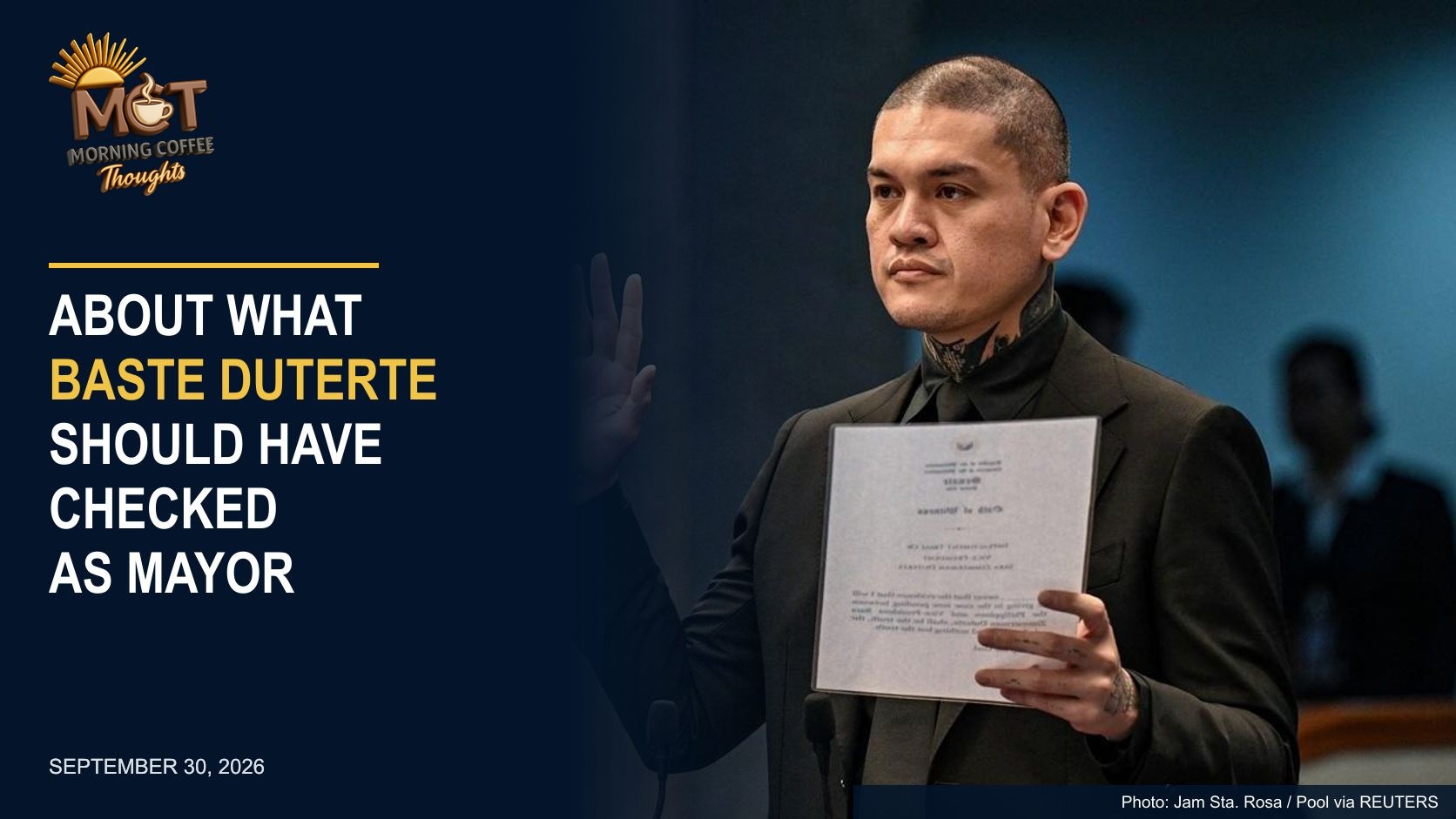
He explained that other officials handled procurement and signed contracts under delegated authority. He also acknowledged that he remained accountable.
A mayor cannot personally handle every purchase made by a city government. Even so, the job comes with duties to supervise officials, protect public funds, and ask for records when questions arise. His testimony puts those duties under scrutiny.
1
A mayor is responsible for supervising the city government
Section 455 of the Local Government Code gives a city mayor general supervision and control over the city’s programs, projects, services, and activities.
The law also gives the mayor authority to examine city records and requires him to see that executive officials carry out their duties.
That does not require memorizing every supplier’s name. It does require a working way to know whether city offices are doing their jobs, especially when spending has been questioned.
Baste’s lack of direct knowledge raises a practical question: what reports and checks were reaching his office about these transactions?
WHAT TO WATCH
Records showing what his office received, what officials reported, and what follow-up was done.
2
Delegating signing authority still requires supervision
Baste said he had authorized another official to sign contracts on his behalf.
Delegation can be allowed under applicable rules. A city government needs officials who can carry out assigned work without every document stopping at the mayor’s desk.
But the arrangement should have clear authority, limits, and reporting. During the hearing, Baste agreed that delegating his signature did not transfer all his accountability.
The question remains how he supervised the work done under that authority.
WHAT TO WATCH
The written delegation, the transactions it covered, and the reports submitted to the mayor. Delegation by itself does not establish wrongdoing.
3
A supplier’s qualifications need to be supported by records
Baste relied on the work of the Bids and Awards Committee, or BAC, in defending the city’s procurement process.
The BAC handles tasks such as assessing bids and checking whether bidders meet the applicable requirements. A mayor can rely on staff doing their assigned work, but a public assurance that a supplier was properly checked should have a basis that can be produced.
If a requirement is questioned, the useful answer is in the bidding documents and the supplier’s supporting records. An assumption that the process was followed leaves that question unanswered.
WHAT TO WATCH
The actual requirements for each questioned transaction and the records used to determine whether GenCorp met them.
4
Family links can affect whether a company is allowed to bid
Procurement rules require disclosure of certain relationships between bidders and officials involved in procurement.
Under the 2016 rules, the restriction for a corporation covers its officers, directors, and controlling stockholders who are related within the prohibited degree to specified officials. The exact role a relative holds therefore needs checking.
Baste said he did not know of Sara’s business interest in GenCorp. He also said he would have blocked the contracts had he known of her interest.
Her declared interest raises a question requiring records. It does not, by itself, settle whether she held a role covered by the disqualification rule at the relevant time.
WHAT TO WATCH
The company records, sworn disclosures, and evidence establishing the nature and timing of her interest.
5
A mayor should have a basis for publicly defending questioned contracts
Baste had defended the city’s handling of the GenCorp transactions. His testimony then exposed limits to his personal knowledge of the company and the contracts.
A mayor can ask the officials responsible for a transaction to explain how it was approved. Before making a firm public assurance, he should know what records support it and where questions remain.
That review can include the supplier’s qualifications, the reason for the award, and proof that the goods or services were delivered and paid for properly.
Saying that no problem was reported to the mayor leaves open whether the checks were thorough enough to find one.
WHAT TO WATCH
Whether the city produces records that answer the specific questions raised, and whether those records support its earlier assurances.
BOTTOM LINE
Baste’s answers leave legitimate questions about how closely his office supervised the transactions it was defending. His acknowledgment of accountability belongs alongside those gaps.
The public can expect a mayor to explain how city spending was checked. Whether any particular contract was unlawful, or any official personally liable, still requires evidence about what happened.
GOOGLE PREFERRED SOURCES
FOLLOW MCT ON GOOGLE
Google’s Preferred Sources feature lets you choose publications you want Google to prioritize for you. Select “Add to Preferred Sources” to make MCT easier to find in Top Stories and other eligible Google results. This does not subscribe you to email.
SUPPORT MCT
HELP KEEP INDEPENDENT POLITICAL WRITING GOING.
Morning Coffee Thoughts is reader-supported. Contributions help pay for research tools, hosting, and the work required to verify and explain each development.