
LATEST COMMENTARY
FIVE THINGS TO KNOW
MCT READER PULSE · MCT-PULSE-2026-017
MCT READER SURVEY
Gaano ka nagtitiwala na tama ang ginagawa ng Kongreso sa budget ng bayan?
This is an informal survey of people who choose to participate. It is not a scientific or nationally representative sample.
ABOUT WHY PROSECUTORS DROPPED THREE ARTICLES AGAINST SARA DUTERTE
Why prosecutors narrowed Sara Duterte’s impeachment case, what the court accepted, and what the choice means for the evidence and the defense.
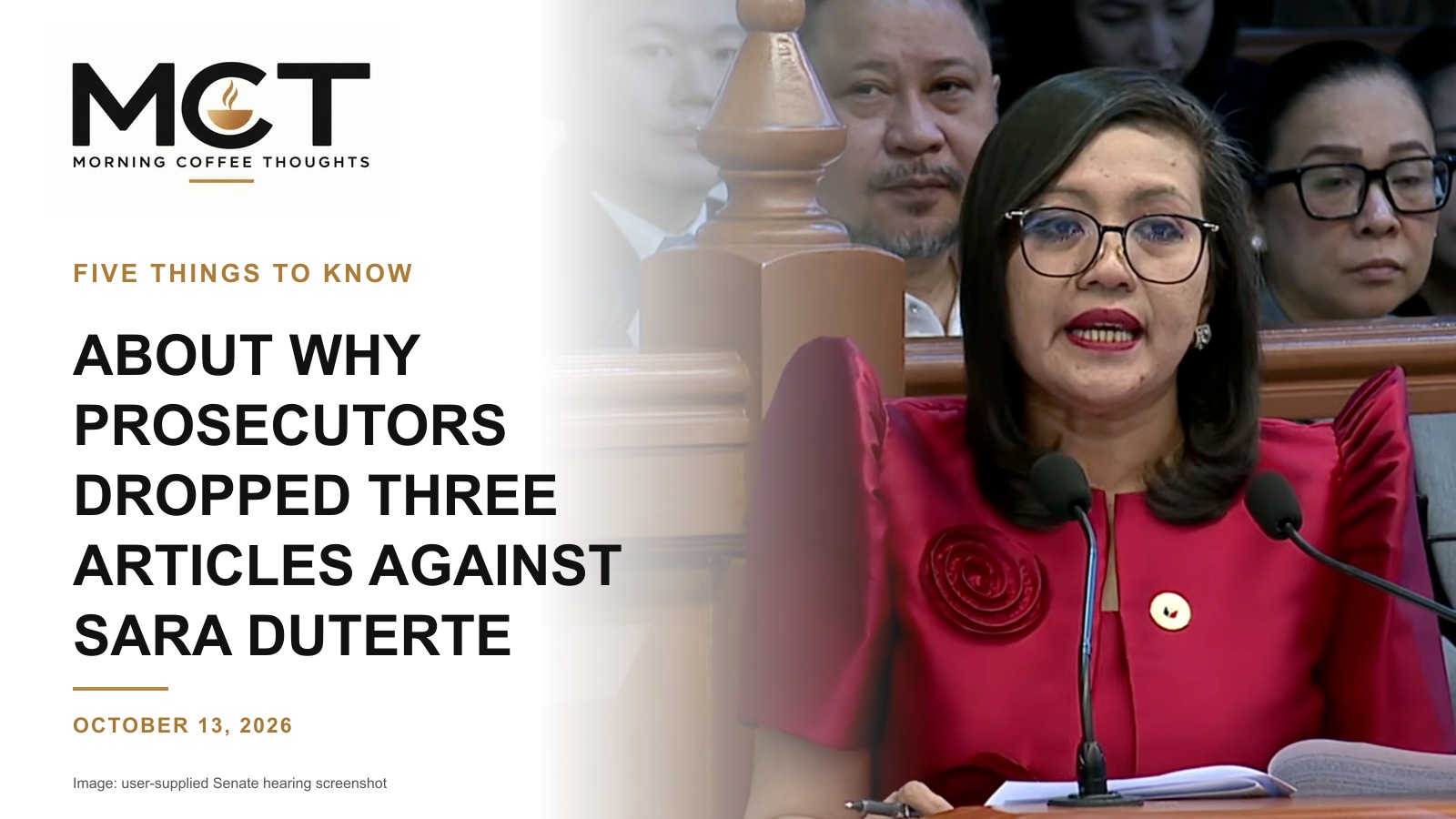
The prosecution has chosen to pursue just one of the four impeachment articles against Vice President Sara Duterte. On October 13, the Senate impeachment court accepted the withdrawal of Article I on confidential funds, Article III on bribery, and Article IV concerning alleged threats. Article II, involving alleged unexplained wealth, asset disclosures and business interests, remains.
After weeks of hearings, that decision deserves an explanation. Why spend so much time presenting allegations and then abandon three parts of the case?
The prosecution says Article II can support removal on its own and that narrowing the case will reduce the work still ahead. The defense has raised a fairness objection: the public has already heard accusations, and Duterte's lawyers want their answers heard in court. Here are five things to understand about the choice and its consequences.
1
PROSECUTORS BELIEVE ARTICLE II CAN SECURE REMOVAL ON ITS OWN
Lead House prosecutor Gerville Luistro has expressed confidence that the evidence under Article II is sufficient to support Duterte's removal. The House's October 13 statement identifies alleged unexplained wealth, failures concerning the Statement of Assets, Liabilities and Net Worth or SALN, and prohibited business interests as the remaining article's subjects.
That is the prosecution's assessment. The senator-judges still have to evaluate the evidence and the defense's answers. Withdrawal does not turn the remaining accusations into established facts.
There is a precedent for a single article deciding an impeachment case. Chief Justice Renato Corona was convicted under Article II in 2012. That helps explain why prosecutors can regard one article as sufficient to pursue removal. It cannot establish whether the evidence against a different official will withstand scrutiny.
Counting accusations is therefore a poor shortcut for judging the case. One adequately proved article can support conviction. Several accusations do not guarantee it. Readers should examine what supports the surviving grounds and how the court evaluates that evidence.
WHAT TO WATCH
The prosecution's formal offer of evidence and the court's rulings on it. A formal offer identifies the evidence a party asks the court to consider and the purpose for which it is offered. These records will help readers connect documents to particular allegations.
2
NARROWING THE CASE CAN REDUCE THE WORK STILL AHEAD
Hearing witnesses is only part of the work. Prosecutors must connect testimony and documents to the grounds they are trying to prove. The defense can object, and the court must resolve disputes over the evidence.
Luistro explained that keeping all four articles would require further work on the evidence and arguments for each. The House statement also said roughly 32 previously listed witnesses would no longer be called.
That gives the choice a practical basis. Fewer allegations to pursue can mean fewer witnesses, fewer disputed documents and a more focused set of arguments. It may help senator-judges concentrate on the financial case.
There is no verified calculation here of the hearing days or pesos the move will save. It also cannot recover the time already spent. The question is whether the additional work now avoided would have contributed enough to justify continuing all four articles.
For people frustrated by the trial's length, a shorter proceeding can be useful if it still allows a fair decision on the evidence. The defense is entitled to question whether the prosecution's proposed savings come at the expense of an adequate opportunity to answer allegations already aired.
WHAT TO WATCH
The revised witness list and hearing schedule. They will show how much work has actually been removed and whether the remaining disputes can be handled within the revised plan.
3
WITHDRAWAL WAS AN OPTION, BUT THE COURT CONTROLLED ITS EFFECT
The prosecution could ask to narrow its case. Once the articles were before the impeachment court, it could not determine every consequence simply by announcing that it would stop pursuing them.
Presiding officer Francis Escudero stressed that the articles were under the court's disposition. He subsequently announced the court's acceptance of the withdrawal. GMA News and ABS-CBN both reported that acceptance. The earlier request and the court's approved change in the trial's scope are separate events.
The Constitution gives the Senate the sole power to try and decide impeachment cases. Prosecutors decide what case to present within that process; the court determines how to act on their request and, ultimately, whether the surviving grounds have been established.
Withdrawal should not be described as a finding that every underlying allegation was fabricated or disproved. Duterte has argued that dropping the bribery article reflects a lack of evidence. Prosecutors have presented their decision as a choice to focus on Article II. Those are the parties' positions. Neither position replaces a reasoned determination of the allegations.
Any claim about reviving an article or pursuing a separate proceeding also needs the court's precise terms and the applicable law. Acceptance alone should not be stretched into a promise that all allegations can automatically return or a declaration of immunity from every other form of accountability.
WHAT TO WATCH
The written order or official record setting out the withdrawal's terms. Its wording determines the restrictions attached to each article and the scope of the remaining proceedings.
4
THE DEFENSE HAS A SUBSTANTIVE FAIRNESS OBJECTION
Lead defense counsel Sheila Sison argued that, after weeks of public accusations, the defense wanted to present its own evidence concerning the withdrawn articles. GMA News reported that position, and ABS-CBN's coverage recorded the exchanges about the defense's opportunity to answer.
Luistro pointed to the defense's opportunity to cross-examine prosecution witnesses. Sison insisted that a meaningful opportunity to answer also includes presenting the respondent's own evidence. Cross-examining another side's witness and presenting one's own records or witnesses serve different purposes.
This does not establish that the proposed defense evidence would disprove the allegations. It explains the objection: accusations have already reached the public, and the respondent wants the answers heard in the same setting.
Escudero raised the possibility of alternating prosecution and defense evidence in future proceedings to avoid this difficulty. That observation should not be treated as a completed change to the rules governing this trial.
People following the hearings should ask what was tested, what remains contested, and which allegations will receive a decision. A prosecution strategy aimed at removal may leave the public with fewer answers about other accusations raised during the trial.
WHAT TO WATCH
The court's directions on the remaining defense presentation and any official changes to the sequence of evidence. Those decisions show how it handles the opportunity to answer while keeping the proceedings within their proper scope.
5
THE FINANCIAL CASE NOW CARRIES MORE OF THE PROSECUTION'S RISK
Concentrating on Article II puts greater pressure on the financial evidence. Readers need to ask how the records establish ownership, income, liabilities, disclosure obligations and the alleged violations.
A large figure cannot answer those questions by itself. Money moving through an account needs context. An asset must be connected to the person alleged to own it. Calculations need to account for relevant liabilities and avoid counting the same value more than once.
The House statement described Alexander Cabrera's approximately ₱818 million estimate for 2022 to 2025 as conservative and discussed a broader possible figure of about ₱1.5 billion. It also acknowledged qualifications involving liabilities and tax deductions. These are prosecution-side estimates supporting allegations. They are not amounts established by a final judgment against Duterte.
The defense has challenged the scope and completeness of the financial review. Its objections should be examined against the actual records, just as the prosecution's calculations should. Confidence in an expert, or a general attack on the expert, cannot replace checking the method and documents.
Narrowing the case can improve clarity. It also reduces the prosecution's alternative routes within this trial. If Article II's evidence fails to support the grounds alleged, confidence in the choice to drop the other articles will not repair that failure.
For taxpayers and voters, the useful result is a reasoned account of what the financial records establish, where explanations hold up, and where they do not.
WHAT TO WATCH
The defense's financial records, its challenges to the calculations, and any corrections accepted during the proceedings. Then examine how senator-judges explain their conclusions about Article II.
BOTTOM LINE
The prosecution has given two connected reasons for narrowing the case: confidence that Article II can support removal, and a desire to reduce the remaining work. The court has accepted the withdrawal, making this an approved change in the trial's scope.
Whether the strategy succeeds depends on the evidence that survives scrutiny and the court's eventual decision. Calling it surrender assumes too much. Calling it a guaranteed path to conviction does the same.
The public should keep asking whether the remaining case can be proved and what answers it will receive about the withdrawn allegations. Removal and a complete public accounting of everything raised during the trial are different objectives. Pursuing one article may serve the first while leaving questions about the second.
GOOGLE PREFERRED SOURCES
FOLLOW MCT ON GOOGLE
Google’s Preferred Sources feature lets you choose publications you want Google to prioritize for you. Select “Add to Preferred Sources” to make MCT easier to find in Top Stories and other eligible Google results. This does not subscribe you to email.
SUPPORT MCT
HELP KEEP INDEPENDENT POLITICAL WRITING GOING.
Morning Coffee Thoughts is reader-supported. Contributions help pay for research tools, hosting, and the work required to verify and explain each development.