
LATEST COMMENTARY
FIVE THINGS TO KNOW
MCT READER PULSE · MCT-PULSE-2026-017
MCT READER SURVEY
Gaano ka nagtitiwala na tama ang ginagawa ng Kongreso sa budget ng bayan?
This is an informal survey of people who choose to participate. It is not a scientific or nationally representative sample.
ABOUT WHY THE OMBUDSMAN DOES NOT HAVE TO WAIT FOR COA
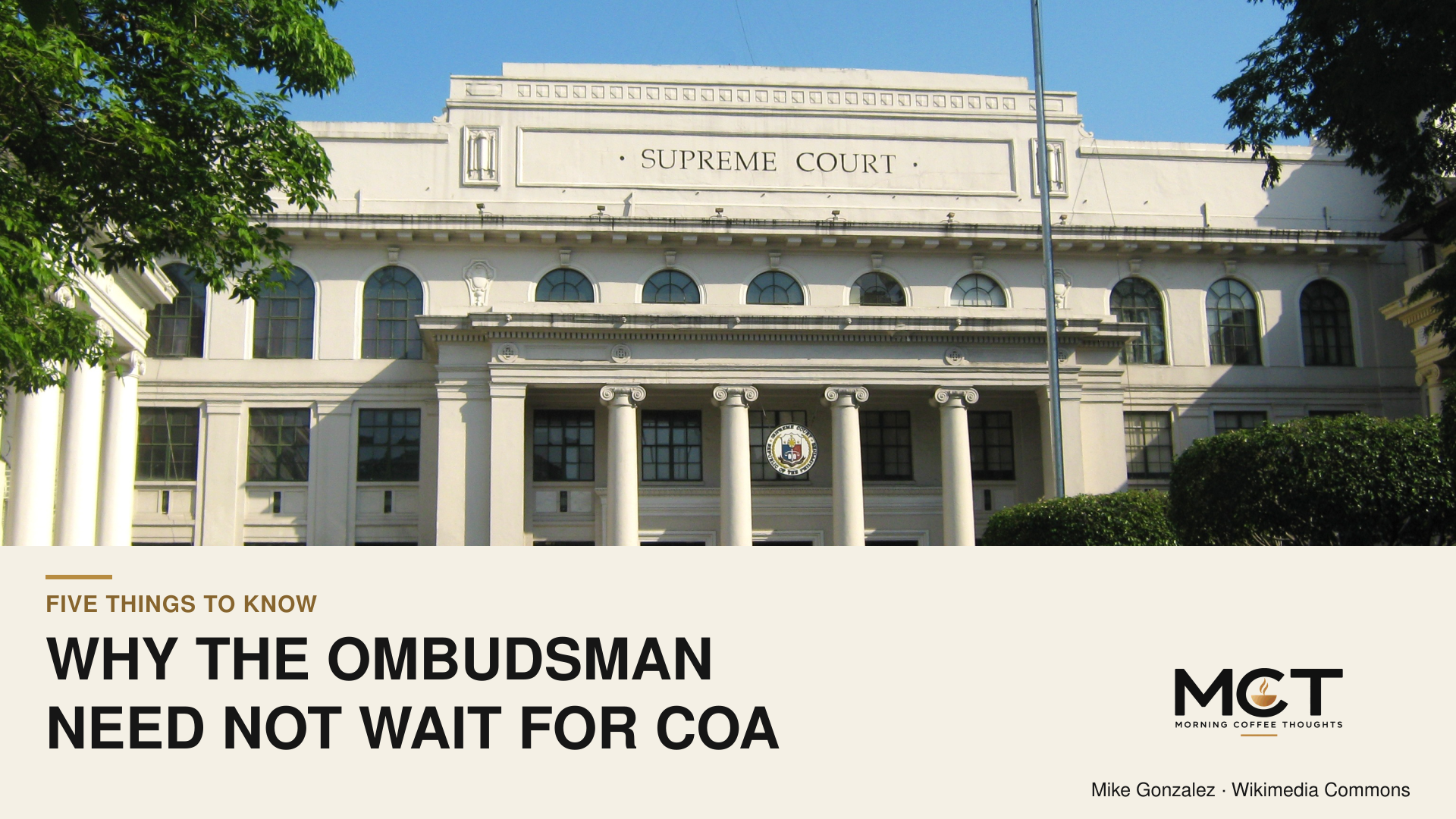
Must an investigation into public spending wait until government auditors' findings become final? The Supreme Court says no. Its October 20 summary of an April 22, 2026 decision explains the distinction.
1
THE TWO AGENCIES HAVE DIFFERENT JOBS
The Constitution assigns the Commission on Audit the task of checking government accounts, funds and property. It gives the Ombudsman authority to investigate public officials' acts that appear illegal, unjust, improper or inefficient.
Those jobs can involve the same project without becoming the same proceeding. The Ombudsman Act also allows the office to request help and information from other government agencies.
2
COA FINDINGS DO NOT HAVE TO BE FINAL FIRST
In the Palawan Malampaya Fund cases, officials argued that the Ombudsman's investigation was premature because COA's findings were not final. The Supreme Court rejected that argument.
The distinction matters when following a spending controversy. A challenge to an audit finding and an Ombudsman investigation are separate processes; the existence of one does not tell us the outcome of the other.
3
THE OMBUDSMAN STILL HAS TO CHECK THE EVIDENCE
The Court said the Ombudsman had independently checked the complaints and supporting records, including bidding documents, contracts and inspection reports. It had not simply relied on COA's conclusions.
For readers, an agency's name is not a substitute for the supporting records. Ask what documents were checked and what they establish about the particular official or transaction.
4
THE LATER COA DECISION DID NOT END THESE CASES
The officials also cited a later COA decision ordering further review. The Court said it did not make these administrative cases moot because the Ombudsman's conclusions rested on its own investigation.
That explains the outcome of these cases, not every dispute involving an audit. When reading two decisions about the same spending, check the question each answered before treating one as cancelling the other.
5
ADMINISTRATIVE LIABILITY IS NOT A CRIMINAL CONVICTION
The decision upheld administrative liability in the Palawan cases. That is not a criminal conviction.
The Constitution protects due process and separately guarantees the presumption of innocence in criminal prosecutions. An investigation, an administrative finding and a criminal judgment must not be reported as though they mean the same thing.
COA findings that are not yet final are not, by themselves, a legal bar to an Ombudsman investigation. The next questions are what evidence the Ombudsman has and what it has actually decided.
SOURCES
- Supreme Court, official summary, October 20, 2026https://sc.judiciary.gov.ph/sc-ombudsman-need-not-wait-for-coa-findings-to-probe-officials/
- 1987 Constitution, Articles IX-D, XI and IIIhttps://elibrary.judiciary.gov.ph/thebookshelf/showdocs/3/353
- Republic Act No. 6770, Section 15https://elibrary.judiciary.gov.ph//thebookshelf//showdocs/2/2100
GOOGLE PREFERRED SOURCES
FOLLOW MCT ON GOOGLE
Google’s Preferred Sources feature lets you choose publications you want Google to prioritize for you. Select “Add to Preferred Sources” to make MCT easier to find in Top Stories and other eligible Google results. This does not subscribe you to email.
SUPPORT MCT
HELP KEEP INDEPENDENT POLITICAL WRITING GOING.
Morning Coffee Thoughts is reader-supported. Contributions help pay for research tools, hosting, and the work required to verify and explain each development.