
LATEST COMMENTARY
FIVE THINGS TO KNOW
MCT READER PULSE · MCT-PULSE-2026-017
MCT READER SURVEY
Gaano ka nagtitiwala na tama ang ginagawa ng Kongreso sa budget ng bayan?
This is an informal survey of people who choose to participate. It is not a scientific or nationally representative sample.
WHY GOVERNMENT DEBT ROSE BY ₱53.47 BILLION IN SEPTEMBER
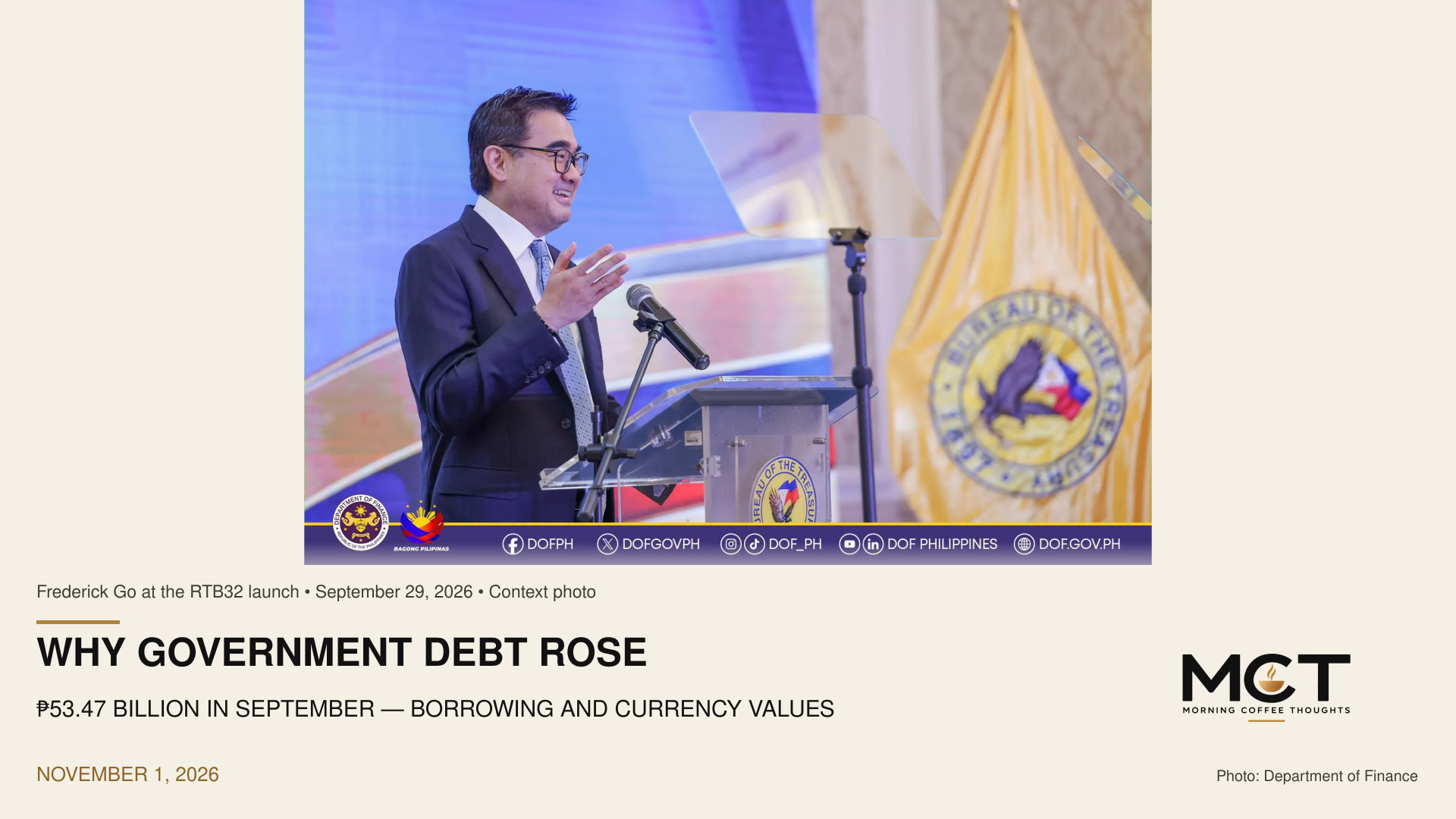
The national government's debt reached ₱19.66 trillion at the end of September 2026. The Bureau of the Treasury's October 30 release shows that much of the month's increase came from changes in currency values. Separating that from net borrowing helps explain what the government actually added to its obligations and what a weaker peso did to the balance.
1
THE ₱53.47 BILLION IS ONE MONTH'S INCREASE
Treasury reported ₱19,660.30 billion in outstanding debt at the end of September, up from ₱19,606.83 billion at the end of August. The increase was ₱53.47 billion, or 0.27 percent, using the release's published figures. Those figures describe the balance at the end of September, even though the report came out in October.
A debt balance can change for different reasons. Government can borrow, repay some of what it owes, or record a different peso value for an existing foreign-currency obligation. Reading the monthly increase as one new loan would mix those movements together.
2
NET FINANCING ADDED ₱16.93 BILLION
The release attributes ₱7.66 billion to net issuance of domestic government securities and ₱9.27 billion to net external loan borrowing. Adding them gives ₱16.93 billion. Here, “net” means the increase after repayments, rather than the full amount raised before repayments are deducted.
Think of an illustrative borrower who takes a new ₱100 loan and repays ₱60 of earlier debt. The net increase from those transactions is ₱40, even though the borrower received ₱100 in new funds. The same distinction helps explain why a net borrowing figure cannot tell us the total amount borrowed during the month.
3
CURRENCY MOVEMENTS ADDED A NET ₱36.54 BILLION
Treasury lists three currency effects: ₱1.12 billion added to domestic Onshore Dollar Bonds, ₱40.12 billion added to the peso value of external foreign-currency debt, and a ₱4.70-billion reduction from favorable movements in other currencies against the US dollar. Together, those produce a net increase of ₱36.54 billion.
That calculation accounts for about 68 percent of September's ₱53.47-billion increase, using the rounded figures in the release. The ₱36.54 billion reflects a change in the peso value of recorded debt obligations. It is not additional loan money that arrived for government to spend.
4
A DOLLAR OBLIGATION CAN GROW IN PESO TERMS WITHOUT GROWING IN DOLLARS
For a simple illustration, an unchanged US$1 million debt is worth ₱62 million at ₱62 to the dollar. At ₱63 to the dollar, the same debt is worth ₱63 million. The dollar amount stayed the same, while its peso value rose by ₱1 million.
Where a debt is classified also does not settle which currency it uses. September's release places Onshore Dollar Bonds under domestic debt, and records a currency-related increase there. The word “domestic” alone therefore cannot tell a reader that an obligation is protected from exchange-rate changes.
5
THE HIGHER PESO VALUE CAN STILL AFFECT PUBLIC FINANCES
A valuation increase brings no new money to spend, but the repayment obligation remains. If the government needs more pesos to buy the foreign currency due when payment comes, that can raise the peso cost of repayment. The actual cost depends on payment dates, exchange rates and how the currency exposure is managed.
An IMF working paper on public-debt currency risk explains how exchange-rate movements can raise both the local-currency debt balance and debt-servicing costs. For the public, that means checking the repayment bill alongside the borrowing figures. More revenue used to meet a higher repayment cost leaves less room for other spending unless government finds additional revenue, savings or financing.
BOTTOM LINE
Using Treasury's published September figures, ₱16.93 billion in net financing and ₱36.54 billion in net currency effects account for the ₱53.47-billion increase. Keeping those amounts separate lets the public ask two different questions: how much additional financing government took on, and how much more existing obligations cost when counted in pesos.
SOURCES
- Bureau of the Treasury. National Government Debt Reaches P19.66 Trillion as of End-September 2026. October 30, 2026.https://www.treasury.gov.ph/wp-content/uploads/2026/10/NG-Debt-Press-Release-September-2026.pdf
- International Monetary Fund. Managing Foreign Exchange Rate Risk: Capacity Development for Public Debt Managers in Emerging Market and Low-Income Countries. Working Paper 2024/167.https://www.imf.org/-/media/files/publications/wp/2024/english/wpiea2024167-print-pdf.pdf
- International Monetary Fund and World Bank. Revised Guidelines for Public Debt Management. 2014.https://thedocs.worldbank.org/en/doc/480221510086905662-0340022017/render/PDMPublicationPolicyPaperRevisedGuidelinesforPublicDebtManagement.pdf
GOOGLE PREFERRED SOURCES
FOLLOW MCT ON GOOGLE
Google’s Preferred Sources feature lets you choose publications you want Google to prioritize for you. Select “Add to Preferred Sources” to make MCT easier to find in Top Stories and other eligible Google results. This does not subscribe you to email.
SUPPORT MCT
HELP KEEP INDEPENDENT POLITICAL WRITING GOING.
Morning Coffee Thoughts is reader-supported. Contributions help pay for research tools, hosting, and the work required to verify and explain each development.