
LATEST COMMENTARY
FIVE THINGS TO KNOW
MCT READER PULSE · MCT-PULSE-2026-017
MCT READER SURVEY
Gaano ka nagtitiwala na tama ang ginagawa ng Kongreso sa budget ng bayan?
This is an informal survey of people who choose to participate. It is not a scientific or nationally representative sample.
HOW THE NEW CLASS-SUSPENSION RULES WORK
Executive Order No. 130 sets out three ways to suspend classes, conditions for a safe return, and learning-continuity requirements. Here is what families should check in school and local-government announcements.
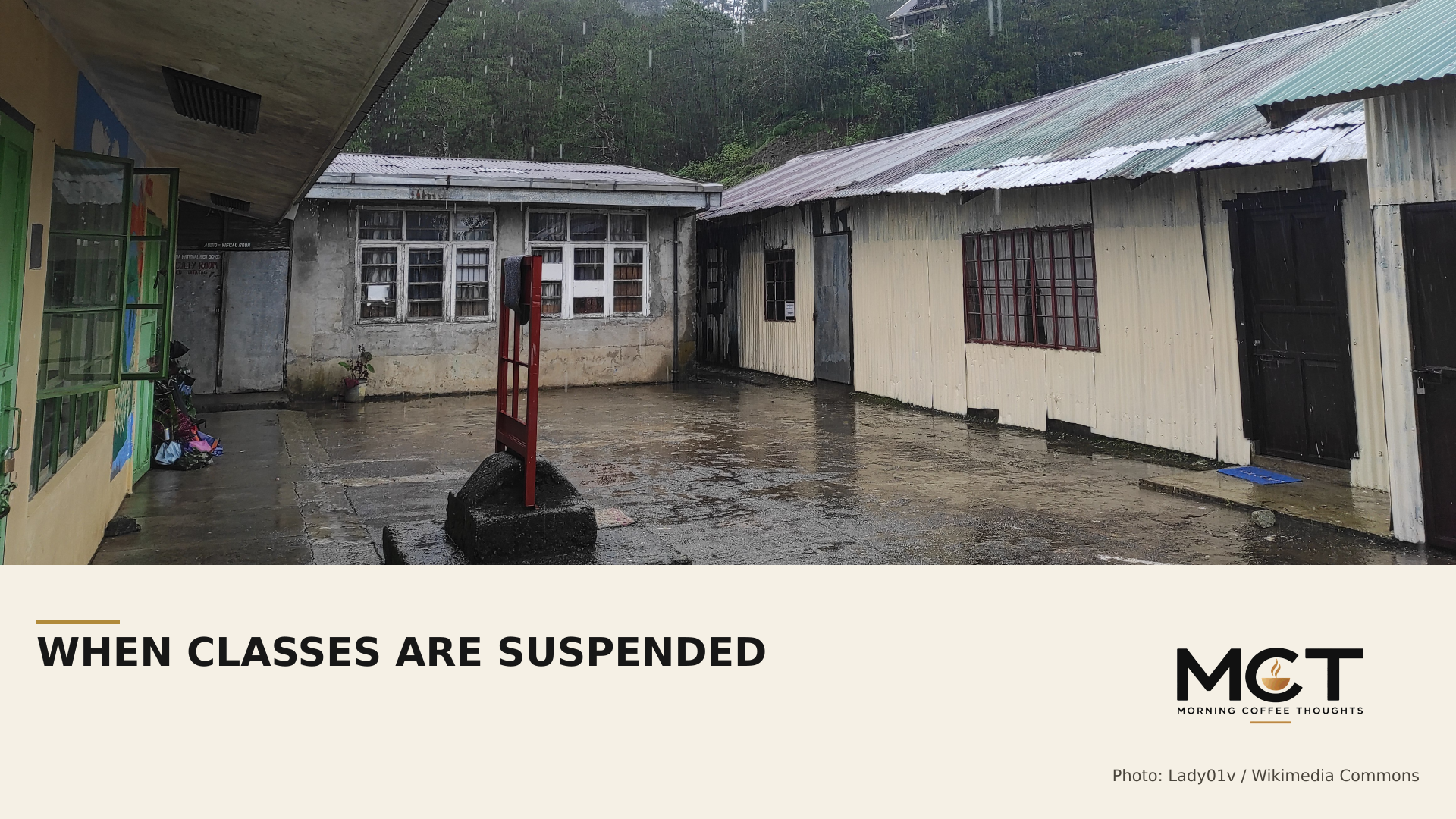
Five Things · November 4, 2026
A suspension announcement can leave families with several questions: Is our school covered? Are lessons continuing at home? Who decides when it is safe to return?
Executive Order No. 130, signed on October 28 and announced by the Palace on November 3, sets out a framework for suspending and resuming in-person classes, school activities and onsite work in public and private educational institutions and learning centers. It recognizes that conditions can differ between communities and even between schools in the same locality.
Here are five things to understand about the order and the decisions families will need to follow.
1
There are three ways a suspension can be declared
The framework distinguishes automatic, localized and school-level suspensions.
Automatic suspension is tied to official hazard information and the technical thresholds prescribed under the framework. Localized suspension is a decision by the concerned local chief executive, based on conditions and documented risk in the affected area when no applicable automatic suspension is in force.
The third route is a granular, or school-level, suspension. It allows an institution to respond to a documented threat specific to its location, subject to the order's conditions and coordination requirements.
These routes answer different questions. An official hazard warning provides technical information about a hazard. A local assessment considers how that hazard affects a community. A school assessment examines conditions that may be specific to the institution and its surroundings.
For a family reading an announcement, the useful details are which places and schools it covers, which activities are suspended, and how long the decision applies. An announcement for one area should not be assumed to cover every nearby school.
2
A school can act on a specific threat, but it must coordinate
Section 4 allows a duly authorized school official to declare a granular suspension when an actual or imminent threat to learners or personnel is established through documented, site-specific conditions.
This route applies in the absence of an applicable automatic suspension or localized suspension declared by the concerned local chief executive. The school must coordinate with that local official.
The distinction matters when conditions are uneven. A problem affecting a particular campus can require action even when the wider locality has not suspended classes. The order gives schools a way to address that situation through an assessment and a recorded decision.
It does not mean that an informal message or a general claim that an area is unsafe automatically establishes a school suspension. Families should check announcements from the institution's authorized officials and the relevant local authorities to see which decision applies.
3
Returning early requires safety evidence and local concurrence
Suspending classes and resuming them involve separate decisions.
Under Section 5, a school seeking to resume while a localized suspension remains in force needs the concurrence of the concerned local chief executive. It must also have a documented, site-specific safety assessment.
That assessment includes safe and unimpeded access to and from the institution. A campus can be usable while the route to it remains affected. Looking only at the condition of the classrooms would miss that part of the requirement.
The Palace's explanation also states that automatic and localized resumption remain subject to the required safety assessments and inspections. A warning being lifted or a suspension period ending should therefore be read together with the applicable safety requirements and any official resumption instructions.
For parents and staff, the practical question is whether the return has been authorized under the relevant mechanism and whether safe access has been considered.
4
Suspending in-person classes does not automatically stop all learning
Section 3 distinguishes suspension of physical attendance from suspension of learning.
Institutions are directed to use learning-continuity measures whenever feasible and appropriate, consistent with the policies of the agencies that supervise them. The condition matters: the order does not say that every disruption must become an online class, regardless of circumstances.
Families need clear instructions from their school about the arrangement that applies. That includes the learning materials or activities to use, how instructions will reach students, and whom to contact when access is a problem.
The framework aims to protect both safety and learning time. Whether a particular arrangement is workable depends on the hazard, the affected learners and the relevant education policies. A suspension notice alone does not answer every question about the day's lessons.
5
Detailed thresholds and procedures belong in the implementing guidelines
EO 130 directs DepEd to coordinate with the other concerned agencies and issue implementing guidelines within 30 days from the order's effectivity. The required guidelines cover the detailed thresholds and procedures used to apply the framework.
The order takes effect upon publication in the Official Gazette or a newspaper of general circulation. Its signing date and the date of the Palace announcement should not automatically be substituted for that publication trigger when calculating a deadline.
The new framework should also not be read as a fresh list of storm-signal, rainfall, heat or other numerical cutoffs. Families should follow the applicable official hazard advisories, education issuances and school or local-government announcements rather than infer a threshold from a general news summary.
The central change is a more specific basis for decisions: the hazard, the affected place, the institution's conditions and the requirements for a safe return. Clear announcements and documented coordination will determine how useful that framework is on the next disrupted school day.
SOURCES
- Official Gazette, Executive Order No. 130, s. 2026, signed October 28, 2026https://www.officialgazette.gov.ph/2026/10/28/executive-order-no-130-s-2026/
- Signed published order, Sections 3–5, 7 and 12https://www.officialgazette.gov.ph/downloads/2026/10oct/20261028-EO-130-FRM.pdf
- Presidential Communications Office, via Philippine Information Agency, November 3, 2026https://pia.gov.ph/news/president-marcos-signs-eo-establishing-unified-rules-on-class-suspensions-resumption/
- EDCOM 2, explanation of EO 130, November 3, 2026https://edcom2.gov.ph/eo-130-replaces-blanket-class-suspensions-policy-with-area-and-school-level-decisions/
GOOGLE PREFERRED SOURCES
FOLLOW MCT ON GOOGLE
Google’s Preferred Sources feature lets you choose publications you want Google to prioritize for you. Select “Add to Preferred Sources” to make MCT easier to find in Top Stories and other eligible Google results. This does not subscribe you to email.
SUPPORT MCT
HELP KEEP INDEPENDENT POLITICAL WRITING GOING.
Morning Coffee Thoughts is reader-supported. Contributions help pay for research tools, hosting, and the work required to verify and explain each development.