
LATEST COMMENTARY
FIVE THINGS TO KNOW
MCT READER PULSE · MCT-PULSE-2026-017
MCT READER SURVEY
Gaano ka nagtitiwala na tama ang ginagawa ng Kongreso sa budget ng bayan?
This is an informal survey of people who choose to participate. It is not a scientific or nationally representative sample.
FIVE THINGS ABOUT VICTIM PARTICIPATION IN DUTERTE’S ICC TRIAL
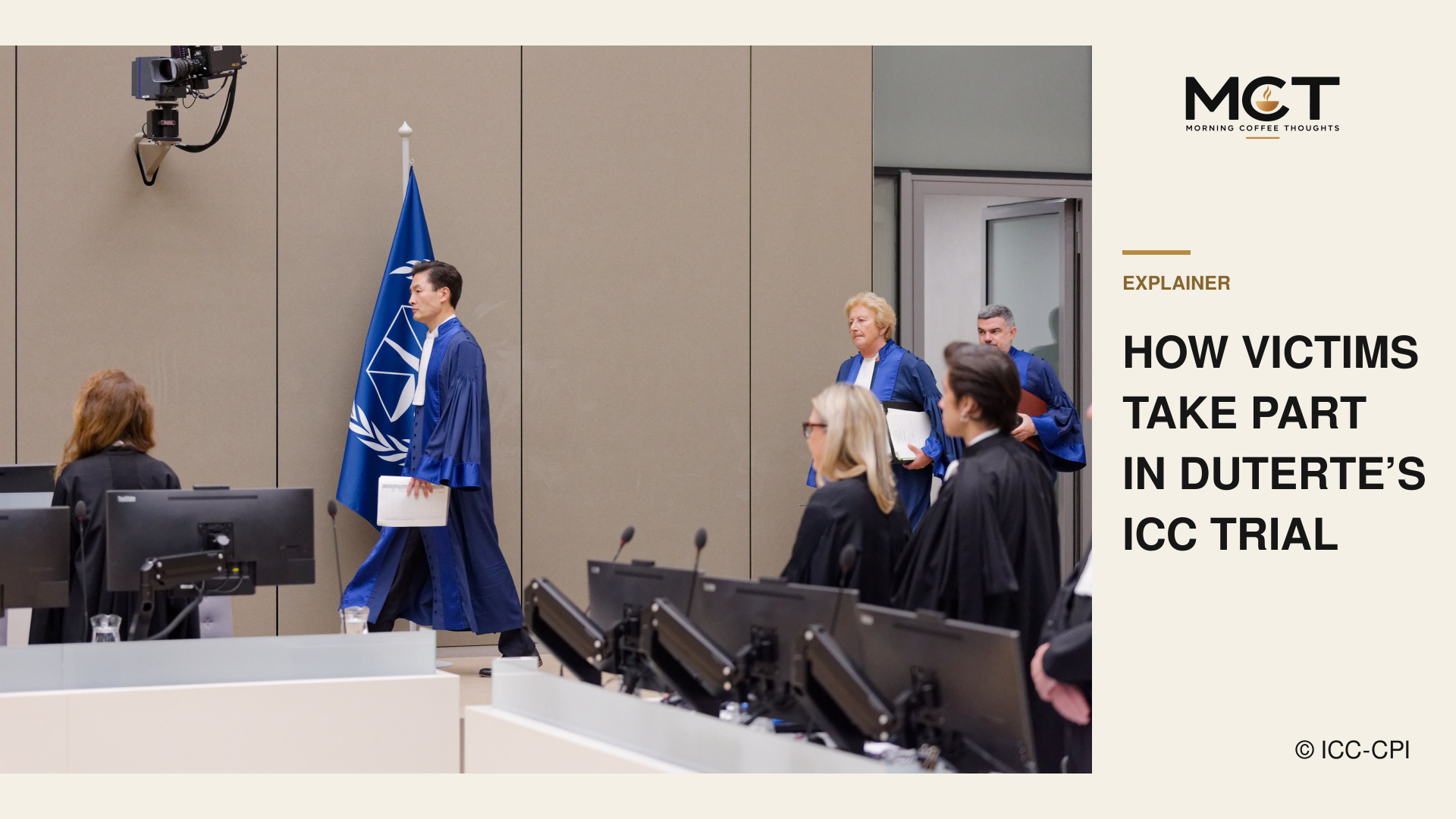
A new Registry report has put victim applications back in focus ahead of Rodrigo Duterte’s trial at the International Criminal Court. The October 29 filing assesses 50 applications. It does not announce that 50 people have been admitted to the trial.
For families seeking a place in the proceedings, the distinction has practical consequences. An application has to be assessed against the crimes covered by the case, and the judges decide whether to admit it. Even after admission, participation has a different purpose from giving witness testimony or receiving compensation.
Here are five things to understand before the trial’s scheduled opening on November 30.
1
THE REGISTRY SCREENS APPLICATIONS; THE JUDGES DECIDE
The Registry’s Victims Participation and Reparations Section helps process applications. It checks whether they are complete and whether the harm described is connected to crimes covered by the case.
Its screening system has three groups. Group A contains applications it considers clearly eligible. Group B contains those it considers outside the case’s scope. Group C contains applications on which it cannot make a clear determination. Those classifications help the judges assess the applications; they do not replace the judges’ decision.
In the October 29 report, the Registry classified 46 complete applications as Group A and four as Group C. It asked for judicial guidance on the unresolved applications. Calling all 50 “newly admitted victims” would skip that decision.
There is another counting problem: the court permits both individual and household application forms. The number of forms cannot simply be reported as the number of people.
2
ELIGIBILITY DEPENDS ON THE CRIMES INCLUDED IN THIS CASE
A person seeking participation must show a connection between the harm suffered and the crimes charged. The process therefore requires more than establishing that someone was affected by the wider anti-drug campaign.
The October 29 report also raises questions about people already authorized to participate. Following the Chamber’s October 9 decision on the charges, the Registry preliminarily identified at least 13 earlier applications, involving 16 participants, as outside its understanding of the trial’s scope.
The Registry said it would finalize its review after the judges’ decision and any clarification. It did not report that the judges had excluded those 16 people. Subtracting them from the earlier participation total would turn an unfinished assessment into a final result.
For families, a decision about the limits of this particular case must also be distinguished from a finding that no harm occurred. The participation process asks whether the harm fits the case before these judges.
3
VICTIMS HAVE THEIR OWN LEGAL VOICE
Participating victims can present their views and concerns when their personal interests are affected, usually through lawyers. Their representatives speak for those interests independently of the prosecution and defense.
The judges determine when and how that participation takes place. Lawyers may make written or oral submissions and, when permitted, question witnesses. Participation does not give every applicant an unrestricted opportunity to address the courtroom or direct the prosecution.
The ICC’s October 30 trial advisory illustrates the separate roles. It schedules opening statements from the prosecution and the victims’ common legal representatives, followed by the defense if it requests to make one. The victims’ representatives have been allotted three hours for their opening statement; the prosecution has six.
This gives families a formal route to raise concerns through their lawyers without requiring every participating victim to travel to The Hague.
4
A PARTICIPANT IS NOT AUTOMATICALLY A WITNESS
A participating victim presents views and concerns through the process the judges allow. A witness gives evidence and answers questions. One person can have both roles, but admission as a participant does not automatically make that person a prosecution witness.
That difference helps explain why an application count is not a measure of how much trial evidence has been proved. The judges still have to assess the evidence supporting the charges and the defense’s response.
Duterte remains presumed innocent. Under Article 66 of the Rome Statute, the prosecution carries the burden of proving guilt, and conviction requires proof beyond reasonable doubt. Article 68 also requires victim participation to respect the accused’s rights and a fair, impartial trial.
Recognizing a person’s right to participate does not decide whether Duterte is criminally responsible for the alleged harm.
5
PARTICIPATION DOES NOT GUARANTEE REPARATIONS
Reparations are a separate process through which the court can order redress for harm. After a conviction, judges may order reparations relating to the crimes for which the person was convicted. Depending on the case, these can include compensation, rehabilitation or other measures.
Being admitted as a participant is not a promise of payment. Conversely, the ICC’s guidance for the Duterte case says a person does not have to participate in the pre-trial or trial proceedings to apply for reparations.
Families therefore need to distinguish three decisions: acceptance of an application to participate, the verdict on the accused, and any later reparations decision. None should be announced merely because the preceding step has taken place.
BOTTOM LINE
The October 29 filing shows how the Registry is assessing applications and which questions it wants the judges to resolve. The trial will separately determine whether the prosecution proves its case.
Victim participation gives affected people a legal voice in that process. Accurate reporting must preserve both that role and the decisions that remain unfinished: who qualifies to participate, what the evidence proves, and whether reparations can eventually be ordered.
SOURCES
- ICC Registry, October 29, 2026: First Registry Report on Group A and C Applications for Victim Participation in Trial Proceedings. Original public redacted report, paragraphs 1, 7, 17–19 and 28–29.
- ICC: Information for victims in the Duterte case, including application assessment, household forms and reparations guidance.
- ICC: Victims and their participation in proceedings.
- ICC: Victims’ information booklet, explaining the distinction between participation and witness testimony.
- ICC, October 30, 2026: Opening of the Duterte trial on November 30: practical information.
- Rome Statute, Articles 66, 68(3) and 75.
GOOGLE PREFERRED SOURCES
FOLLOW MCT ON GOOGLE
Google’s Preferred Sources feature lets you choose publications you want Google to prioritize for you. Select “Add to Preferred Sources” to make MCT easier to find in Top Stories and other eligible Google results. This does not subscribe you to email.
SUPPORT MCT
HELP KEEP INDEPENDENT POLITICAL WRITING GOING.
Morning Coffee Thoughts is reader-supported. Contributions help pay for research tools, hosting, and the work required to verify and explain each development.