
LATEST COMMENTARY
FIVE THINGS TO KNOW
MCT READER PULSE · MCT-PULSE-2026-017
MCT READER SURVEY
Gaano ka nagtitiwala na tama ang ginagawa ng Kongreso sa budget ng bayan?
This is an informal survey of people who choose to participate. It is not a scientific or nationally representative sample.
ABOUT THE PROPOSED PORK-TARIFF INCREASE AND WHAT IT COULD MEAN FOR YOUR FOOD BUDGET
What the DA proposes, why hog raisers want help, and why the effect on household food costs is not yet settled.
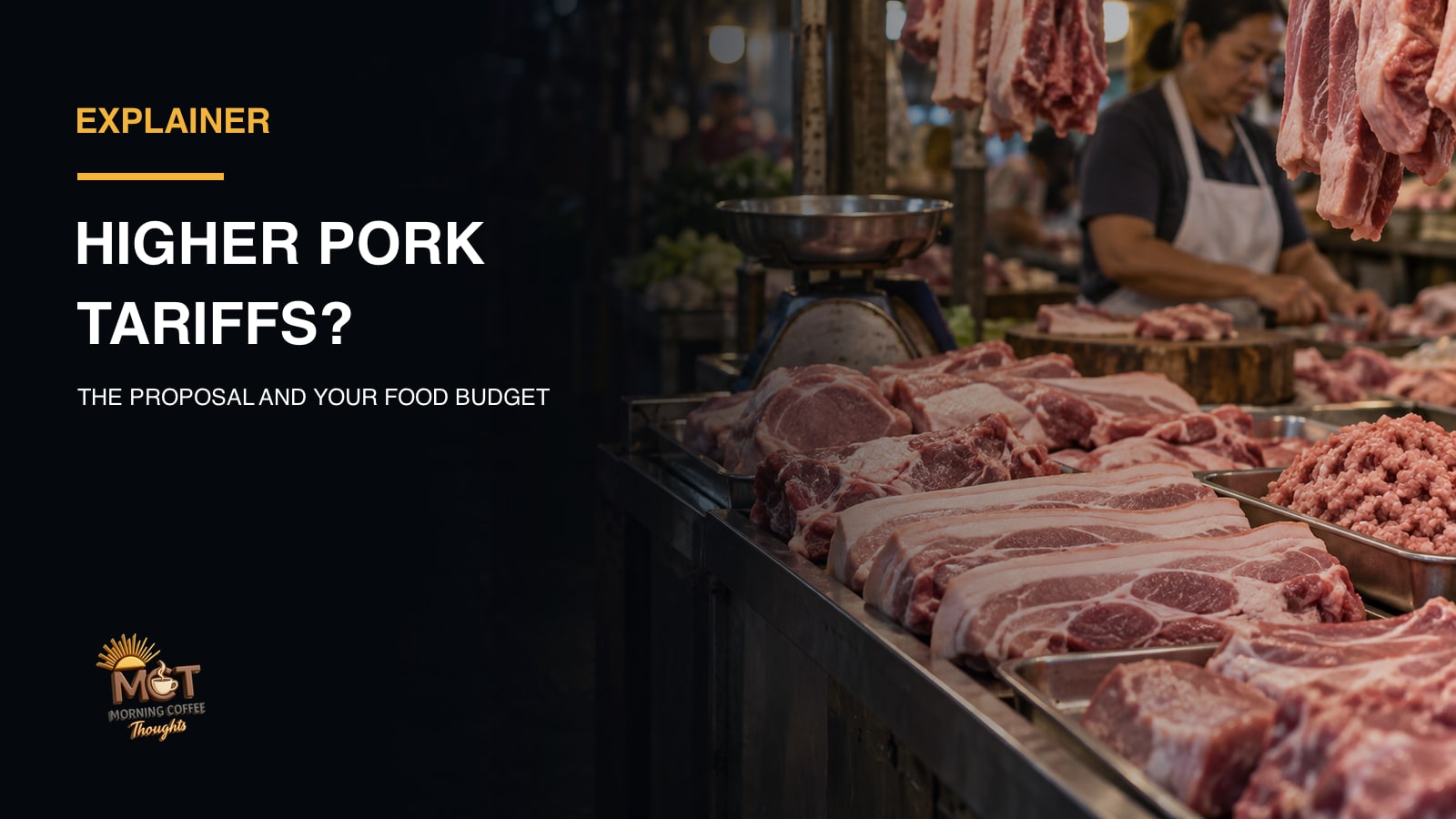
The Department of Agriculture wants to raise tariffs on imported pork to help local hog raisers facing falling farmgate prices. The proposal would increase rates in stages in 2027 and 2028. It is not a new tariff already being collected.
For a family buying pork, the question is what this could do to the food budget. For a raiser, it is whether selling prices will cover the cost of keeping the farm operating. A useful explanation needs to consider both, without pretending the final outcome is already known.
Here are five things to know.
1
1. THE ANNOUNCEMENT IS A PROPOSAL, NOT AN IMPLEMENTATION NOTICE
Agriculture Secretary Francisco Tiu Laurel Jr. said he had discussed with President Ferdinand Marcos Jr. a proposed return to pre-African swine fever pork-tariff levels. The DA's September 25 announcement describes a phased increase.
That status matters. Discussion of a policy does not establish its final terms or make it immediately enforceable. The announcement does not support saying importers are already paying the proposed higher rates, or that a new retail price now applies because of them.
Consumers and businesses need the final approval, coverage and implementation date before treating the proposal as a completed change. Those details should remain separate from the government's stated intention to help producers.
WHAT TO WATCH
The formal issuance setting the rates and effective dates. A meeting or announcement is not a substitute for the final policy document.
2
2. THERE ARE TWO TARIFF CATEGORIES AND TWO PROPOSED STAGES
The proposed 2027 rates are 25% for in-quota imports and 35% for out-quota imports, compared with the current 15% and 25%. The proposed 2028 rates are 30% and 40%.
In-quota and out-quota distinguish imports within and beyond the applicable quota. They do not describe the share of pork on a family's plate, and a tariff rate is not an announced percentage increase in retail prices.
The arithmetic also needs care. Moving from 15% to 25% is a ten-percentage-point increase, not an increase equal to only 10% of the old rate. Combining the categories into one headline number would lose an important part of the proposal.
WHAT TO WATCH
Both categories in the final schedule, rather than a headline quoting only one rate. Also check whether the dates and product coverage remain the same when the proposal becomes a formal decision.
3
3. THE DA'S CONCERN IS THE PRICE RECEIVED BY RAISERS
The DA says farmgate prices fell from ₱215 per kilogram in June 2025 to ₱150 in August 2026. It also reports that local hog production grew 6% in the first half of 2026 while imports and inventories reached high levels.
Farmgate prices are not the prices of particular pork cuts at a meat stall. A comparison between the two must not pretend they refer to the same product at the same stage of sale.
The figures explain why producers are asking for help, but they do not answer every question about their finances. How much does production cost? Which raisers are struggling most? Would the proposed measure reach them? Those are questions the policy needs to address, not findings established by the announcement.
WHAT TO WATCH
Selling prices alongside production costs. A rise in receipts alone would not establish that a farm has returned to a sustainable margin.
4
4. TARIFFS ARE ONLY PART OF THE INDUSTRY'S REQUESTS
Industry representatives also proposed closer scrutiny of imported meat and shipment declarations, measures against undervaluation, and time-bound import restrictions. The DA is separately seeking a tariff line for frozen pork jowls. These remain proposals, not confirmation that every measure has been approved.
These requests should not be folded into one broad promise that the industry will recover. Checking a shipment, correcting its declared value and changing an import-duty rate involve different decisions. Each needs a stated purpose and a way to judge its result.
For readers, the useful follow-up is not simply whether government accepted an industry recommendation. It is what was adopted, who will implement it and what evidence will show whether it worked.
WHAT TO WATCH
Separate decisions for separate measures. A long list of possible remedies does not establish that any of them is operating successfully.
5
5. PRODUCER GAINS AND HOUSEHOLD COSTS BOTH NEED TO BE MEASURED
The announcement does not establish the retail price that would follow implementation. It would be misleading to promise an exact increase or reduction for every kilogram of pork.
The questions to put to the proposal are practical: What benefit is expected for local raisers? What additional cost could consumers face? What would government do if farmgate income did not improve but retail prices rose? These are possible outcomes to examine, not predictions that they will occur.
Success should not be declared solely because one rate changed. Readers need a way to see whether the intended beneficiaries were helped and what happened to the households buying the product.
WHAT TO WATCH
Farmgate and retail-price reports, supply information and a clear policy review if the increase is approved. The producer's position and the consumer's position should both remain visible.
BOTTOM LINE
The DA is trying to address falling farmgate prices while domestic production recovers. But the proposed schedule is not yet an implemented increase, and the eventual effect on retail prices is not established.
It is reasonable to ask how local hog raisers can stay in business. It is equally reasonable to ask who will carry any additional cost. The proposal needs answers to both before it can be judged by its results.
SOURCES
GOOGLE PREFERRED SOURCES
FOLLOW MCT ON GOOGLE
Google’s Preferred Sources feature lets you choose publications you want Google to prioritize for you. Select “Add to Preferred Sources” to make MCT easier to find in Top Stories and other eligible Google results. This does not subscribe you to email.
SUPPORT MCT
HELP KEEP INDEPENDENT POLITICAL WRITING GOING.
Morning Coffee Thoughts is reader-supported. Contributions help pay for research tools, hosting, and the work required to verify and explain each development.