
LATEST COMMENTARY
FIVE THINGS TO KNOW
MCT READER PULSE · MCT-PULSE-2026-017
MCT READER SURVEY
Gaano ka nagtitiwala na tama ang ginagawa ng Kongreso sa budget ng bayan?
This is an informal survey of people who choose to participate. It is not a scientific or nationally representative sample.
WHAT THE NOVEMBER 3 DEADLINE MEANS FOR THE 2027 PUBLIC-WORKS BUDGET
Five Things · November 1, 2026
If a road or flood-control project appears in the proposed national budget, what should the government be able to show for it?
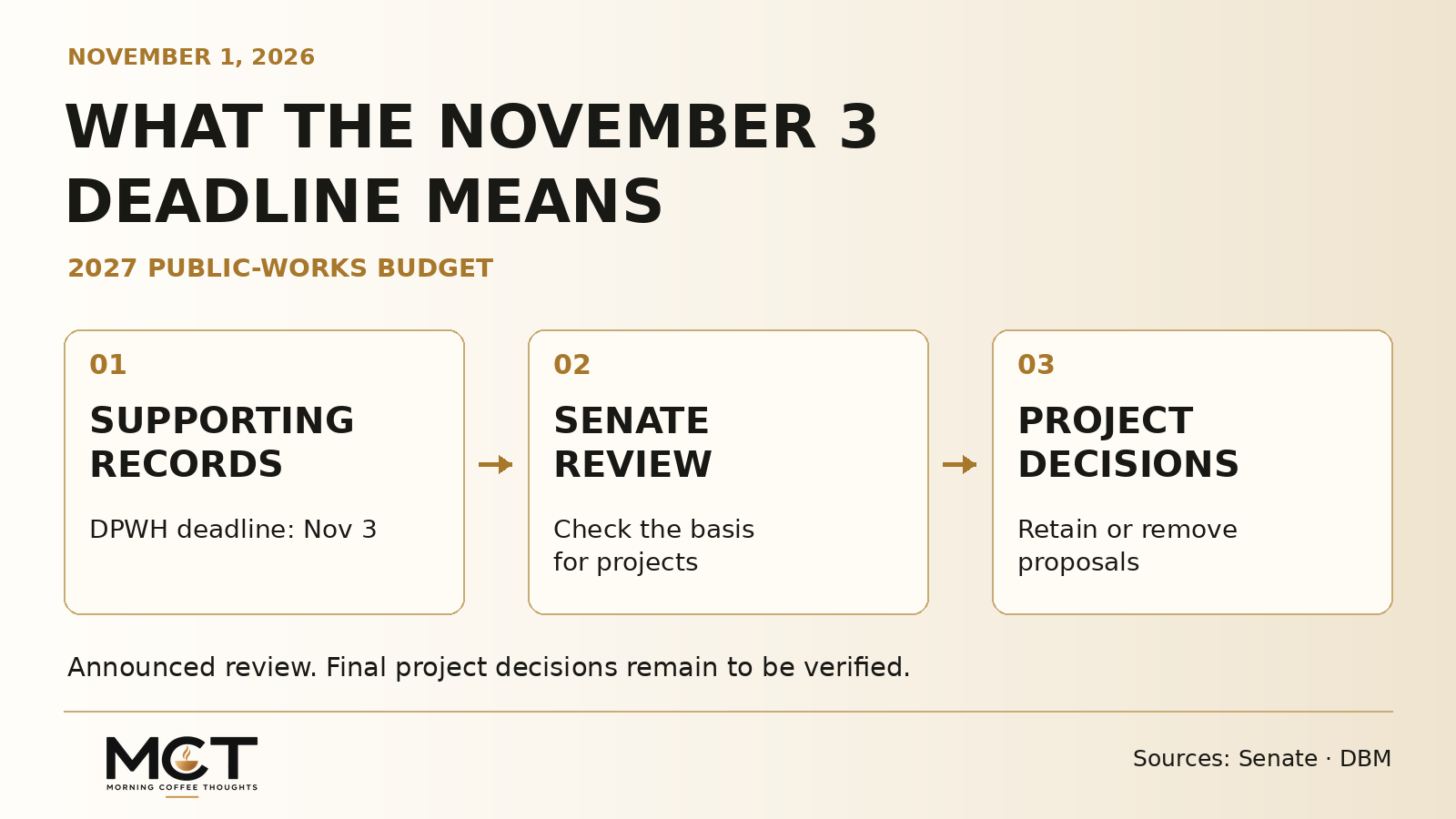
That question is behind the November 3 deadline set by Senate finance committee chair JV Ejercito for documents supporting thousands of additions to the proposed 2027 public-works budget. The deadline concerns proposals still being examined by Congress, with communities waiting to learn which projects will survive the review.
Here are five things that make the numbers, the paperwork and the next decisions easier to follow.
1
NOVEMBER 3 IS THE DEADLINE FOR SUPPORTING RECORDS
Ejercito has asked the Department of Public Works and Highways to submit supporting documents and justifications for 6,271 projects identified as additions in the House version of the budget.
Following an October 30 meeting with newly appointed DPWH Secretary Giovanni Lopez and Transportation Secretary Vince Dizon, who previously headed DPWH, Ejercito reported a commitment to remove projects that fail the documentary requirements before Senate plenary deliberations. Senator Panfilo Lacson's November 1 statement backed that review.
Anyone looking for a project in their town should keep the timing in mind. The announced consequence is removal from the proposed budget if the requirements are not met. These statements do not establish that all 6,271 projects have already been removed.
2
THE TWO PROJECT COUNTS ANSWER DIFFERENT QUESTIONS
According to the Senate review, the executive's National Expenditure Program contained 11,420 DPWH projects. The House-transmitted General Appropriations Bill contained 16,244.
Subtracting those totals gives a net increase of 4,824 projects. Separately, the review identified 6,271 newly introduced projects that were absent from the executive proposal.
There is no need to force those figures into the same meaning. One compares the size of two lists; the other counts entries identified as new. A proper reconciliation would require matching the individual projects across both versions, including any changes to names or scope.
MCT has not audited that underlying comparison. The reported count of additions, by itself, also does not tell us how many projects will fail the document review.
3
THE PAPERWORK SHOULD HELP EXPLAIN WHAT IS BEING FUNDED
The requirements reported in connection with Ejercito's deadline include Certificates of Implementability, Programs of Works and geotagged photographs.
The Department of Budget and Management (DBM)'s explanation of its 2027 infrastructure screening says proposals need enough information to establish necessity and readiness. Depending on a project's nature and stage, supporting records may include feasibility studies, engineering requirements, procurement plans, right-of-way requirements, permits and coordination with local governments.
For a resident, the practical questions are straightforward: Where is the project? What work is proposed? Why is it needed? What supports the cost and the claim that it can proceed?
A geotagged photograph is one piece of evidence to check alongside those records. Its presence alone cannot establish that the proposed work is necessary or has been completed. Likewise, missing paperwork warrants scrutiny without automatically proving theft.
4
INCLUSION IN A BILL DOES NOT MEAN MONEY HAS BEEN PAID
The executive proposal and the House bill are successive steps toward an enacted national budget. The Senate still considers the measure, differences between the chambers must be resolved, and the legislation goes through enactment.
DBM's budget primer separates preparation and legislation from execution and accountability. That separation is useful when a headline talks about billions being “added” or “removed.” A proposed allocation is not a receipt showing that a contractor has been paid.
Even projects that receive funding remain subject to procurement, accounting, auditing and monitoring requirements during implementation. Checking the proposal is an early safeguard; checking contracts, actual work and payments remains necessary afterward.
5
THE USEFUL RESULT WILL BE A TRACEABLE PROJECT LIST
Senate President Win Gatchalian has said relevant information will be uploaded to the Senate Transparency Portal. That is a stated commitment, not confirmation that the complete records are already available there.
To understand what the deadline achieves, readers will need to see which projects were supported, which were removed, their amounts and the reasons for each decision. Those entries can then be compared with later Senate and bicameral versions and the enacted budget.
For someone searching their own area, a project name, location and amount are more useful than a nationwide total alone. The value of this review will become clearer when people can follow an individual proposal through those changes and see the evidence behind the decision.
BOTTOM LINE
November 3 is DPWH’s deadline to supply the supporting records requested for proposed public-works projects. Its effect on communities will depend on the decisions that follow: which proposals keep their funding, which lose it, and whether the supporting records and explanations become available for public checking. The announced review still has to produce those answers.
SOURCES
- Senate / Office of Senator Panfilo Lacson, November 1 statement on the proposed 2027 budgethttps://senate.gov.ph/media/news-release/lacson-on-senate-majority-unity-in-purging-2027-budget-bill-of-pork-all-means-all-2
- Daily Tribune, October 31: Ejercito's documentary deadline and October 30 meetinghttps://tribune.net.ph/amp/story/2026/10/30/jv-draws-line-on-hgab
- The Philippine Star, November 1: proposed project removals and transparency commitmenthttps://www.philstar.com/headlines/2026/11/01/2567041/senate-could-weed-out-thousands-infrastructure-projects-budget/amp/
- Politiko, October 31: project-count comparison and documentary requirementshttps://politiko.com.ph/walang-papel-walang-proyekto-jv-ejercito-gives-dpwh-until-nov-3-to-justify-6271-house-budget-insertions/
- DBM, August 27: safeguards for proposed 2027 infrastructure spendinghttps://www.dbm.gov.ph/index.php/management-2/4181-dbm-higher-infra-spending-to-support-economic-growth-jobs-connectivity-in-2027
- DBM: Budget 101https://www.dbm.gov.ph/wp-content/uploads/AboutDBM/Budget%20101_Reader%20View.pdf
GOOGLE PREFERRED SOURCES
FOLLOW MCT ON GOOGLE
Google’s Preferred Sources feature lets you choose publications you want Google to prioritize for you. Select “Add to Preferred Sources” to make MCT easier to find in Top Stories and other eligible Google results. This does not subscribe you to email.
SUPPORT MCT
HELP KEEP INDEPENDENT POLITICAL WRITING GOING.
Morning Coffee Thoughts is reader-supported. Contributions help pay for research tools, hosting, and the work required to verify and explain each development.