Gaano ka nagtitiwala na tama ang ginagawa ng Kongreso sa budget ng bayan?
This is an informal survey of people who choose to participate. It is not a scientific or nationally representative sample.
DAILY BRIEF
MCT DAILY BRIEF
Good morning.
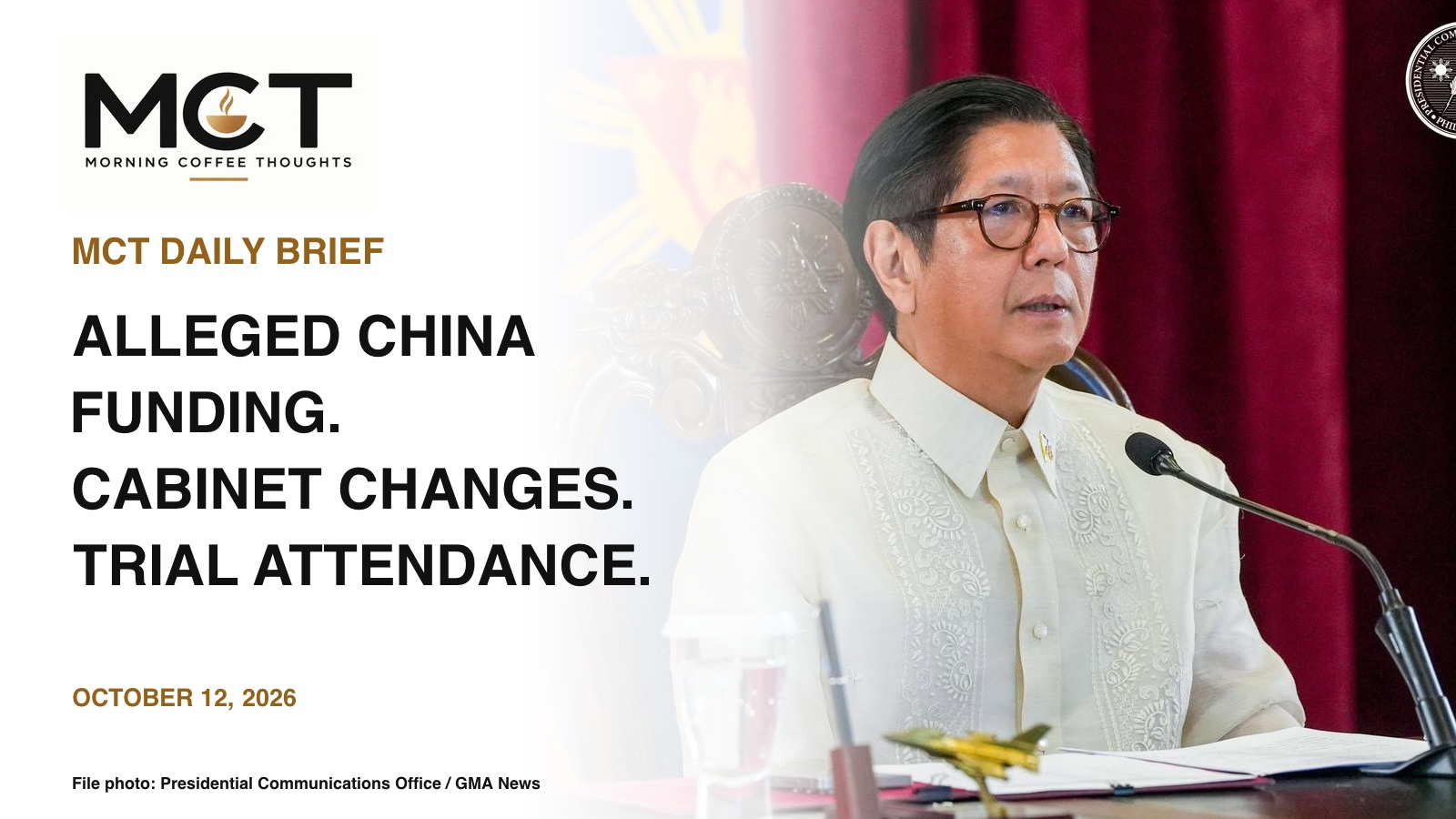
A warning about skipping the impeachment trial, a presidential response to the alleged China-linked funding, and changes at two Cabinet offices are setting the political agenda as the week begins. Authorities have also arrested a man they link to two former POGO hubs. Here are five developments to follow, with the questions that still need answers.
1
PADILLA RAISES THE POSSIBILITY OF SKIPPING THE IMPEACHMENT TRIAL
Senator Robin Padilla said on Sunday that he and allied senators might stop attending Sara Duterte’s impeachment trial if what he considers a distortion of the law continues. He also said the minority senators had not discussed such a move. There is therefore no announced collective boycott to report.
His objection concerns the impeachment court’s interpretation of the two-thirds conviction requirement. Padilla and Senator Bong Go have brought that dispute to the Supreme Court. Their request for judicial intervention is a procedural step; its outcome has to be established through an actual court order.
For voters, the immediate question is whether the senators entrusted with judging the evidence will attend and hear it. A warning about absence does not tell us who will actually stay away, whether proceedings will be affected, or how a future vote will be counted. Those questions require the attendance record and the court’s directions.
WHAT TO WATCH
The attendance record when the trial resumes, any joint statement from the senators, and any Supreme Court order addressing the petition. These will establish whether Sunday’s warning becomes an action that affects the proceedings.
2
MARCOS RESPONDS TO THE ALLEGED CHINA-LINKED FUNDING
President Ferdinand Marcos Jr. said alleged Chinese funding involving a company linked to Sara Duterte could present a national security threat at the highest level if proven true. He made the remarks as his Singapore visit ended on Sunday. The qualification is part of his statement: the alleged security implications still have to be established.
This adds the President’s public response to an issue already raised through financial records and the impeachment proceedings. It does not settle who ultimately benefited from a transaction, why the money was transferred, or whether a foreign government directed it.
A foreign business payment, a charitable contribution and money intended to influence an official would require different explanations and evidence. Readers should expect investigators to identify the sender, recipient, purpose and eventual use of the funds before attaching a political or criminal conclusion to them. Marcos’s concern increases the demand for a clear investigation; it does not supply the missing findings.
WHAT TO WATCH
An official investigative finding that traces the transactions and explains any security implications, together with the response of those concerned. A finding supported by records would move this issue beyond competing political statements.
3
AGUDA’S DEPARTURE LEAVES A HANDOVER TO EXPLAIN
Henry Aguda is leaving the Department of Information and Communications Technology. Ombudsman Jesus Crispin Remulla said on Saturday that Aguda had resigned and the President had accepted the resignation. Reports of Marcos’s Sunday interview also confirm the departure. The announcement follows an earlier public assurance that Aguda would continue serving.
The sequence deserves a clear explanation from the administration. A change in leadership should come with a definite effective date and an identified official responsible for the department during the transition. The reports reviewed for this edition did not identify Aguda’s successor.
The resignation alone does not establish wrongdoing or resolve questions about the department’s decisions. Any investigation needs its own evidence and findings. Meanwhile, people waiting for better connectivity or functioning government digital services need continuity: who is authorized to decide, which projects are proceeding, and where complaints should go.
WHAT TO WATCH
The appointment of a successor or officer in charge, the handover date, and a published account of ongoing programs. These will show whether the leadership change disrupts services or leaves decisions unattended.
4
LINO CAYETANO IS MARCOS’S CHOICE FOR THE PCO
Marcos announced on Sunday that Lino Cayetano would replace Dave Gomez at the Presidential Communications Office. The President said Gomez’s appointment had been bypassed and that the change would be formalized upon their return to the Philippines. The announcement should be followed through to the appointment document and assumption of office.
Cayetano has been heading the government’s PTV network. He previously served as Taguig mayor and as a district representative, and has worked in television production. The new post puts him in charge of an office responsible for coordinating the administration’s messaging.
People rely on official announcements to find out what government has decided and how a policy will work. They need dates, documents and usable instructions, especially when earlier statements change. The incoming communications chief’s performance can be judged through those answers. A polished presentation cannot explain away an unanswered question about a government decision.
WHAT TO WATCH
The formal appointment, the effective handover, and Cayetano’s first briefings. Check whether the PCO explains changes clearly and provides the records behind its statements.
5
AUTHORITIES ARREST A MAN LINKED TO TWO FORMER POGO HUBS
The Presidential Anti-Organized Crime Commission reported the arrest of Huang Mingmin in Parañaque on October 9 in an operation with police investigators. Reports published over the weekend link him to the former POGO hubs in Bamban, Tarlac, and Porac, Pampanga, and to allegations of human trafficking. He was arrested under a warrant; the allegations remain subject to court proceedings.
The arrest is a concrete enforcement development in cases that extend beyond the closure of gambling operations. For people allegedly exploited inside these facilities, accountability depends on identifying those responsible, protecting witnesses and presenting evidence that can withstand examination in court.
The public should also ask what the proceedings establish about the businesses and people involved. An arrest does not automatically prove every claim about a suspect or implicate everyone associated with a property. Following the case through its filings and hearings gives a more reliable picture than treating the announcement as the end of the investigation.
WHAT TO WATCH
The court handling the warrant, the charges pursued, Huang’s response and subsequent hearings. Those records will show which allegations are being tested and what the prosecution can establish.
BOTTOM LINE
The week begins with officials making consequential statements about attendance, funding and leadership. Each one has a next step that readers can check: an attendance record, an investigative finding, an appointment or a court proceeding. Following those records gives us a way to judge whether officials are answering the questions their announcements have raised.
Google’s Preferred Sources feature lets you choose publications you want Google to prioritize for you. Select “Add to Preferred Sources” to make MCT easier to find in Top Stories and other eligible Google results. This does not subscribe you to email.
Morning Coffee Thoughts is reader-supported. Contributions help pay for research tools, hosting, and the work required to verify and explain each development.
Monthly PayPal subscription — choose your support amount.