
LATEST COMMENTARY
FIVE THINGS TO KNOW
MCT READER PULSE · MCT-PULSE-2026-017
MCT READER SURVEY
Gaano ka nagtitiwala na tama ang ginagawa ng Kongreso sa budget ng bayan?
This is an informal survey of people who choose to participate. It is not a scientific or nationally representative sample.
ABOUT PHP2SHELL AND THE RISK TO PHILIPPINE GOVERNMENT WEBSITES
When a government website asks for a copy of your ID, your address or your medical information, you have little choice about trusting the agency with it. You may need those records to claim a benefit or complete an application.
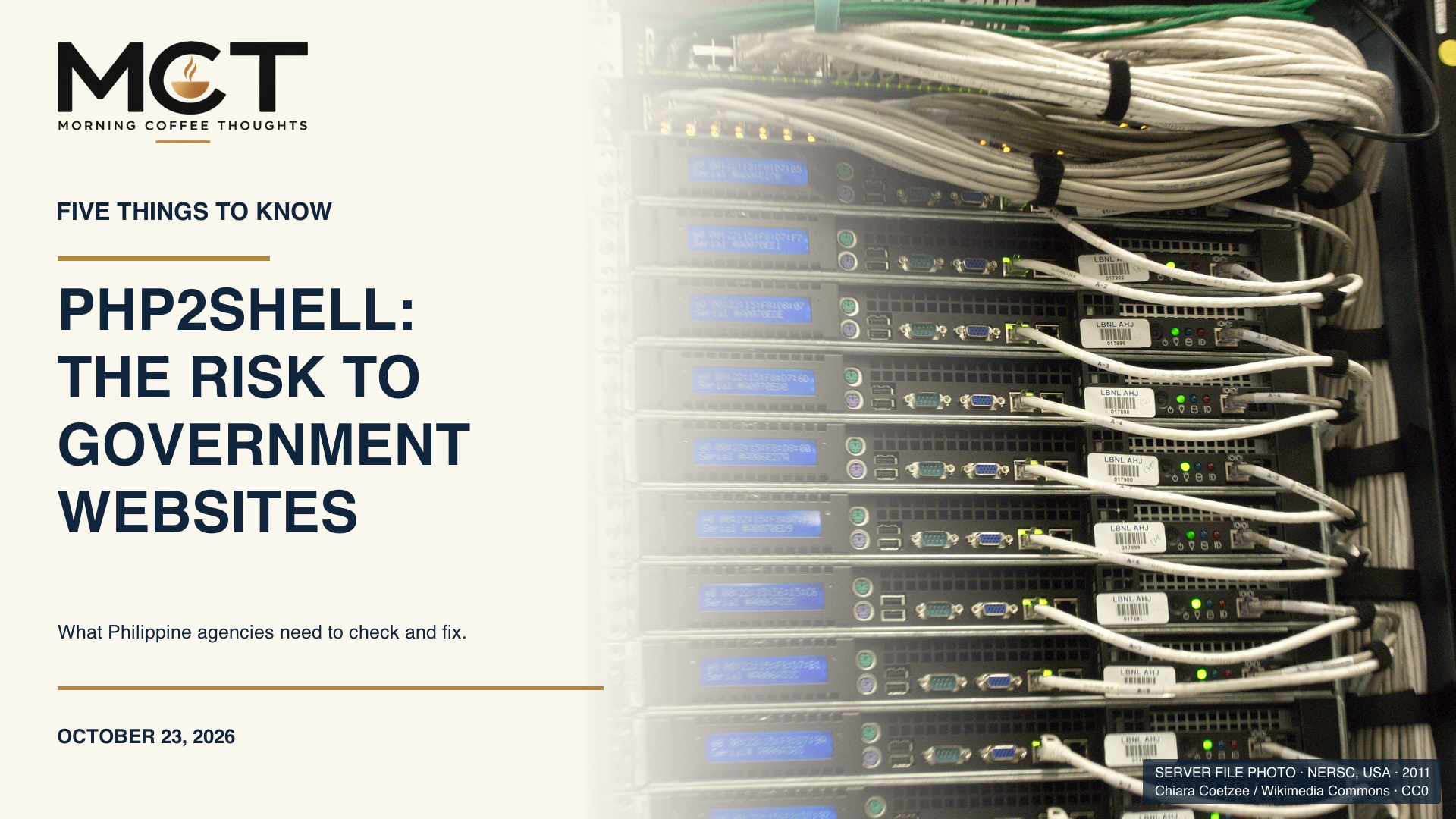
That is why the new warning about PHP2Shell deserves attention here. It involves two serious weaknesses in PHP, software used to run websites. Fixes were released on October 21, and security authorities have reported attempts to exploit the flaws.
The immediate questions for Philippine agencies are which of their systems use the affected software, whether those systems have been repaired, and whether anyone got in before the repair.
1
AN ATTACKER COULD GET IN WITHOUT AN ACCOUNT
PHP helps a website process requests and produce the pages people see. The newly disclosed flaws can, under certain conditions, let an outsider run commands on the server without first signing in.
That puts the computer running the website at risk. Depending on what the attacker can reach, a successful break-in could expose information, change content or interrupt a service.
The PHP Foundation confirmed that researchers had demonstrated attacks that could run code on affected systems. The PHP team released fixes for its supported versions and told operators to update.
Changing your own password does not repair this software problem. The people running the website and its hosting service have to do that work.
WHAT TO WATCH
Look for confirmation that agencies and their contractors have checked the software behind their websites, including services that accept applications or store personal records.
2
A SECURITY WARNING DOES NOT PROVE A WEBSITE WAS HACKED
In its October 22 update, Singapore's Cyber Security Agency reported widespread attempts to exploit PHP2Shell. That is evidence of attackers trying, not proof that every attempt succeeded.
The official advisories reviewed for this article do not identify a Philippine government website confirmed to have been breached through these flaws.
A website going offline does not settle that question either. It may have been taken down for repairs, or it may have another problem. Likewise, a page that still opens normally tells visitors very little about the security of the server behind it.
Agencies should say what they have checked and what remains under investigation. Readers should be cautious about posts declaring a government-wide breach without evidence.
WHAT TO WATCH
Check whether an announcement describes a possible weakness, an attempted attack or confirmed unauthorized access. Those are different findings, and the public response should match the evidence.
3
PERSONAL INFORMATION CAN BE EXPOSED EVEN IF THE MAIN DATABASE IS INTACT
PhilHealth's September 2023 ransomware attack is a separate, documented example.
In its October 2 notice that year, PhilHealth said its main database remained intact, while data on some servers and local workstations had been compromised. It believed the affected information included names, addresses, birth dates, phone numbers and PhilHealth identification numbers.
That incident is not being linked to PHP2Shell.
It shows why a statement about one database cannot answer every question about people's records. Copies may be held elsewhere. After a breach, an agency should explain which systems were affected and what information they contained.
For someone who submitted an ID or a medical document, being told that the website is back online does not answer whether their information was exposed.
WHAT TO WATCH
Look for notices naming the types of records affected and the people who may need help. A broad assurance that a database is safe should not replace those details.
4
THE FIX HAS TO REACH THE SOFTWARE BEHIND THE WEBSITE
Updating a website's appearance will not solve a flaw in the software running it. The hosting team has to install the corrected PHP release or the equivalent security fix supplied by its software vendor.
The PHP team says temporary measures cannot make an affected installation fully safe. Its advice is to update.
The check also extends beyond the main website. Singapore's advisory tells organizations to inspect third-party applications and components, because those may use PHP even when the main site does not.
For Philippine agencies, that means asking contractors for evidence that the repair was completed. It also means checking for signs of earlier unauthorized access. Installing a fix does not establish what happened before it was installed.
WHAT TO WATCH
Agencies should provide a clear repair status and any changes to public services. If an application portal is temporarily unavailable, users also need a working alternative and an explanation of what happens to approaching deadlines.
5
AFFECTED PEOPLE NEED A NOTICE THEY CAN ACT ON
Under National Privacy Commission rules, mandatory notification generally applies when sensitive or identity-fraud-enabling data is believed to have been acquired without authorization, with a likely real risk of serious harm. When those conditions are met, the agency generally has 72 hours from knowledge or reasonable belief of the breach to notify the commission and affected people, subject to limited exceptions.
Outsourcing the service does not remove that responsibility.
For readers, check unexpected messages through an agency's established contact channels. Do not hand over passwords or one-time codes to someone claiming to be repairing your account.
PHLPost's September warning about fake parcel messages shows how scammers impersonate government services. A familiar agency name in a text message is not enough reason to trust its link or payment request.
WHAT TO WATCH
A useful notice should explain what happened, what information may be affected, what you can do and where to get help. Save any notice about your account and verify follow-up instructions before acting on them.
BOTTOM LINE
PHP2Shell gives government agencies a specific security problem to check and repair. We should expect evidence of that work, without inventing a list of Philippine websites that have supposedly been hacked.
People using government services should not have to understand server software to find out whether their records are safe. Agencies should explain what they know, what they are still checking and what affected users need to do.
GOOGLE PREFERRED SOURCES
FOLLOW MCT ON GOOGLE
Google’s Preferred Sources feature lets you choose publications you want Google to prioritize for you. Select “Add to Preferred Sources” to make MCT easier to find in Top Stories and other eligible Google results. This does not subscribe you to email.
SUPPORT MCT
HELP KEEP INDEPENDENT POLITICAL WRITING GOING.
Morning Coffee Thoughts is reader-supported. Contributions help pay for research tools, hosting, and the work required to verify and explain each development.