
LATEST COMMENTARY
FIVE THINGS TO KNOW
MCT READER PULSE · MCT-PULSE-2026-017
MCT READER SURVEY
Gaano ka nagtitiwala na tama ang ginagawa ng Kongreso sa budget ng bayan?
This is an informal survey of people who choose to participate. It is not a scientific or nationally representative sample.
ABOUT THE BIR’S TEN-YEAR RULE IN SARA DUTERTE’S IMPEACHMENT TRIAL
When can the BIR examine an old tax return? That question became part of Friday’s impeachment hearing when defense counsel Kristine Ferrer asked whether alleged fraud discovered in 2026 would put the earliest assessable tax year at 2016. The prosecution objected, and presiding officer Chiz Escudero sustained the objection.
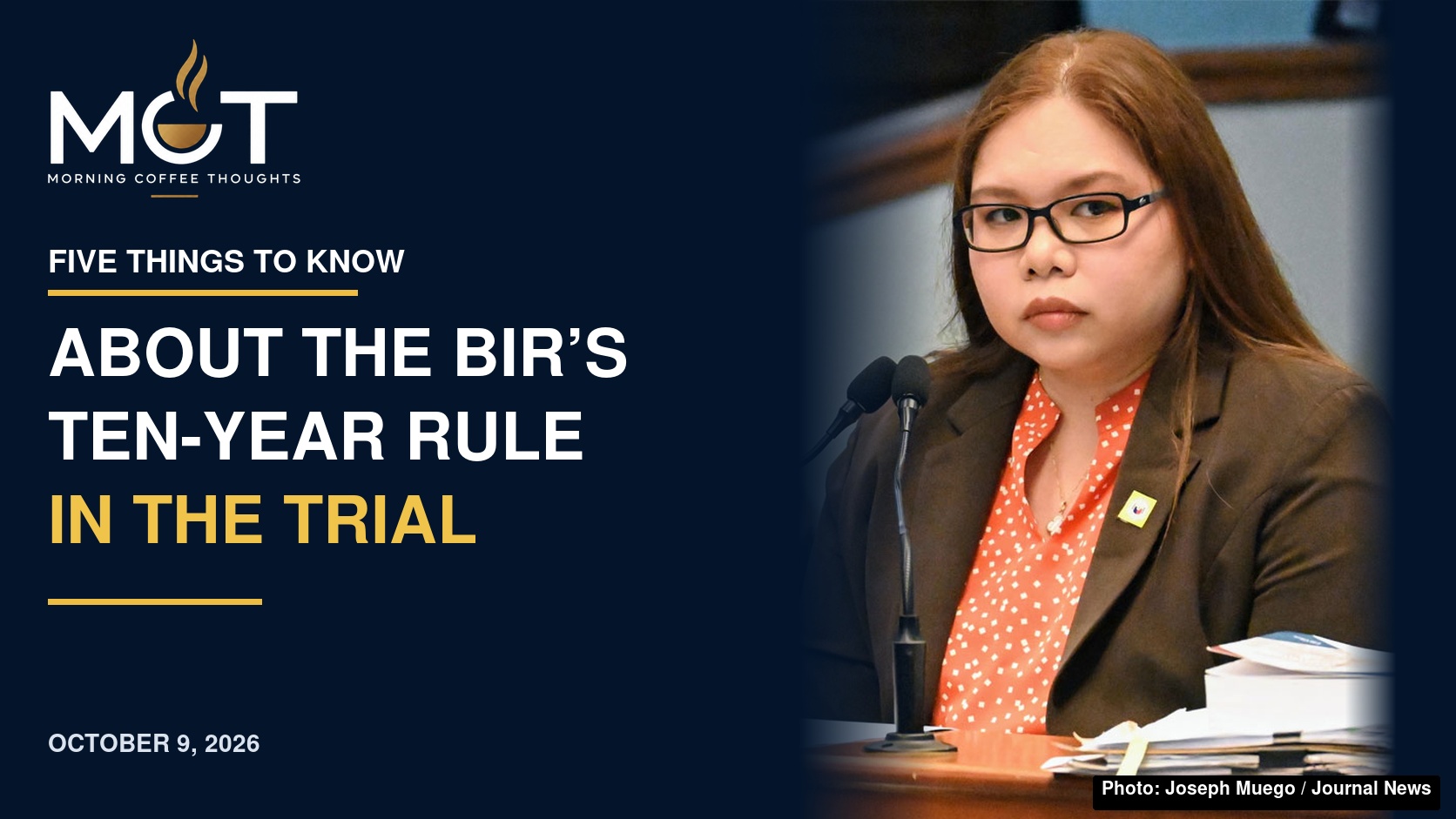
The exchange needs a careful explanation because several clocks are involved. A deadline for assessing tax, the period for prosecuting a tax offense and the use of financial records in an impeachment case serve different purposes. Here are five things to understand.
1
Three years is the ordinary assessment period
Section 203 of the National Internal Revenue Code generally gives the BIR three years to assess internal revenue taxes. The period is counted from the statutory filing deadline. If a return is filed late, the count generally begins on the actual filing date. An early filing is treated as made on the statutory deadline.
An assessment is the bureau’s determination of a tax liability. It is a distinct step from sending authority to examine records or asking a taxpayer to explain an entry. That distinction helps identify which deadline is being discussed.
The ordinary three-year period has exceptions, so a prescription argument needs the applicable rule and supporting dates.
WHAT TO WATCH
The filing deadline, actual filing and assessment dates, and any applicable exception or valid extension.
2
The ten-year exception requires a legal basis
Section 222(a) provides the longer period for a false or fraudulent return with intent to evade tax, or a failure to file a return. The Supreme Court has explained that a simple error or discrepancy does not automatically establish the intentional falsity required for the extraordinary period.
This protects both the government’s ability to pursue concealed violations and the taxpayer’s right to be free from an investigation kept open through unsupported allegations. Invoking fraud requires a basis in evidence. The law also contains a rebuttable presumption for specified substantial underdeclarations; its conditions must be established rather than assumed.
In Duterte’s case, the existence of a tax inquiry or testimony about this provision should not be treated as a finding that she or her husband committed tax fraud.
WHAT TO WATCH
Which ground the BIR is invoking, the records supporting it and the taxpayer’s response. Ask what establishes the exception, rather than accepting the label alone.
3
The ten years are counted forward from discovery
The exceptional period is reckoned from discovery of the qualifying falsity, fraud or omission. It sets a period within which the relevant tax assessment or court collection proceeding without assessment may be undertaken.
Take a hypothetical discovery in 2026. The wording does not automatically make 2016 the earliest tax year that can be examined. It directs attention to when the qualifying violation was discovered and whether the action was brought within the applicable period after that discovery.
This is not permission to declare every old return open indefinitely. The BIR still has to establish the ground for using the exception and the relevant discovery date. A later audit does not, by itself, prove that the legal clock has just begun.
WHAT TO WATCH
The claimed discovery date and how it is supported. Keep the year of the transaction, the filing of the return and discovery of an alleged violation distinct.
4
Criminal tax offenses have a separate prescription rule
The ten-year assessment provision should not be used as a blanket statement about how long criminal tax charges can be pursued. Section 281 sets a five-year prescription period for violations of the Tax Code, subject to its rules on when the period begins and when it is interrupted.
In People v. Consebido, decided on April 2, 2025, the Supreme Court clarified how discovery affects prescription when a violation was initially unknown. It also explained that discovery is not automatically the date a complaint is filed, and addressed interruption through proceedings before the prosecution office.
The practical lesson is to identify the proceeding before applying a deadline. Assessment, collection and criminal prosecution cannot all be reduced to the same ten-year explanation.
WHAT TO WATCH
The alleged offense, the relevant dates and the proceedings actually instituted. Be cautious with any headline suggesting criminal tax cases universally have no deadline.
5
The impeachment charge still has to be proven
Article II raises allegations concerning Duterte’s wealth, asset declarations and business interests. The court has sought bank and tax records to examine those allegations. An argument about the BIR’s assessment powers does not settle what those records establish in the impeachment trial.
A return’s age does not answer whether a later SALN correctly listed an asset. Equally, a discrepancy between records needs explanation and testing before it becomes a conclusion about wrongdoing. Ownership, reporting periods, liabilities and the sources of funds all matter when financial figures are compared.
The senator-judges must evaluate the evidence and the parties’ arguments. A witness’s explanation of a tax provision is one part of that process; it does not replace the court’s findings.
WHAT TO WATCH
The specific declarations and transactions being challenged, the expert’s supporting calculations and the defense’s explanations. Follow the connection between each record and the allegation it is being used to support.
BOTTOM LINE
The ten-year rule runs forward from discovery when its legal conditions are met. The BIR needs a proper basis for invoking it, and criminal tax offenses have a separate limitation framework. For this impeachment trial, the useful questions remain concrete: which records are being examined, which allegation they support, and what the evidence actually establishes.
GOOGLE PREFERRED SOURCES
FOLLOW MCT ON GOOGLE
Google’s Preferred Sources feature lets you choose publications you want Google to prioritize for you. Select “Add to Preferred Sources” to make MCT easier to find in Top Stories and other eligible Google results. This does not subscribe you to email.
SUPPORT MCT
HELP KEEP INDEPENDENT POLITICAL WRITING GOING.
Morning Coffee Thoughts is reader-supported. Contributions help pay for research tools, hosting, and the work required to verify and explain each development.