
LATEST COMMENTARY
FIVE THINGS TO KNOW
MCT READER PULSE · MCT-PULSE-2026-017
MCT READER SURVEY
Gaano ka nagtitiwala na tama ang ginagawa ng Kongreso sa budget ng bayan?
This is an informal survey of people who choose to participate. It is not a scientific or nationally representative sample.
ABOUT THE CREDIT CARD CHARGES IN SARA DUTERTE’S IMPEACHMENT TRIAL
A restaurant charge above ₱200,000. Two purchases at a Nike store in Davao on the same day. More shopping in Japan and Malaysia. These credit card entries appear in financial forensic analyst Alexander Cabrera’s October 9 testimony at Sara Duterte’s impeachment trial.
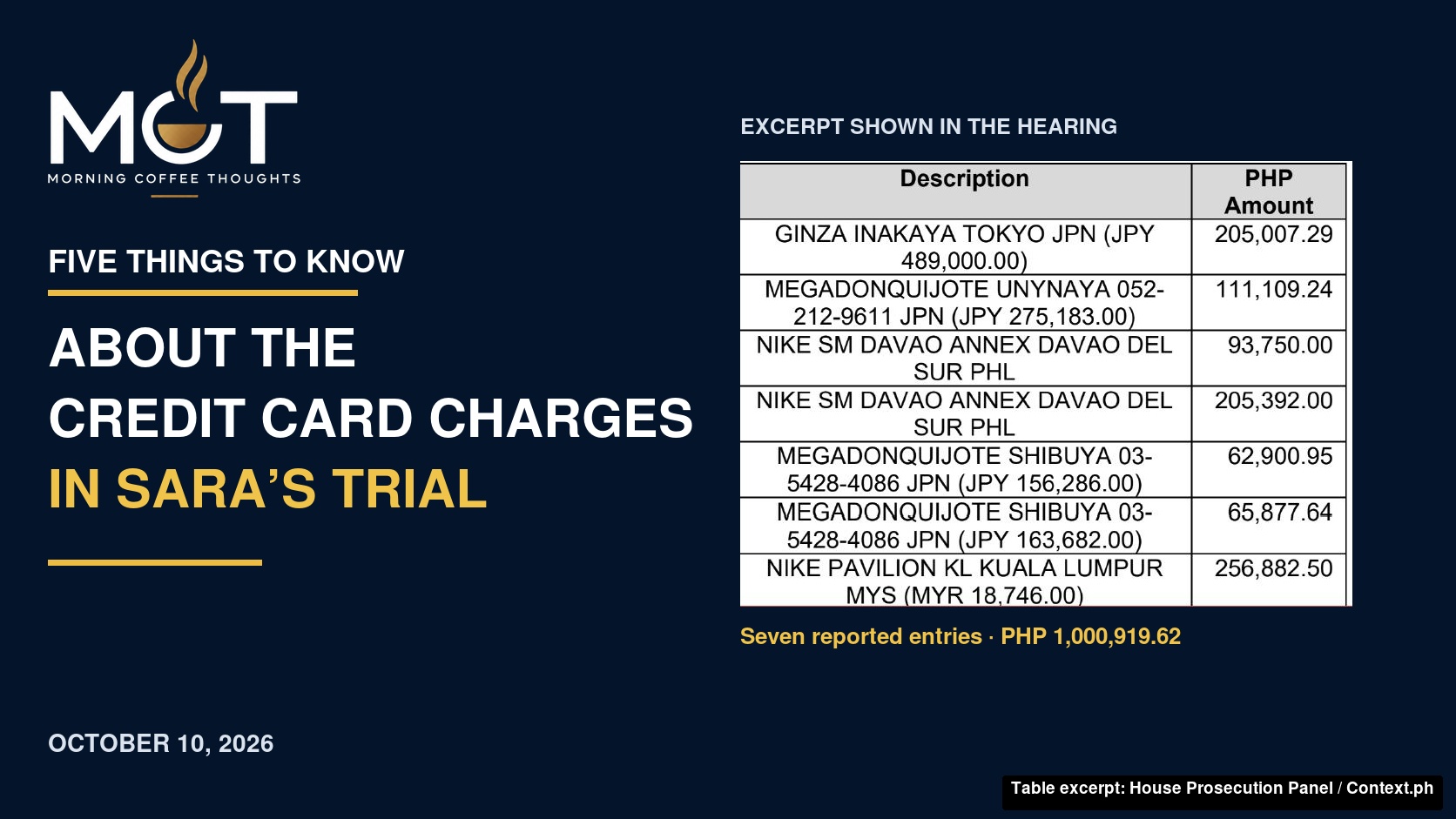
The amounts are striking. Understanding their place in the case takes more than adding them up. There are questions about the transactions themselves, how the bills were paid, and how that spending fits the financial declarations being examined. Here are five things to know.
1
The seven reported entries total just over ₱1 million
Reports identifying Table 25 of Cabrera’s presentation list seven charges totaling ₱1,000,919.62. Three were at Mega Don Quijote outlets in Japan, with a combined value of ₱239,887.83. The other entries were a reported ₱205,007.29 charge at Ginza Inakaya in Tokyo, two Nike SM Davao Annex transactions totaling ₱299,142, and a ₱256,882.50 purchase at Nike Pavilion Kuala Lumpur.
This selection is not a complete account of the cardholder’s spending or evidence that all seven purchases happened on one day. The two Davao transactions were reported as occurring on the same day; the other entries need their own transaction dates.
WHAT TO WATCH
The underlying statements, transaction dates and any refunds or reversals. The complete records will show how these selected entries fit into the account’s activity.
2
The merchant names do not tell us everything that was bought
The two reported Nike Davao amounts—₱93,750 and ₱205,392—add up to ₱299,142. That is just under ₱300,000. Headlines describing spending above ₱300,000 exaggerate this pair.
A Nike merchant entry does not establish how many shoes were bought, which products were purchased or who received them. The Tokyo restaurant charge similarly does not tell us how many people were at the table. Receipts or other supporting records would identify the items and the dining party.
The large amounts justify scrutiny. Inventing the contents of the shopping bags or the size of the dining party makes the explanation less reliable.
WHAT TO WATCH
Itemized receipts and the cardholder’s explanation. Look for evidence of what each charge covered and whether the amount appearing on the statement was the final amount settled.
3
How the bill was paid is central to the financial question
A credit card charge records a transaction financed through a card account. To trace the money, the next step is to examine its settlement: who paid, from which account, and with what source of funds.
In a wealth inquiry, the records must show how purchases and payments affected declared income, available funds and outstanding balances. A purchase can create an unpaid obligation; payment later reduces available funds. Reimbursements, refunds and supplementary-card arrangements can also affect the explanation. None of those possibilities should be assumed to have occurred in this case.
Under Section 8 of Republic Act 6713, public officials must disclose assets, liabilities and financial and business interests under oath. An alleged omission can be assessed by comparing these purchases with the records and reporting dates. The shopping total alone cannot establish that connection.
WHAT TO WATCH
Card ownership, settlement records, outstanding balances at the relevant declaration dates, and the source of payments. These are the details that connect spending to the financial case.
4
Simple living is an obligation for public officials
Section 4(A)(h) of RA 6713 sets a modest-living standard for public officials, employees and their families, measured against their positions and income. It also bars extravagant or ostentatious displays of wealth.
The law gives the public a reason to ask how a senior official’s spending fits that obligation. The assessment still needs the circumstances: the official’s lawful income, what the transactions covered and the explanation supported by the records.
An itemized bill, a settlement record and a supported explanation help the court assess the transaction. The amount gives it a starting point; those records provide the context for a legal finding.
WHAT TO WATCH
How the parties connect the purchases to the specific impeachment allegations and the applicable standards. Follow the evidence supporting that connection, rather than treating a headline as the finding.
5
Cabrera’s interpretation will face cross-examination
The House prosecution identifies Cabrera as its final witness and says his cross-examination is scheduled for Monday, October 12. Prosecutors have also welcomed the defense’s stated plan to present a financial expert of its own. Those are the next reported steps, subject to the impeachment court’s directions.
The card entries form part of the prosecution’s financial presentation. They do not, by themselves, establish that public funds paid for the purchases, that every charge represented personal consumption, or that the impeachment allegations have been proven. Those conclusions need supporting evidence and evaluation by the senator-judges.
WHAT TO WATCH
The defense’s questions about the records, Cabrera’s explanation of his assumptions, and any documents or expert evidence offered in response. A clear explanation should follow the transaction through to its financial significance.
BOTTOM LINE
The reported credit card charges deserve a clear, documented explanation. The public can reasonably ask about spending of this scale by a senior official. The strongest examination follows the whole trail: what was charged, who incurred it, how it was settled, and how it relates to lawful income and financial disclosures. That is how an eye-catching shopping story becomes a useful account of the evidence.
GOOGLE PREFERRED SOURCES
FOLLOW MCT ON GOOGLE
Google’s Preferred Sources feature lets you choose publications you want Google to prioritize for you. Select “Add to Preferred Sources” to make MCT easier to find in Top Stories and other eligible Google results. This does not subscribe you to email.
SUPPORT MCT
HELP KEEP INDEPENDENT POLITICAL WRITING GOING.
Morning Coffee Thoughts is reader-supported. Contributions help pay for research tools, hosting, and the work required to verify and explain each development.