
LATEST COMMENTARY
FIVE THINGS TO KNOW
MCT READER PULSE · MCT-PULSE-2026-017
MCT READER SURVEY
Gaano ka nagtitiwala na tama ang ginagawa ng Kongreso sa budget ng bayan?
This is an informal survey of people who choose to participate. It is not a scientific or nationally representative sample.
ABOUT AMICI CURIAE IN SARA DUTERTE’S IMPEACHMENT TRIAL
An amicus curiae is someone who helps a court understand a legal question. The phrase means “friend of the court.” When more than one person takes that role, they are called amici curiae. They give advice. The court still makes the decision.
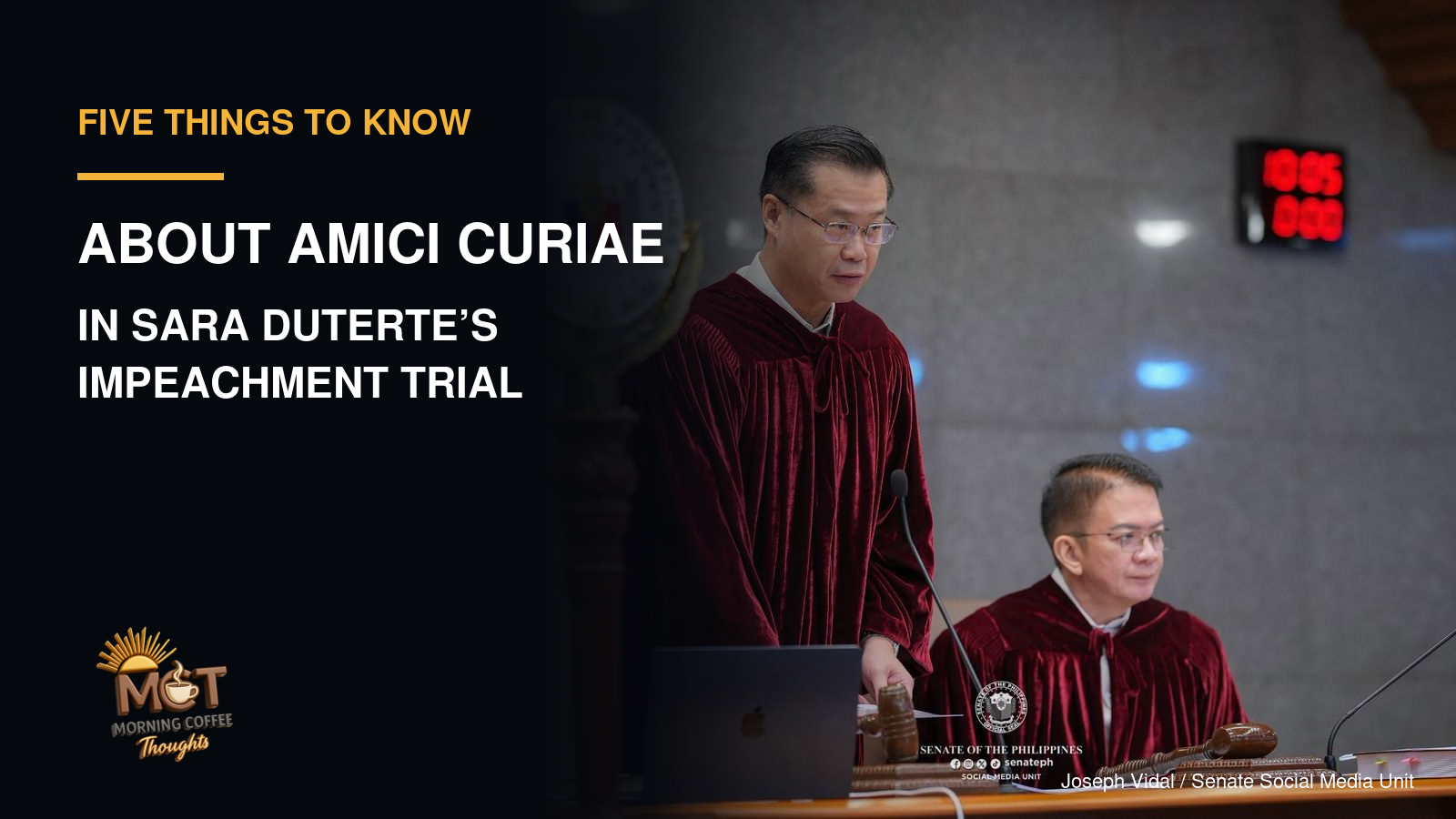
The term came up at Sara Duterte’s impeachment hearing on September 8 because the Senate plans to invite legal experts to discuss how many votes are needed to convict her. Retired Supreme Court justices are being considered. The disagreement concerns the Constitution’s two-thirds requirement and questions about senators who are not attending the proceedings. Inviting experts does not change the voting rule or decide Duterte’s case.
1
A FRIEND OF THE COURT HELPS EXPLAIN THE LAW
An amicus can explain the meaning of a constitutional provision, discuss earlier court decisions and show how different interpretations would work. In this trial, that advice would help the senator-judges examine the rule for counting votes.
The word “friend” refers to helping the court. It does not give the adviser a vote or make the person part of the prosecution or defense. The adviser may agree with an argument from either side while still serving in that separate role.
Philippine legal practice recognizes this kind of assistance. The professional rules for lawyers address requests to serve as an amicus on questions related to their expertise. Experience with constitutional law can be useful here because the dispute concerns a requirement written into the Constitution.
WHAT TO WATCH
The invitations should identify the questions the experts will address. That will establish the scope of the consultation and whether it includes related questions about the court’s earlier ruling.
2
THE QUESTION IS HOW MANY VOTES ARE NEEDED TO CONVICT
The Constitution requires two-thirds of all Senate members to agree before an impeachment conviction. Presiding officer Francis Escudero has used the full 24-member Senate as the basis. Two-thirds of 24 is 16.
At the September 8 hearing, senator-judge Erwin Tulfo asked about voting and members who were not attending. Senator-judge Pia Cayetano also questioned whether the impeachment court could revisit Escudero’s earlier ruling. The disagreement therefore includes both the counting rule and the court’s power to reconsider it.
The number has a direct effect on the outcome. Under a 16-vote requirement, 15 votes for conviction would fall short. A senator’s absence does not automatically establish a lower requirement. The planned consultation gives the court a chance to hear the legal arguments before resolving the dispute.
WHAT TO WATCH
The court’s ruling should state the number of votes required and explain its basis. The plan to seek advice did not itself replace the 16-vote interpretation.
3
THE EXPERTS HAD NOT YET BEEN PUBLICLY CONFIRMED
Escudero said names of retired Supreme Court justices had been discussed with the prosecution and defense. He did not announce them because they had not yet been contacted. The September 8 announcement therefore did not provide a confirmed list of participants.
Senator-judge Francis Pangilinan proposed allowing the presiding officer to choose the amici after consulting both sides. That would give the prosecution and defense a part in the discussion about whom to invite. It would not commit either side to accepting the advice later given.
An expert’s experience can help explain the law, but the arguments remain open to disagreement. An adviser who agrees with the prosecution or defense on one question does not become that side’s lawyer. The Senate still has to weigh the reasons offered.
WHAT TO WATCH
Accepted invitations will establish who is taking part and whether the proposed schedule can proceed. The names, availability and questions assigned to the experts had not all been confirmed in the September 8 announcement.
4
THEIR ADVICE CANNOT DECIDE WHETHER THE CHARGES ARE PROVED
The advisers are being asked about the voting requirement. Their views cannot establish what happened to confidential funds or whether an allegation against Duterte has been proved. Those questions depend on the evidence presented during the trial and the Senate’s assessment of it.
The Constitution gives the Senate the power to try and decide impeachment cases. A retired Supreme Court justice invited as an amicus would not be issuing a Supreme Court judgment. The person would be giving advice to the impeachment court.
The Senate does not have to adopt that advice. It may accept the argument, accept part of it or reach a different conclusion. An opinion supporting one side’s position also does not amount to a ruling in that side’s favor.
WHAT TO WATCH
After the experts speak, the Senate’s own ruling will establish the interpretation it adopts. A ruling on the voting requirement would settle that question without deciding the allegations against Duterte.
5
SEPTEMBER 16 AND SEPTEMBER 23 HAVE DIFFERENT PURPOSES
Escudero tentatively set September 16 for the amici curiae to appear, depending on their availability. September 23 was intended for oral arguments by the prosecution and defense on the voting question. Oral arguments give the lawyers a chance to explain their positions and answer questions from the court.
The plan would give the senator-judges expert advice first, followed by the arguments of the two sides. It also called for action on the voting issue after those arguments. The schedule could still change through later court announcements.
Neither date was announced as a guaranteed date for Duterte’s conviction or acquittal. The planned discussions concern how the votes should be counted. Whether the evidence proves an impeachment charge remains a separate decision in the trial.
WHAT TO WATCH
The confirmed notices will establish whether the September 16 consultation and September 23 arguments will proceed as proposed. Any ruling afterward should state the voting requirement the Senate adopts.
BOTTOM LINE
The Senate plans to ask legal experts for advice about the votes needed to convict Sara Duterte. They can explain the constitutional arguments, but they cannot change the rule on their own or decide the case. Those decisions remain with the senator-judges.
As announced on September 8, the experts had not yet been publicly confirmed. Their consultation and the arguments from the prosecution and defense concern the voting rule. The allegations against Duterte still have to be decided through the impeachment trial.
GOOGLE PREFERRED SOURCES
FOLLOW MCT ON GOOGLE
Google’s Preferred Sources feature lets you choose publications you want Google to prioritize for you. Select “Add to Preferred Sources” to make MCT easier to find in Top Stories and other eligible Google results. This does not subscribe you to email.
SUPPORT MCT
HELP KEEP INDEPENDENT POLITICAL WRITING GOING.
Morning Coffee Thoughts is reader-supported. Contributions help pay for research tools, hosting, and the work required to verify and explain each development.