LATEST COMMENTARY
FIVE THINGS TO KNOW
MCT READER PULSE · MCT-PULSE-2026-017
MCT READER SURVEY
Gaano ka nagtitiwala na tama ang ginagawa ng Kongreso sa budget ng bayan?
This is an informal survey of people who choose to participate. It is not a scientific or nationally representative sample.
ABOUT THE CHILDREN’S NUTRITION BILL
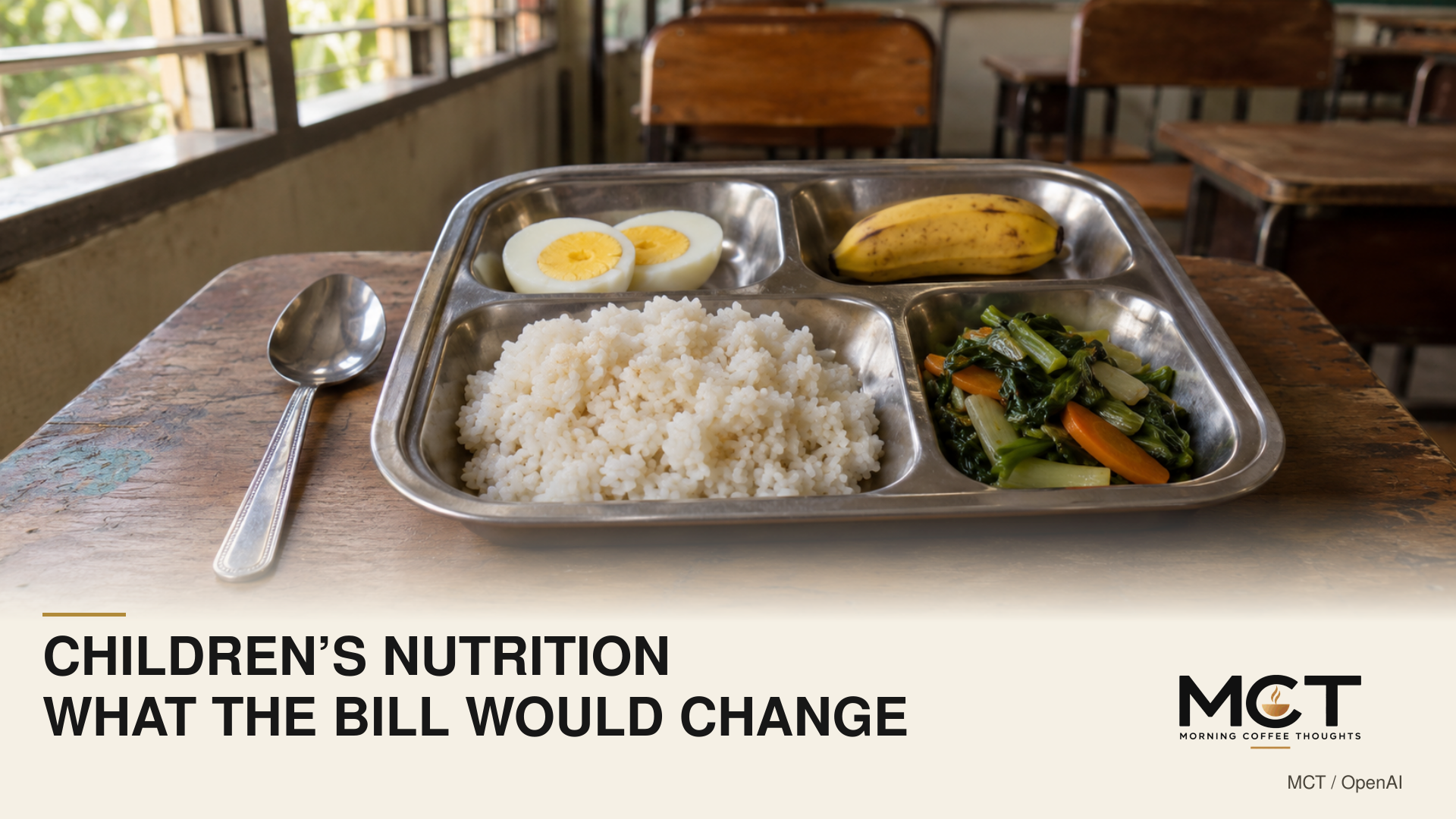
More children would qualify for feeding programmes under the proposed National Children’s Nutrition Act. The Senate and House have agreed on a reconciled version, according to EDCOM 2’s November 7 announcement. The proposal would replace Republic Act 11037, the country’s existing national feeding law.
The changes concern who receives meals, additional nutrition support, and how food funding is protected. Bicameral agreement does not yet make those benefits available.
1
EARLY-CHILDHOOD FEEDING WOULD HAVE BROADER COVERAGE
The proposal covers children aged two to below five in the early childhood care and development system, regardless of nutritional status. It includes daycare, supervised neighbourhood play, and community- and home-based programmes.
The existing law specifies supplemental feeding for undernourished children aged three to five. However, DSWD already serves some younger children through supervised neighbourhood play programmes. It would therefore be misleading to say that every two-year-old would be receiving government feeding support for the first time.
The proposed change is broader eligibility across early-childhood programmes, including children who are not classified as undernourished.
2
ALL PUBLIC-SCHOOL LEARNERS FROM KINDERGARTEN TO GRADE 3 WOULD QUALIFY
The reconciled proposal provides feeding for all public-school learners from Kindergarten through Grade 3. In Grades 4 to 6, coverage would remain targeted at undernourished learners.
That differs from Republic Act 11037, which directs school-based feeding towards undernourished children throughout Kindergarten to Grade 6. Under the proposed arrangement, nutritional status would no longer determine eligibility in the first four school levels.
The distinction matters for families with children in different grades: broader coverage in the early years would not automatically mean universal feeding throughout elementary school.
3
PREGNANT ADOLESCENT LEARNERS WOULD BE EXPRESSLY INCLUDED
Pregnant adolescent learners in participating schools would receive fortified meals and additional micronutrients, including iron, folic acid and calcium as needed.
This would expressly identify them within the school feeding programme. It would not be the first Philippine law to address teenage maternal nutrition: Republic Act 11148 already covers nutritionally at-risk pregnant and lactating women, particularly teenage mothers, alongside infants and young children.
The two measures concern related but distinct routes to support. The existing law addresses maternal and early-childhood health and nutrition; this proposal specifies assistance for pregnant learners through participating schools.
4
MEAL FUNDING WOULD BE ADJUSTED ANNUALLY AND RESERVED FOR FOOD
The proposal requires annual adjustments to meal funding based on nutrition recommendations and inflation. Supplemental and school-based feeding allocations would go to direct food costs.
Those are separate provisions: one concerns how funding is adjusted; the other concerns what the allocation can pay for.
The programme already extends beyond serving a meal. Republic Act 11037 provides for milk, micronutrient supplements, health examinations, deworming and other supporting measures. A food allocation should therefore not be confused with the entire cost of delivering nutrition services.
The announcement does not provide a new peso amount per child. That figure should not be guessed from the promise of annual adjustments.
5
BICAM AGREEMENT IS NOT YET AN IMPLEMENTATION DATE
A bicameral conference reconciles differences between the House and Senate versions. The agreed report must pass the remaining congressional steps before the enrolled bill goes to the President for constitutional action.
Enactment and implementation are also different stages. Families would still need information on when expanded coverage starts and how schools and local programmes will apply it. The November 7 announcement does not establish a nationwide starting date.
For assistance already available, parents can ask their child’s school or local social welfare office about the programme currently operating. Existing feeding services should not be confused with benefits still being proposed.
BOTTOM LINE
The proposal would broaden feeding eligibility in early childhood and the first years of public school, expressly include pregnant adolescent learners, and change meal-funding rules. Families still need an enacted measure and implementation details before treating the proposed coverage as an available benefit.
SOURCES
- EDCOM 2https://edcom2.gov.ph/senate-house-finalize-national-childrens-nutrition-act-in-bicam/
- Republic Act 11037https://elibrary.judiciary.gov.ph/thebookshelf/showdocs/2/84997
- DSWD CARhttps://car.dswd.gov.ph/programs-services/protective-services-program/supplementary-feeding-program/
- Republic Act 11148https://issuances-library.senate.gov.ph/legislative%2Bissuances/Republic%20Act%20No.%2011148
- EDCOM 2 Legislative Trackerhttps://edcom2.gov.ph/tracker../
GOOGLE PREFERRED SOURCES
FOLLOW MCT ON GOOGLE
Google’s Preferred Sources feature lets you choose publications you want Google to prioritize for you. Select “Add to Preferred Sources” to make MCT easier to find in Top Stories and other eligible Google results. This does not subscribe you to email.
SUPPORT MCT
HELP KEEP INDEPENDENT POLITICAL WRITING GOING.
Morning Coffee Thoughts is reader-supported. Contributions help pay for research tools, hosting, and the work required to verify and explain each development.