
LATEST COMMENTARY
FIVE THINGS TO KNOW
MCT READER PULSE · MCT-PULSE-2026-017
MCT READER SURVEY
Gaano ka nagtitiwala na tama ang ginagawa ng Kongreso sa budget ng bayan?
This is an informal survey of people who choose to participate. It is not a scientific or nationally representative sample.
WHY WINNING DOES NOT END A VOTE-BUYING CASE
If a candidate has already won and been proclaimed, can a vote-buying case still cost them the position? The Supreme Court’s latest announcement on two Candijay, Bohol candidates shows why the election result does not settle everything.
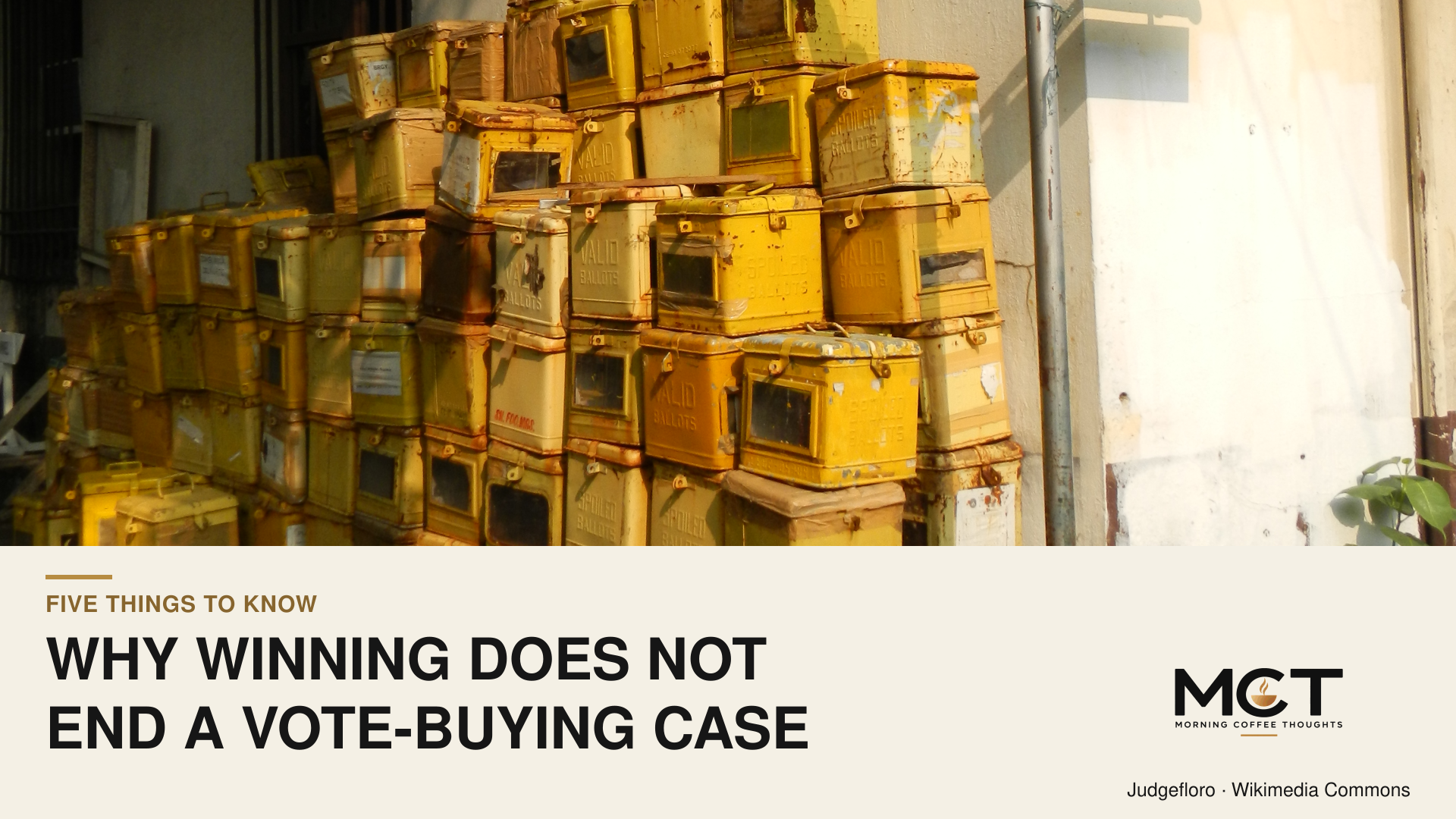
On October 29, the Court announced that it had upheld the disqualifications of Charina C. Bagor and Erlinda Curativo from the 2025 municipal council race. The cases concern their right to hold office after winning the election.
1
THE COURT UPHELD TWO DISQUALIFICATIONS
During its October 28 session, the Supreme Court rejected Bagor’s and Curativo’s challenges to the Commission on Elections’ rulings. Their proclamations as winning candidates were also voided, according to the Court’s official summary.
The full decisions were still to be released when the announcement was issued. The Court’s summary did not name their replacements or say whether further requests for review had been resolved.
2
VOTE-BUYING CAN INVOLVE MORE THAN CASH
In Bagor’s case, the Court’s summary described food packs given in exchange for votes. In Curativo’s case, it described ₱60,000 given to a barangay council member for distribution at ₱100 per voter.
The Omnibus Election Code covers money and other things of value used to influence votes. A cash envelope is therefore not the only possible form of vote-buying. The evidence must connect what was offered or given to an effort to influence the voter’s choice.
3
GIVING AID IS NOT ENOUGH, BY ITSELF, TO PROVE VOTE-BUYING
A photograph of a distribution does not answer every question. What was being given? Was it meant to obtain votes? What evidence connects the candidate to it? Those are questions the evidence has to answer.
In its 2024 Rosal decision, the Supreme Court explained that the evidence must show the candidate’s participation, personally or through instructions to others, and the purpose of influencing votes. The vote-buying question turns on that evidence. Rosal was disqualified under a separate rule on public spending, not on the vote-buying ground.
4
A PROCLAMATION DOES NOT ERASE THE CASE
Section 68 of the Omnibus Election Code allows disqualification from continuing as a candidate or, after election, from holding office. Winning the count and being proclaimed do not make that provision disappear.
The Candijay announcement shows the practical consequence: the candidates had been proclaimed winners, but the Court upheld their disqualifications and voided those proclamations. The right to hold the position remained subject to the outcome of the legal challenge.
5
DISQUALIFICATION AND CRIMINAL PUNISHMENT ARE SEPARATE QUESTIONS
The result announced in Candijay concerns eligibility to hold an elected position. A criminal prosecution for an election offense is a separate process. The Court explained that distinction in its 2024 Noveras decision, and the Election Code separately identifies vote-buying as an election offense.
The Candijay announcement does not report a prison sentence. A disqualification ruling alone cannot be read as a criminal conviction.
SOURCES
- Supreme Court, official announcement on the Candijay disqualifications, October 29, 2026https://www.facebook.com/SupremeCourtPhilippines/posts/pfbid02MRhTjjJ3kzcMpxTTN1Rhgcp5nspAGSF5aLcUXQjzFHoLgsLPkUFmPiu8r78yfo9Xl
- Omnibus Election Code, Sections 68 and 261(a)https://lawphil.net/statutes/bataspam/bp1985/bp_881_1985.html
- Supreme Court, Rosal v. COMELEC and consolidated cases, October 22, 2024https://elibrary.judiciary.gov.ph/thebookshelf/showdocs/1/69657
- Supreme Court, Noveras v. COMELEC, October 22, 2024https://elibrary.judiciary.gov.ph/thebookshelf/showdocs/1/69759
GOOGLE PREFERRED SOURCES
FOLLOW MCT ON GOOGLE
Google’s Preferred Sources feature lets you choose publications you want Google to prioritize for you. Select “Add to Preferred Sources” to make MCT easier to find in Top Stories and other eligible Google results. This does not subscribe you to email.
SUPPORT MCT
HELP KEEP INDEPENDENT POLITICAL WRITING GOING.
Morning Coffee Thoughts is reader-supported. Contributions help pay for research tools, hosting, and the work required to verify and explain each development.