Gaano ka nagtitiwala na tama ang ginagawa ng Kongreso sa budget ng bayan?
This is an informal survey of people who choose to participate. It is not a scientific or nationally representative sample.
DAILY BRIEF
MCT DAILY BRIEF
The impeachment trial is moving toward testimony from banks and financial firms, while a dispute over ride-hailing fares puts drivers and passengers in the middle. Elsewhere, the government is preparing for a stronger El Niño, the Coast Guard is challenging a Chinese research vessel near Batanes, and new fish-import rules raise questions about supply and prices.
1
BANKS AND FINANCIAL FIRMS SUMMONED IN SARA DUTERTE TRIAL
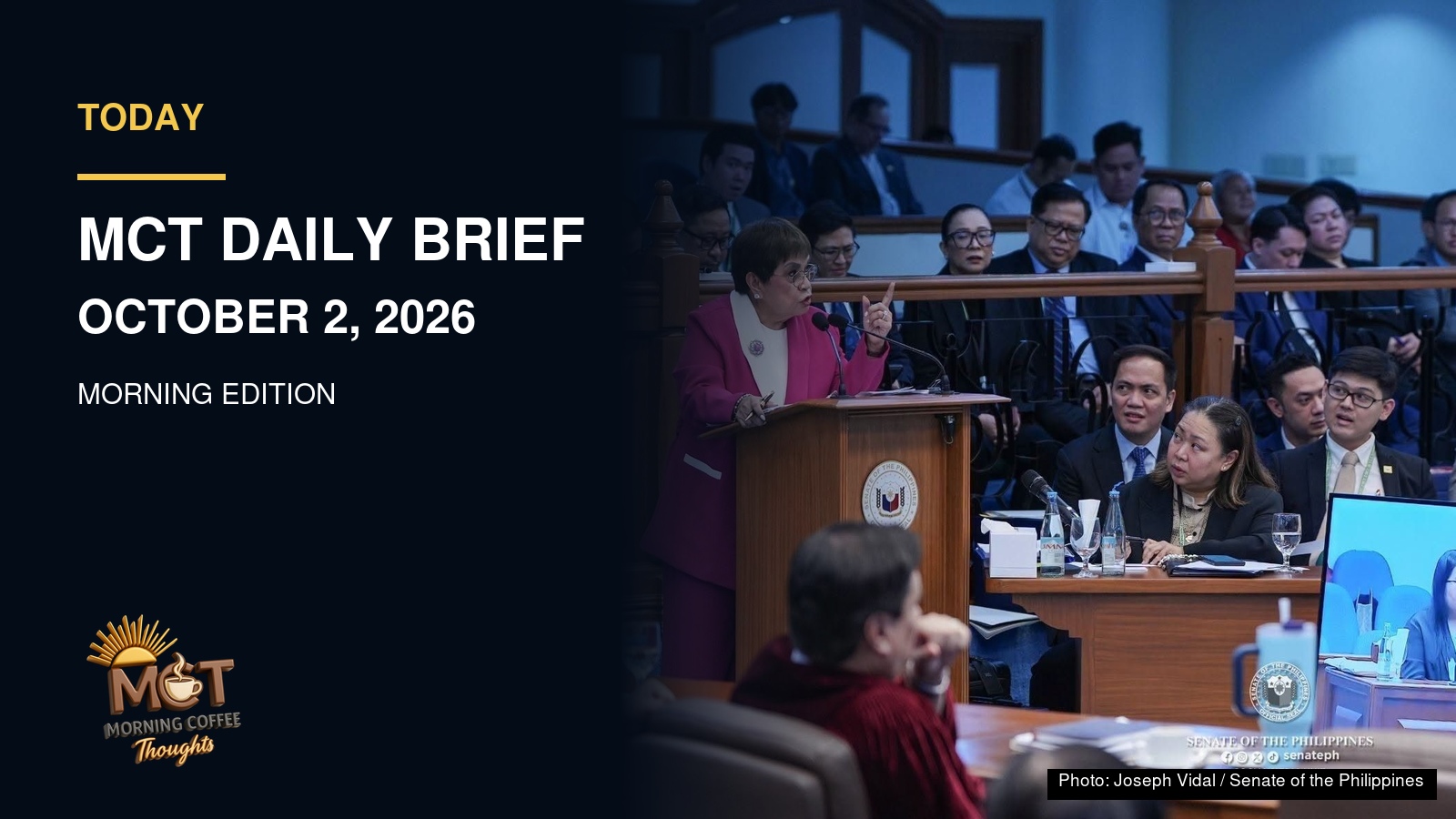
The Senate impeachment court has ordered representatives of seven banks and seven insurance and financial firms to appear in Vice President Sara Duterte's trial on October 6. The October 1 order followed the prosecution's request to present financial evidence.
The court also canceled the October 2 hearing and moved the appearance of Anti-Money Laundering Council executive director Ronel Buenaventura to October 5. The defense was given more time to prepare for his testimony and the large volume of records involved.
A subpoena is an order to appear or produce records. It does not establish that Duterte or any of the institutions committed wrongdoing. The witnesses' explanations, the documents they identify, and the defense's questions will help the court decide what the records actually prove.
WHAT TO WATCH
Watch the AMLC testimony scheduled for October 5 and the bank and financial-firm appearances scheduled for October 6. Pay attention to what the witnesses can establish from their records and which claims remain disputed.
2
LTFRB ASKS 19 RIDE-HAILING FIRMS TO EXPLAIN FARE COMPLAINTS
The Land Transportation Franchising and Regulatory Board has issued show-cause orders to 19 transport network companies following complaints that they failed to fully implement the approved fare increase. The firms have been asked to explain why their authority to operate should not be suspended or canceled. A hearing is scheduled for October 7.
The approved base fares are ₱65 for sedans, ₱75 for AUVs and SUVs, ₱55 for hatchbacks, and ₱165 for premium vehicles. Each is ₱20 higher than the previous base fare. These are starting charges, so they should not be mistaken for the full cost of a trip.
Drivers pay for the fuel used during trips. The dispute affects how much they receive and how much passengers are charged. The orders begin a process in which the companies must answer the complaints; they do not mean the firms have already lost their operating authority.
WHAT TO WATCH
Watch the companies' explanations and the October 7 hearing. Passengers and drivers should keep trip receipts showing the fare breakdown if they need to question how a charge was calculated.
3
EL NIÑO PREPARATIONS NEED TO REACH HOUSEHOLDS AND FARMS
Malacañang said on October 1 that government agencies are preparing assistance for farmers and fisherfolk and coordinating measures for water supply, irrigation, and food production. Palace Press Officer Claire Castro said the lead agency for the El Niño task force was still under discussion.
Castro identified ₱6.2 billion for agriculture assistance. Separately, the 2026 budget contains a ₱39.82-billion national disaster fund that can support responses to climate-related events. Adding those amounts together should not suggest that the entire sum is a new fund devoted only to El Niño, or that it has already reached beneficiaries.
PAGASA says a strong El Niño is already active and is expected to intensify into a very strong event between September and December 2026, with conditions persisting into the first half of 2027. This raises the risk of below-normal rainfall and drought in affected areas.
For families, the practical questions are whether water service remains dependable and whether farms have enough water to keep producing food. Announced funding and preparations need to lead to working irrigation, clear water advisories, and assistance that reaches the people who qualify. A budget announcement alone cannot show that those services have been delivered.
WHAT TO WATCH
Watch PAGASA's area-specific outlooks, water-provider advisories, and the DA's assistance schedules. These will show where the risks are growing and when affected farmers can actually receive help.
4
COAST GUARD CHALLENGES CHINESE RESEARCH VESSEL NEAR BATANES
The Philippine Coast Guard deployed BRP Teresa Magbanua and an aircraft on October 1 to challenge the Chinese research vessel Jia Hai Ke 7 off Itbayat, Batanes. The PCG said the vessel was conducting marine scientific research without Philippine consent inside the country's exclusive economic zone.
According to the PCG, the vessel began moving away from its position late that morning, and the Philippine patrol ship continued to follow it. Movement away from that position should not be read as confirmation that it had already left the Philippine EEZ.
The dispute concerns research activity in waters where the Philippines has rights over resources and jurisdiction over marine scientific research. Those rights differ from full sovereignty over territorial waters. Keeping that clear helps readers understand what the Coast Guard is challenging without treating every foreign vessel's passage through the EEZ as unlawful.
WHAT TO WATCH
Watch for the PCG's confirmation of the vessel's subsequent location and any response from China. Claims about the purpose of the research should be weighed against evidence, rather than treated as established espionage.
5
NEW RULES TIGHTEN CONDITIONS FOR FISH IMPORTS
The Department of Agriculture has issued additional rules for the 250,000-metric-ton fish-import program covering the off and closed fishing season. Department Circular 53, dated September 29, sets conditions for the portion assigned to Kadiwa and for additional allocations to qualified importers.
The program reserves 10,000 metric tons for Kadiwa. Fish imported under that allocation must go through authorized Kadiwa centers or stores unless the DA gives written permission for another distribution channel. Importers and participating stores must keep records of where the fish goes and how it is sold.
The circular also links additional import allocations to verified arrivals and use of earlier allocations. Import permission alone does not mean fish has arrived in the market. For consumers, the useful results will be available supply and affordable prices. For local fishers, the timing and volume of imported fish deserve close attention because they may affect the prices buyers offer for local catch.
WHAT TO WATCH
October 31 is the reference date for the circular's performance-based incentives. Watch actual arrivals, Kadiwa availability, and market prices to see whether the program is helping consumers while protecting local livelihoods.
BOTTOM LINE
The coming week brings scheduled testimony, a fare hearing, and decisions that can affect household expenses. Each deserves follow-through: what the financial records establish, how fares are applied, and whether preparations for food and water shortages produce services people can use.
Google’s Preferred Sources feature lets you choose publications you want Google to prioritize for you. Select “Add to Preferred Sources” to make MCT easier to find in Top Stories and other eligible Google results. This does not subscribe you to email.
Morning Coffee Thoughts is reader-supported. Contributions help pay for research tools, hosting, and the work required to verify and explain each development.
Monthly PayPal subscription — choose your support amount.